
[论文解读] TimeSeriesBench: An Industrial-Grade Benchmark for Time Series Anomaly Detection Models
TimeSeriesBench 引入了一个工业级的时间序列异常检测(TSAD)基准,用于在真实条件下评估模型,包括在未见过的时间序列上进行全量训练(All-in-One training)和零样本推理(Zero-Shot inference)。该基准涵盖7个数据集、8种评估指标和3种范式,共168种评估设置。FITS在大多数基准上达到最先进性能,尤其在零样本和统一训练设置下表现突出。
Time series anomaly detection (TSAD) has gained significant attention due to its real-world applications to improve the stability of modern software systems. However, there is no effective way to verify whether they can meet the requirements for real-world deployment. Firstly, current algorithms typically train a specific model for each time series. Maintaining such many models is impractical in a large-scale system with tens of thousands of curves. The performance of using merely one unified model to detect anomalies remains unknown. Secondly, most TSAD models are trained on the historical part of a time series and are tested on its future segment. In distributed systems, however, there are frequent system deployments and upgrades, with new, previously unseen time series emerging daily. The performance of testing newly incoming unseen time series on current TSAD algorithms remains unknown. Lastly, the assumptions of the evaluation metrics in existing benchmarks are far from practical demands. To solve the above-mentioned problems, we propose an industrial-grade benchmark TimeSeriesBench. We assess the performance of existing algorithms across more than 168 evaluation settings and provide comprehensive analysis for the future design of anomaly detection algorithms. An industrial dataset is also released along with TimeSeriesBench.
研究动机与目标
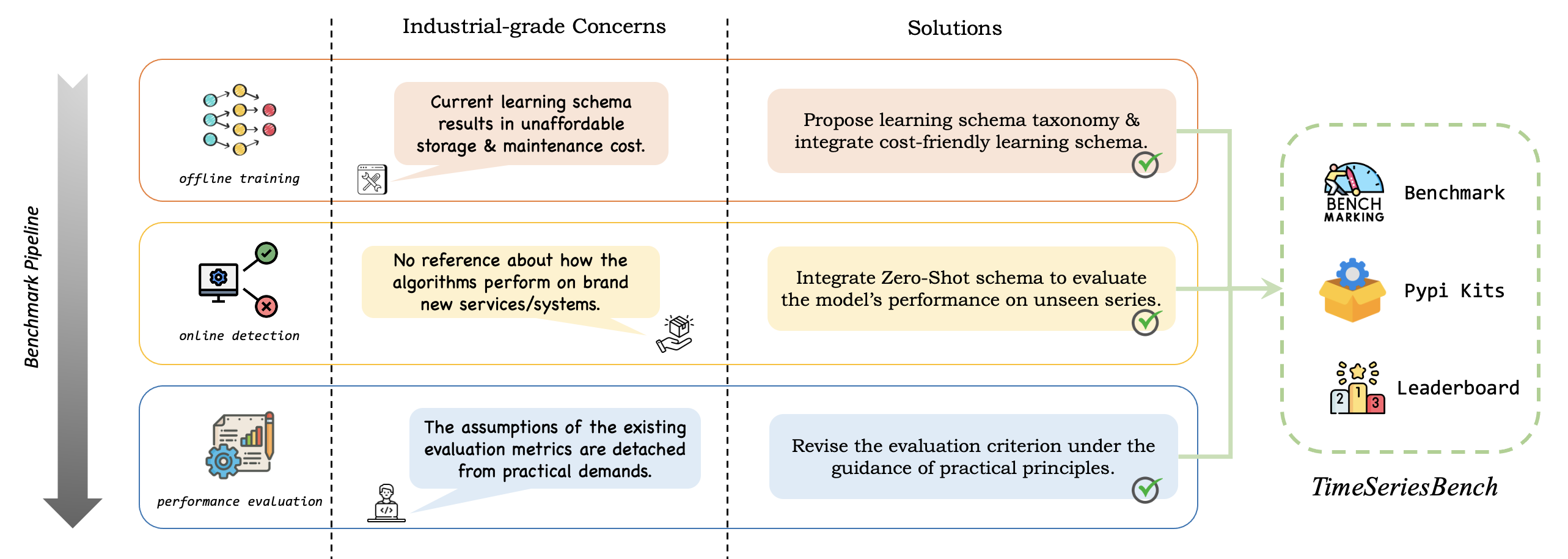
- 为解决学术界 TSAD 模型与工业部署需求之间的差距,特别是因逐条时间序列模型训练带来的高维护成本。
- 在不重新训练的情况下评估模型在之前未见过的时间序列曲线上的性能,模拟真实世界中的系统升级和新部署场景。
- 统一并标准化不同评估指标与训练范式之间的评估方式,实现 TSAD 算法的公平比较。
- 建立一个持续更新的在线排行榜,以追踪 TSAD 领域的最先进水平,类似于自然语言处理中的 GLUE 基准。
- 发布一个新的工业规模数据集和一个工具包(EasyTSAD),以支持可复现且可扩展的 TSAD 模型评估。
提出的方法
- 提出一种全量训练范式(All-in-One training paradigm),即单个模型在多个时间序列上进行训练,以模拟工业场景下的可扩展性。
- 引入一种新型数据划分策略,以支持零样本推理,评估模型在完全未见过的时间序列曲线上的表现。
- 将3种训练范式(单条序列、全量训练、零样本)、8种评估指标和7个数据集组合成168种不同的评估设置。
- 开发一种基于事件的评估指标,更好地契合工业需求,聚焦于异常检测的精确率与召回率。
- 在 https://adeval.cstcloud.cn 建立在线排行榜,持续对所有设置下的模型进行排名。
- 发布一个新的工业级数据集和 EasyTSAD 工具包,用于 TSAD 模型的标准化、可复现评估。
实验结果
研究问题
- RQ1当在所有时间序列上训练单一统一模型(All-in-One)与为每条时间序列单独训练模型时,模型性能如何变化?
- RQ2现有 TSAD 模型在未见过的时间序列曲线上的检测性能如何,且无需微调(即零样本推理)?
- RQ3哪种评估指标最能反映时间序列异常检测在真实工业场景中的表现?
- RQ4不同深度学习架构在多种训练范式和数据集上的表现如何比较?
- RQ5在真实、工业级部署约束条件下,当前时间序列异常检测的最先进水平是什么?
主要发现
- FITS 在全部 168 种评估设置中平均表现最高,平均 F1 分数达到 0.9469,优于所有其他模型。
- 在 All-in-One 训练范式下,FITS 在 NEK 数据集上的 F1 分数达到 0.9469,显著优于第二名方法(OFA 的 0.8083)。
- 在零样本推理中,FITS 在 NEK 数据集上仍保持强劲表现,F1 分数为 0.9233,表明其对未见过的曲线具有出色的泛化能力。
- All-in-One 训练范式持续提升泛化性能,12 种模型中有 8 种相比单条序列训练的性能提升超过 5%。
- 基于事件的评估指标显示,FITS 和 OFA 等模型在关键异常事件上实现了更高的精确率与召回率,表明其更符合工业优先事项。
- 在线排行榜表明,没有单一模型在所有设置中占据主导地位,凸显了在多样化、真实条件下进行评估的重要性。
阅读本论文
在 Nubint 阅读器中打开原文,边读边就任意段落提问。
在 Nubint 中阅读本论文本解读由 AI 根据论文原文生成,引用前请核对原文。