
[论文解读] TinyVLA: Towards Fast, Data-Efficient Vision-Language-Action Models for Robotic Manipulation
TinyVLA 通过利用小型预训练多模态模型和扩散策略解码器,提出了一种紧凑、快速且数据高效的视觉-语言-动作模型,用于机器人操作,实现了比 OpenVLA 更优的推理速度,且在真实世界和零样本泛化设置下性能相当或更优,而无需大规模预训练数据。
Vision-Language-Action (VLA) models have shown remarkable potential in visuomotor control and instruction comprehension through end-to-end learning processes. However, current VLA models face significant challenges: they are slow during inference and require extensive pre-training on large amounts of robotic data, making real-world deployment difficult. In this paper, we introduce a new family of compact vision-language-action models, called TinyVLA, which offers two key advantages over existing VLA models: (1) faster inference speeds, and (2) improved data efficiency, eliminating the need for pre-training stage. Our framework incorporates two essential components to build TinyVLA: (1) initializing the policy backbone with robust, high-speed multimodal models, and (2) integrating a diffusion policy decoder during fine-tuning to enable precise robot actions. We conducted extensive evaluations of TinyVLA in both simulation and on real robots, demonstrating that our approach significantly outperforms the state-of-the-art VLA model, OpenVLA, in terms of speed and data efficiency, while delivering comparable or superior performance. Additionally, TinyVLA exhibits strong generalization capabilities across various dimensions, including language instructions, novel objects, unseen positions, changes in object appearance, background variations, and environmental shifts, often matching or exceeding the performance of OpenVLA. We believe that \methodname offers an interesting perspective on utilizing pre-trained multimodal models for policy learning. Our project is at https://tiny-vla.github.io.
研究动机与目标
- 解决现有视觉-语言-动作(VLA)模型在机器人操作中推理延迟高和数据效率低的问题。
- 在减少对大规模机器人数据集进行预训练依赖的同时,保持强大的泛化能力和性能。
- 通过模型压缩和非自回归动作生成,加速推理速度,实现端到端的实时、响应式机器人控制。
- 在不使用数据增强的情况下,提升对干扰物、光照变化以及空间/物体外观变化的鲁棒性。
提出的方法
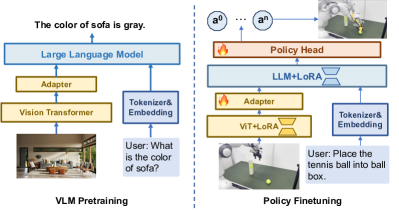
- 使用在视觉-语言数据上预训练的小型高速多模态模型(参数量低于 1B)作为策略主干网络,实现快速推理。
- 在微调过程中,用扩散策略解码器替代自回归动作标记预测,直接生成连续的机器人动作。
- 在少量任务特定的机器人数据上端到端微调整个模型,避免对 OpenX 等大规模数据集进行预训练。
- 利用预训练多模态模型的泛化能力,在无需额外数据增强的情况下,处理未见过的物体、位置和视觉变化。
- 采用单阶段训练流程,将视觉-语言理解与直接策略头预测相结合,降低计算开销。
- 在多种泛化基准上评估性能,包括语言、空间、外观和干扰物泛化,在不同光照和背景条件下进行测试。
实验结果
研究问题
- RQ1紧凑的 VLA 模型是否能在显著降低推理延迟的同时,实现与 SOTA 模型(如 OpenVLA)相当或更优的性能?
- RQ2在未使用大规模机器人数据集进行预训练的前提下,基于非机器人数据预训练的视觉-语言模型在机器人操作任务中的泛化能力有多强?
- RQ3该模型在未见物体形状、颜色、位置以及光照和干扰物等环境变化下的泛化能力如何?
- RQ4将自回归动作生成替换为基于扩散的解码器,是否能显著提升推理速度而不损失准确性?
主要发现
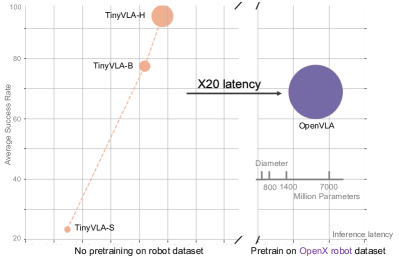
- TinyVLA-H 在真实世界单臂任务中的成功率比 OpenVLA 高 25.7%,且参数量仅为其 5.5 分之一。
- 在相同 A6000 GPU 上,TinyVLA-H 的推理延迟相比 OpenVLA 降低了 20 倍,展现出在实时部署中的显著速度优势。
- 该模型对干扰物具有强鲁棒性,在存在无关物体(如书籍和水杯)的情况下性能未下降,而 OpenVLA 和标准扩散策略则表现不佳。
- 在低光照条件(L1 和 L2)下,模型仍保持高性能,而 OpenVLA 则完全失效,表明其对光照变化具有强大鲁棒性。
- 在外观泛化任务中,TinyVLA 能有效泛化到新型物体形状和颜色,性能与 OpenVLA 相当,且无需数据增强。
- 在双臂操作任务中,TinyVLA-H 表现优于 OpenVLA,后者因依赖单臂 OpenX 预训练数据而表现受限。
阅读本论文
在 Nubint 阅读器中打开原文,边读边就任意段落提问。
在 Nubint 中阅读本论文本解读由 AI 根据论文原文生成,引用前请核对原文。