
[论文解读] Top Leaderboard Ranking = Top Coding Proficiency, Always? EvoEval: Evolving Coding Benchmarks via LLM
该论文提出 EvoEval,一种利用大语言模型(LLMs)演化现有代码生成基准的方法,以创建多样化、针对性的问题集,揭示当前 LLM 在性能上的局限性。通过使用指令提示将 HumanEval 等基准中的问题转化为新领域,EvoEval 揭示了 LLM 性能平均下降 39.4%,表明其对标准基准存在过拟合现象,并凸显了在指令遵循和工具使用能力方面的关键缺陷。
LLMs have become the go-to choice for code generation tasks, with an exponential increase in the training, development, and usage of LLMs specifically for code generation. To evaluate the ability of LLMs on code, both academic and industry practitioners rely on popular handcrafted benchmarks. However, prior benchmarks contain only a very limited set of problems, both in quantity and variety. Further, due to popularity and age, many benchmarks are prone to data leakage where example solutions can be readily found on the web and thus potentially in training data. Such limitations inevitably lead us to inquire: Is the leaderboard performance on existing benchmarks reliable and comprehensive enough to measure the program synthesis ability of LLMs? To address this, we introduce EvoEval -- a program synthesis benchmark suite created by evolving existing benchmarks into different targeted domains for a comprehensive evaluation of LLM coding abilities. Our study on 51 LLMs shows that compared to the high performance obtained on standard benchmarks like HumanEval, there is a significant drop in performance (on average 39.4%) when using EvoEval. Additionally, the decrease in performance can range from 19.6% to 47.7%, leading to drastic ranking changes amongst LLMs and showing potential overfitting of existing benchmarks. Furthermore, we showcase various insights, including the brittleness of instruction-following models when encountering rewording or subtle changes as well as the importance of learning problem composition and decomposition. EvoEval not only provides comprehensive benchmarks, but can be used to further evolve arbitrary problems to keep up with advances and the ever-changing landscape of LLMs for code. We have open-sourced our benchmarks, tools, and complete LLM generations at https://github.com/evo-eval/evoeval
研究动机与目标
- 为解决现有代码生成基准存在的多样性不足、问题类型有限以及数据泄露等问题。
- 探究在标准基准上取得高排名性能是否真正反映 LLM 的真实编程能力。
- 开发一种可扩展、自动化的基准演化方法,以反映现实世界中的编程复杂性与多样性。
- 通过针对性的问题演化,揭示 LLM 的隐藏弱点,如对重述的脆弱性以及工具使用能力差等问题。
- 提供一个全面、开源的基准套件,能够随 LLM 技术的发展而持续演化,实现更可靠的评估。
提出的方法
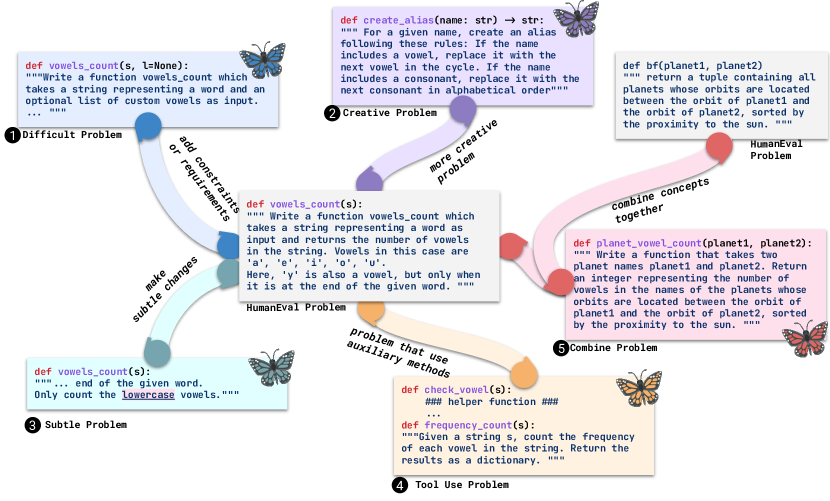
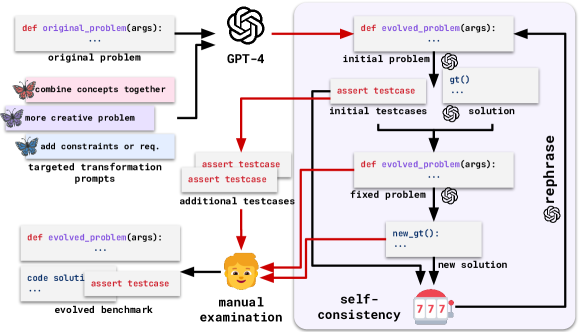
- EvoEval 使用 GPT-4 自动化地通过五类针对性转换提示(Difficult、Creative、Subtle、Combine 和 Tool Use)从现有基准(如 HumanEval)中演化出新问题。
- 每类转换提示将基础问题重写为特定领域内的新变体,从而提升问题的多样性与复杂性。
- 演化后的问题旨在测试特定能力,如函数组合、分解以及与外部工具的交互。
- 该基准套件包含 828 个问题,涵盖七个不同的子基准,每个子基准针对程序生成的某一特定方面。
- 性能通过测试用例上的 pass@1 分数进行评估,实现与标准基准的直接比较。
- 该方法可通过对新问题重新应用转换提示,实现基准的持续演化,确保其在 LLM 技术进步背景下的相关性。
实验结果
研究问题
- RQ1在 HumanEval 等标准基准上取得的高性能在多大程度上反映的是真实编程能力,而非记忆或数据泄露?
- RQ2当评估对象为需要更深层次推理、函数组合或工具使用能力的演化后问题时,LLM 在性能上与标准基准相比如何?
- RQ3当前指令遵循型 LLM 在面对重述或结构上改变的问题描述时,其关键失败模式是什么?
- RQ4LLM 在不同问题类型(如创造性、微妙性、组合型)上的表现与基线基准相比有何差异?
- RQ5LLM 驱动的基准能否揭示以往未被发现的 LLM 能力缺陷,如函数重用与工具集成能力?
主要发现
- LLM 在 EvoEval 上的平均性能相比标准基准(如 HumanEval)下降了 39.4%,表明其对现有基准存在显著过拟合。
- 不同模型的性能下降幅度在 19.6% 至 47.7% 之间,导致排行榜排名发生剧烈变化。
- 许多 LLM,尤其是指令微调模型,对问题描述的重述或细微变化表现出脆弱性,表明其在指令遵循方面鲁棒性差。
- LLM 在 Tool_Use 和 Tool_Use_Main_Only 子基准上的表现较差,暴露出其在利用外部函数或工具方面存在关键缺陷。
- 本研究证明,当前基准无法有效评估真实编程中至关重要的能力,如问题分解与函数组合能力。
- EvoEval 有效揭示了当前 LLM 的局限性,并提供了一个可扩展、开源的框架,用于持续演化基准以匹配 LLM 的发展步伐。
阅读本论文
在 Nubint 阅读器中打开原文,边读边就任意段落提问。
在 Nubint 中阅读本论文本解读由 AI 根据论文原文生成,引用前请核对原文。