
[论文解读] Topological Mixed Valence Model for Twisted Bilayer Graphene
这篇论文将 Song–Bernevig 拓扑重费粒子图景的 MATBG 重写为混价 Anderson 晶格,分析高能与低能量的 Kondo 晶格行为,并讨论掺杂与声子对混成的重整化效应。
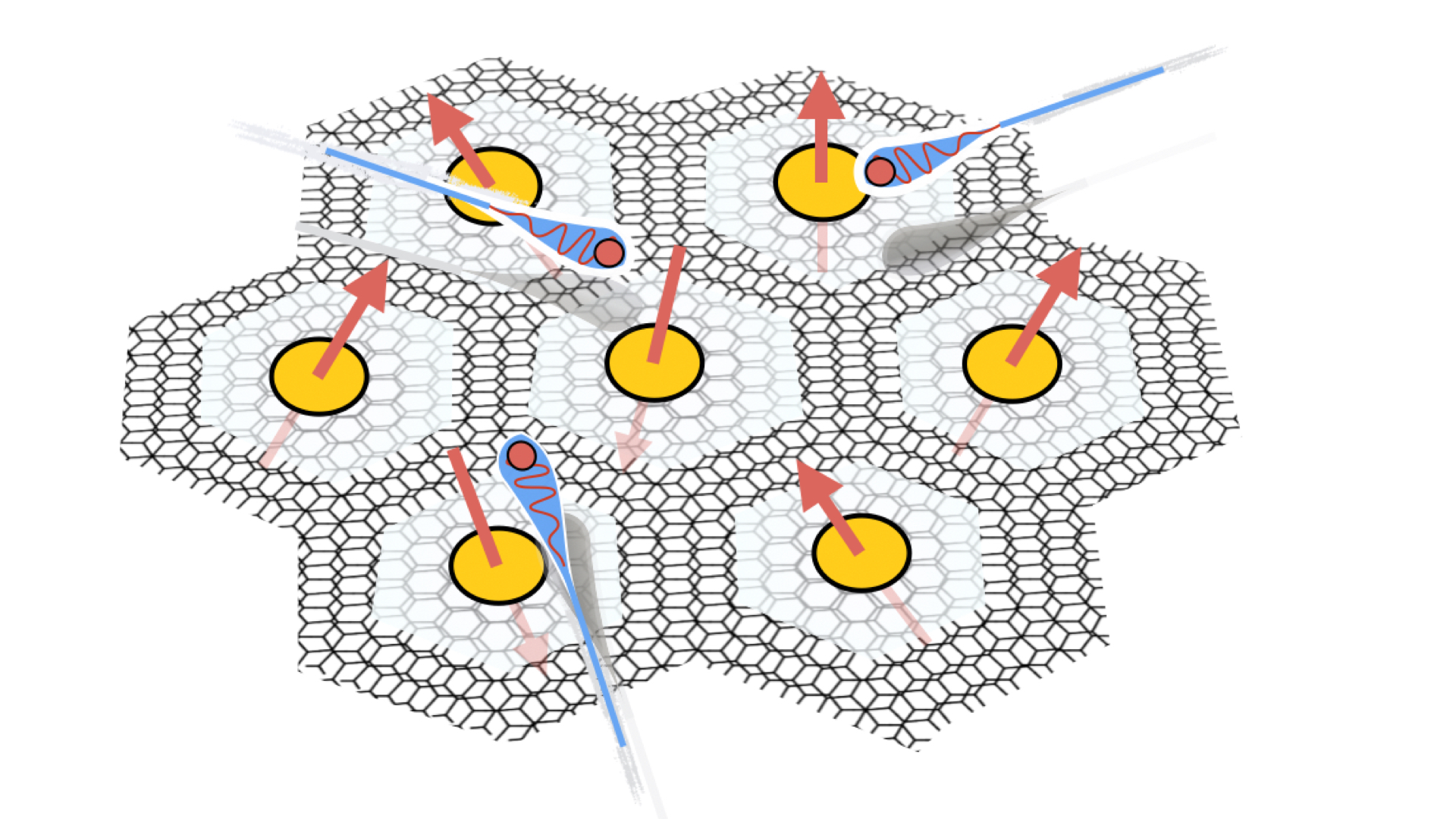
Song and Bernevig (SB) have recently proposed a topological heavy fermion description of the physics of magic angle twisted bilayer graphene (MATBG), involving the hybridization of flat band electrons with a relativistic conduction sea. We explore the consequences of this model, seeking a synthesis of understanding drawn from heavy fermion physics and MATBG experiments. We identify a key discrepancy between measured and calculated onsite Coulomb interactions, implicating renormalization effects that are not contained in the current model. With these considerations in mind, we consider an SB model with a single, renormalized onsite interaction between the f-electrons, containing a phenomenological heavy fermion binding potential on the moiré AA-sites. This feature allows the simplified model to capture the periodic reset of the chemical potential with filling and the observed stability of local moment behavior. We argue that a two stage Kondo effect will develop in MATBG as a consequence of the relativistic conduction band: Kondo I occurs at high temperatures, establishing a coherent hybridization at the $Γ$ points and a non-Fermi liquid of incoherent fermions at the moiré K-points; at much low temperatures Kondo II leads to a Fermi liquid in the flat band. Utilizing an auxiliary-rotor approach, we formulate a mean-field treatment of MATBG that captures this physics, describing the evolution of the normal state across a full range of filling factors. By contrasting the relative time-scales of phonons and valence fluctuations in bulk heavy fermion materials with that of MATBG we propose a valley-polaron origin to the Coulomb renormalization and the heavy fermion binding potential identified from experiment. We also discuss the possibility that the two-fluid, non-Fermi liquid physics of the relativistic Kondo lattice is responsible for the strange metal physics observed in MATBG.
研究动机与目标
- 激励一种基于实空间、拓扑的 MATBG 描述,捕捉局部磁矩与对称性异常。
- 将 Song–Bernevig 模型改写为具有价态涨落的 Anderson 晶格。
- 分析高能 U(8) 和低能 U(4) Kondo 晶格行为及对带结构的后果。
- 预测混成和 Hubbard 带宽随能量与填充的标度,并讨论来自声子的重整化效应。
提出的方法
- 从 Song–Bernevig 哈密顿量出发,结合局部的 f 类 Wannier 状态与拓扑 c 带。
- 定义强度为 γ0 的混成 H_fc 及形式因子 φ^(η)(k, γ0),以连接 f 与 c 区域。
- 将价态涨落映射到混价 (b, t) 玻色表示并推导 Anderson 晶格作用量。
- 对价态涨落进行均场处理,得到具有 SU(8) 轨道的拓扑 Kondo 晶格。
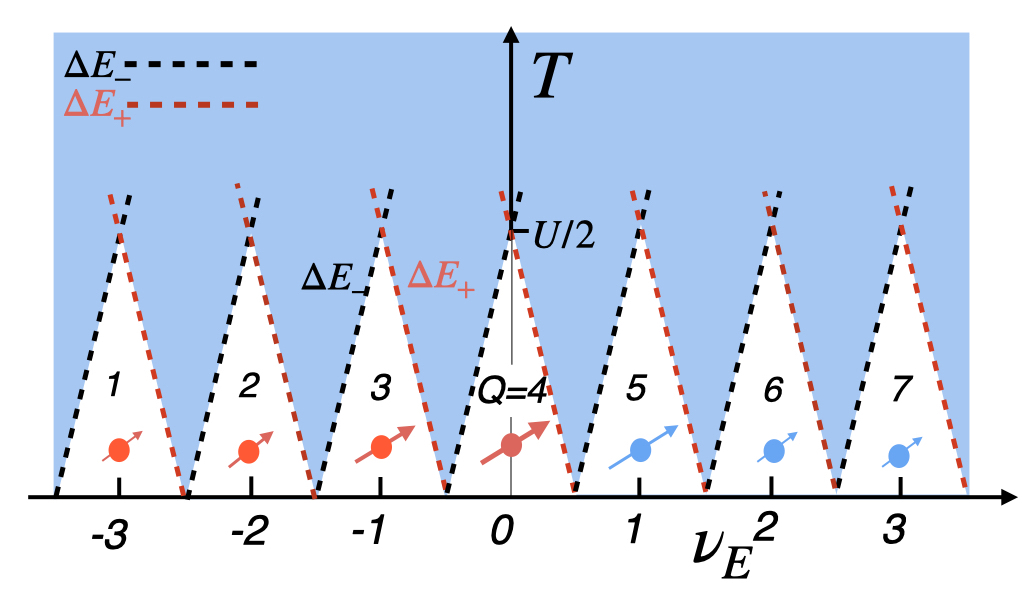
- 讨论 Doniach 型竞争 between Kondo 屏蔽 (T_K) 与 RKKY (T_RKKY) 并在整数填充附近勾勒相图。
实验结果
研究问题
- RQ1SB 拓扑重费粒子图景能否重构为 MATBG 的混价 Anderson 晶格?
- RQ2价态涨落与混成如何影响低能带结构与局部磁矩的形成?
- RQ3能量尺度(Kondo、RKKY、Hubbard)随填充的函数关系,以及它们如何在整数填充附近组织相图?
- RQ4基态混成 γ0 是否被声子(极化子)效应重整化,以解释观测到的局部磁矩行为?
- RQ5高能(U)和低能(Kondo)极限是否映射到 SU(8) 到 SU(4) 的 Kondo 晶格描述?
主要发现
- 与传导海的相互作用在高能时表现为 U(8) Kondo 晶格,在低能时为 U(4) Kondo 晶格。
- 基础混成尺度和 Hubbard 带宽随能量线性标度(通过 μ ~ Uν 与态密度)。
- SB 模型预测的裸混成 γ0 太大,无法解释在大填充时观测到的局部磁矩行为,暗示声子驱动的重整化。
- 混价形成一个具有 SU(8) 复合体的拓扑 Kondo 晶格,以及可调的 Kondo 标度 T_K,与 RKKY 相互作用竞争。
- 该工作预示一个 Doniach 型相图,包含磁性谷自旋相、重费液相以及可能的微弱耦合的 Song–Bernevig Fermi 液态区。
阅读本论文
在 Nubint 阅读器中打开原文,边读边就任意段落提问。
在 Nubint 中阅读本论文本解读由 AI 根据论文原文生成,引用前请核对原文。