
[论文解读] TOTEM: TOkenized Time Series EMbeddings for General Time Series Analysis
TOTEM 提出了一种基于向量量化变分自编码器(VQVAE)的自监督离散标记化框架,用于时间序列数据,实现了在多种领域和任务上的统一、通用建模。该方法在插补、异常检测和预测任务中实现了最先进或具有竞争力的性能,且超参数调优极少,零样本泛化能力优于专用模型,尤其在更大、更丰富的训练数据集上表现更优。
This work studies the problem of time series analysis with generalist (or foundation) models, which are models trained across many data domains. Drawing inspiration from the widespread success of large language models, we consider the simple strategy of discretely tokenizing time series data drawn from a myriad of datasets via self-supervision, then using the fixed tokenization to solve a variety of tasks across many data domains. Canonically, time series models are either trained on a single dataset or built in a task-specific manner (e.g., a forecasting-only model), where many use patches of time as inputs to the model. As such, performant generalist, discrete representation time series models explored across many tasks are of value. Our method, TOkenized Time Series EMbeddings (TOTEM), produces such generalist time series models with minimal or no fine-tuning while exhibiting strong zero-shot performance. We evaluate TOTEM extensively over nearly 500 experiments on three commonly-studied time series tasks with real-world data: imputation (17 baselines, 12 datasets), anomaly detection (19 baselines, 25 datasets), and forecasting (14 baselines, 12 datasets). We conclude that TOTEM matches or outperforms existing state-of-the-art models in both the canonical specialist setting (i.e., training one model on one domain) as well as the generalist setting (i.e., training a single model on many domains), which demonstrates the efficacy of tokenization for general time series analysis. The open-source implementation is available here: https://github.com/SaberaTalukder/TOTEM; a video summary is available here: https://www.youtube.com/watch?v=OqrCpdb6MJk.
研究动机与目标
- 开发一种统一的、通用的时间序列建模框架,适用于多种领域和任务,且超参数调优极少。
- 探索离散、自监督标记表示在时间序列分析中实现零样本泛化的能力。
- 在多个数据集和任务上,评估 TOTEM 在专用模型(按领域)和通用模型(多领域)训练范式下的表现。
- 研究数据量、领域多样性以及标记表示质量对时间序列建模泛化性能的影响。
- 建立一个高效、轻量的标记器,支持对预测、插补和异常检测等任务的全面评估。
提出的方法
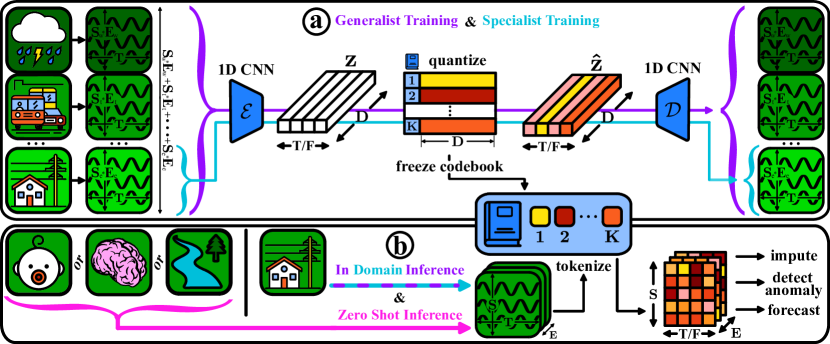
- TOTEM 在 VQVAE 架构中采用一维步长卷积神经网络编码器和解码器,学习时间序列的离散化向量表示。
- 模型使用可学习的、共享的代码本,通过向量量化将时间序列序列转换为离散标记。
- 标记化以自监督方式执行,实现表示学习而无需特定任务的标签。
- 该框架支持使用相同标记器的专用训练(在单一数据集上)和通用训练(在多个数据集上联合训练)。
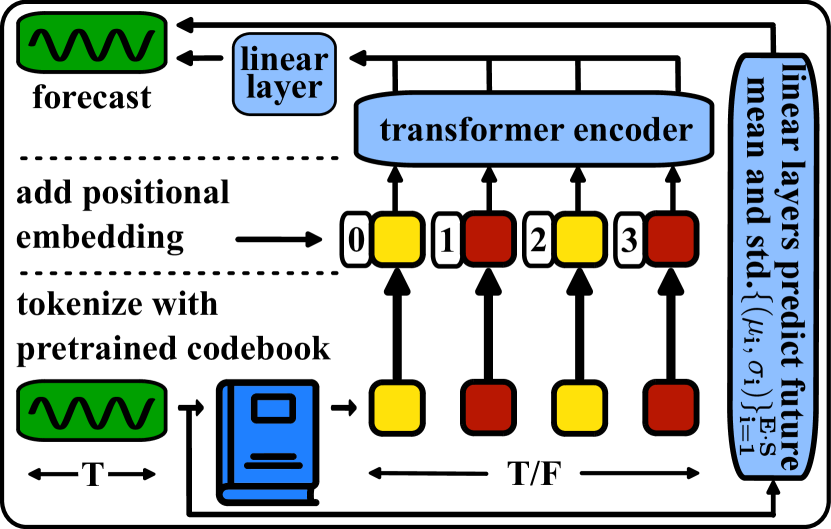
- 推理通过使用学习到的代码本将时间序列嵌入为离散标记来执行,从而实现下游任务的泛化。
- 该方法通过在不同领域和任务间复用相同的离散表示,实现域内和零样本测试。
实验结果
研究问题
- RQ1单一的、离散的、自监督的标记化方法是否能有效实现跨多样化时间序列领域和任务的通用训练?
- RQ2在域内和零样本泛化设置下,TOTEM 的性能与专用模型相比如何?
- RQ3训练数据量和领域多样性对统一时间序列表示泛化能力的影响是什么?
- RQ4在零样本场景下,基于多领域训练的统一代码本是否优于领域特定模型?
- RQ5原始时间序列特征(如时间步数和传感器数量)如何影响通用模型的性能?
主要发现
- 在 17 个真实世界时间序列数据集和三个任务(预测、插补、异常检测)的多个基准测试中,TOTEM 的性能与最先进方法相当或更优。
- 在通用训练范式下,TOTEM 在交通数据集上实现 100% 的 AvgWins,在电力数据集上实现 75% 的 AvgWins,显著优于混合模型专用模型。
- 尽管训练样本少 440 万个,TOTEM-electricity 专用模型在零样本测试中仍优于 TOTEM-traffic 专用模型(12.5% vs. 2.5% 的 AvgWins)。
- 通用模型在零样本测试中实现 85.0% 的 AvgWins,优于所有领域特定专用模型,表明其具备强大的跨领域泛化能力。
- 结果表明,更高的原始时间步数可能比更多的传感器数量更有利于泛化,尽管领域相似性也起着关键作用。
- TOTEM 的统一代码本实现了有效的零样本泛化,表明共享的离散表示即使在有限的域内微调下,也能在不同领域间实现良好泛化。
阅读本论文
在 Nubint 阅读器中打开原文,边读边就任意段落提问。
在 Nubint 中阅读本论文本解读由 AI 根据论文原文生成,引用前请核对原文。