
[论文解读] Toward Grounded Commonsense Reasoning
本文提出了一种用于机器人具身社交推理的框架,结合大语言模型(LLMs)与视觉-语言模型(VLMs),使机器人能够通过有针对性的特写观察主动感知环境,从而提升社交适宜性决策能力。该方法在MessySurfaces基准测试中相较基线模型平均提升12.9%,在真实机器人实验中提升15%。
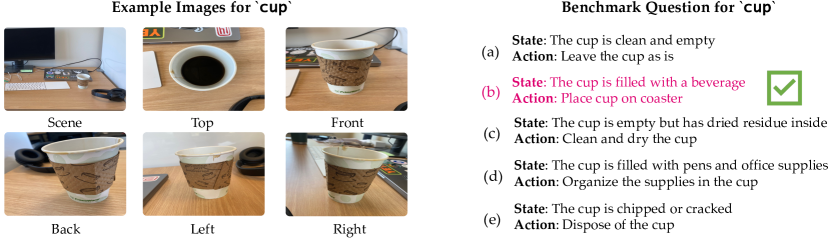
Consider a robot tasked with tidying a desk with a meticulously constructed Lego sports car. A human may recognize that it is not appropriate to disassemble the sports car and put it away as part of the "tidying." How can a robot reach that conclusion? Although large language models (LLMs) have recently been used to enable commonsense reasoning, grounding this reasoning in the real world has been challenging. To reason in the real world, robots must go beyond passively querying LLMs and actively gather information from the environment that is required to make the right decision. For instance, after detecting that there is an occluded car, the robot may need to actively perceive the car to know whether it is an advanced model car made out of Legos or a toy car built by a toddler. We propose an approach that leverages an LLM and vision language model (VLM) to help a robot actively perceive its environment to perform grounded commonsense reasoning. To evaluate our framework at scale, we release the MessySurfaces dataset which contains images of 70 real-world surfaces that need to be cleaned. We additionally illustrate our approach with a robot on 2 carefully designed surfaces. We find an average 12.9% improvement on the MessySurfaces benchmark and an average 15% improvement on the robot experiments over baselines that do not use active perception. The dataset, code, and videos of our approach can be found at https://minaek.github.io/grounded_commonsense_reasoning.
研究动机与目标
- 使机器人能够在无须人工干预的现实环境中执行社交适宜的清洁决策。
- 通过引入主动感知以弥补被动LLM与VLM推理的局限性,获取缺失的感知上下文。
- 开发一种系统,能够识别社交推理中缺失的信息,并通过有针对性的观察主动获取这些信息。
- 通过新的真实世界数据集和真实机器人实验,对框架进行大规模评估。
- 发布MessySurfaces数据集、代码与视频,以支持具身社交推理的可复现性与未来研究。
提出的方法
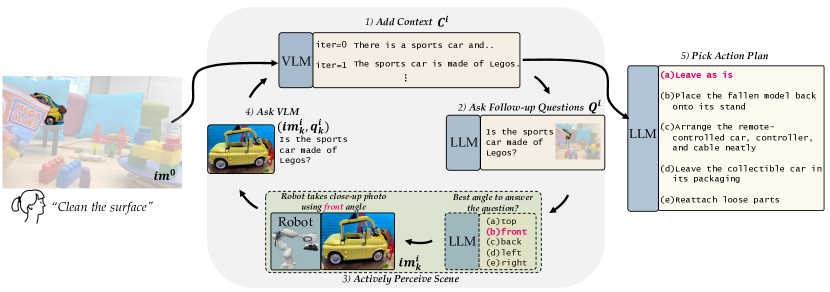
- 该框架使用LLM分析场景图像,并生成关于需澄清对象的后续问题,以支持社交推理。
- 机器人根据LLM建议的角度,对目标对象进行有针对性的特写图像拍摄,以消除歧义。
- 视觉-语言模型(VLM)处理特写图像,提供详细且富含上下文的描述,用于决策支持。
- LLM通过迭代请求额外观察,持续优化其理解,直至能够做出社交适宜的行动决策。
- 最终动作(如保留乐高汽车或丢弃食物残渣)通过少样本学习转化为可执行的机器人API调用。
- 该系统在新的基准数据集(MessySurfaces)和真实世界机器人平台的受控桌面环境中均进行了评估。
实验结果
研究问题
- RQ1与被动LLM和VLM查询相比,主动感知是否能显著提升机器人社交适宜决策的准确性?
- RQ2LLM-VLM循环在识别并解决现实场景中社交推理的感知模糊性方面有多有效?
- RQ3在现实世界的清洁任务中,由LLM生成问题引导的机器人主动感知策略,在多大程度上提升了下游决策质量?
- RQ4该框架在多样化、现实世界中的杂乱表面上(包含不同类型物体与社交规范)表现如何?
- RQ5该方法是否能在无需人工反馈的情况下,泛化至未见过的物体与场景?
主要发现
- 与不使用主动感知的基线相比,该框架在MessySurfaces基准测试中实现了12.9%的平均性能提升。
- 在真实机器人实验中,该框架相较被动基线在社交适宜决策方面实现了15%的平均提升。
- LLM生成的后续问题在识别关键模糊点(如某物体是贵重模型还是玩具)方面表现有效。
- 机器人根据LLM建议角度执行的主动感知策略,显著提升了VLM检测关键细节(如乐高积木或食物变质)的能力。
- 该系统成功保留了复杂物体(如乐高汽车),仅丢弃了不合适的物品(如半只吃剩的香蕉)。
- 发布的MessySurfaces数据集、代码与视频,使得在真实世界环境中对具身社交推理进行可复现评估成为可能。
阅读本论文
在 Nubint 阅读器中打开原文,边读边就任意段落提问。
在 Nubint 中阅读本论文本解读由 AI 根据论文原文生成,引用前请核对原文。