
[论文解读] Towards a universal analytical model for Population III star formation: interplay between feedback and fragmentation
本文提出了一种适用于原初恒星形成过程的通用解析模型,该模型在不同尺度上自洽地耦合了反馈与碎裂机制,能够从云团性质预测最终的恒星质量。结果表明,在约20%至70%的高红移类星体前身晕中会形成质量≥10⁴ M☉的原初大质量星团,为明亮z≈6类星体提供了可行的种子。
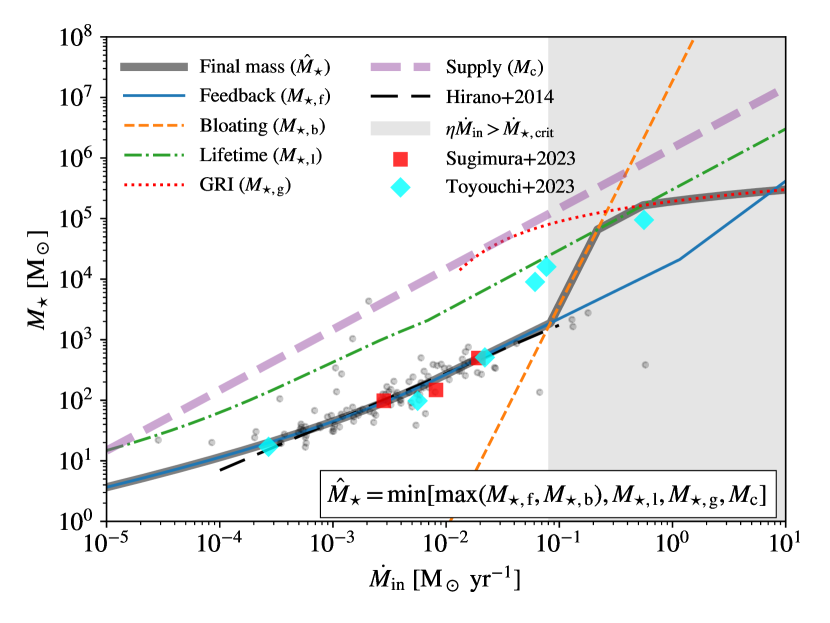
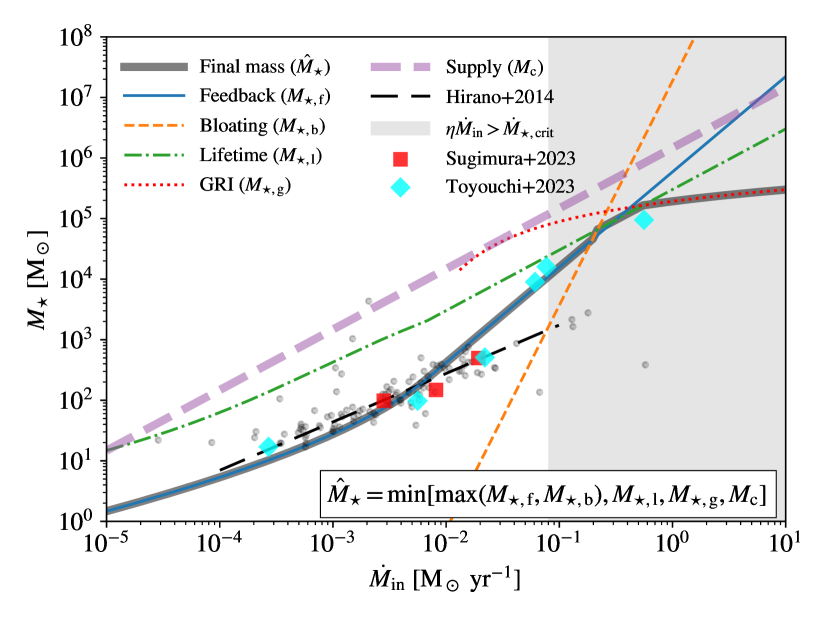
JWST has brought us new insights into Cosmic Dawn with tentative detection of the unique signatures of metal-free Population III (Pop III) stars, such as strong HeII emission, extremely blue UV spectrum, and enhanced nitrogen abundance. Self-consistent theoretical predictions of the formation rates, sites, and masses of Pop III stars are crucial for interpreting the observations, but are challenging due to complex physical processes operating over the large range of length scales involved. One solution is to combine analytical models for the small-scale star formation process with cosmological simulations that capture the large-scale physics such as structure formation, radiation backgrounds, and baryon-dark matter streaming motion that regulate the conditions of Pop III star formation. We build an analytical model to predict the final masses of Pop III stars/clusters from the properties of star-forming clouds, based on the key results of small-scale star formation simulations and stellar evolution models. Our model for the first time considers the interplay between feedback and fragmentation and covers different modes of Pop III star formation ranging from ordinary small ($\sim 10-2000\ m M_\odot$) clusters in molecular-cooling clouds to massive ($\gtrsim 10^{4}\ m M_\odot$) clusters containing supermassive ($\sim 10^{4}-3 imes 10^{5}\ m M_\odot$) stars under violent collapse of atomic-cooling clouds. As an example, the model is applied to the Pop III star-forming clouds in the progenitors of typical haloes hosting high-$z$ luminous quasars, which shows that formation of Pop III massive clusters is common ($\sim 20-70\%$) in such biased ($\sim4σ$) regions, and the resulting heavy black hole seeds from supermassive stars can account for a significant fraction of observed luminous ($\gtrsim 10^{46}\ m erg\ s^{-1}$) quasars at $z\sim 6$.
研究动机与目标
- 开发一个统一的解析框架,用于预测在各种形成环境中原初恒星与星团的质量。
- 解决多尺度物理建模的挑战——从局域碎裂与反馈到大尺度宇宙学条件——这对于解释韦布空间望远镜时代观测至关重要。
- 量化在宿主高红移明亮类星体的晕中形成原初恒星与星团的概率及其质量分布。
- 评估原初超大质量恒星作为驱动z≈6类星体的大质量黑洞种子的可行性。
- 实现与宇宙学模拟和半解析模型的集成,以实现对早期宇宙演化的自洽、大尺度预测。
提出的方法
- 结合小尺度流体动力学模拟与恒星演化模型,为原初恒星吸积与碎裂的解析模型提供依据。
- 提出一种受反馈调控的碎裂准则,其依赖于气体吸积率与云团性质,将反馈与星团质量函数相联系。
- 使用多重性参数N与原初恒星质量函数斜率α来建模碎裂效率与星团质量分布。
- 将该模型应用于具有偏置密度场的宇宙学代表性晕(z≈6时M_h ≈ 10¹² M☉),以评估形成概率。
- 整合来自高分辨率模拟(如Sharda et al. 2020)的吸积历史数据,以标定原初恒星生长与反馈效应。
- 将模型扩展至预测原初恒星的整体初始质量函数(IMF),并展示其对大尺度流入与小尺度碎裂的依赖性。
实验结果
研究问题
- RQ1反馈与碎裂之间的相互作用如何在不同吸积条件下调控原初恒星与星团的最终质量?
- RQ2在宿主z≈6明亮类星体的晕中(z≈6时M_h ≈ 10¹² M☉),有多少比例的高密度区域会通过原子冷却云的剧烈坍缩形成质量≥10⁴ M☉的原初大质量星团?
- RQ3在这些星团中形成的原初超大质量恒星(10⁴–3×10⁵ M☉)在多大程度上可以解释观测到的z≈6明亮类星体(L > 10⁴⁶ erg s⁻¹)群体?
- RQ4整体原初恒星初始质量函数(IMF)如何依赖于大尺度气体流入与小尺度碎裂及反馈之间的平衡?
- RQ5哪些关键的物理缺失要素——如磁场、随机吸积或复杂多重性——可能进一步提升模型的预测能力?
主要发现
- 该模型预测,在约20%至70%的高密度(4σ偏置)区域中,会形成质量≥10⁴ M☉的原初大质量星团,这些区域是z≈6明亮类星体的宿主。
- 在这些星团中形成的原初超大质量恒星(10⁴–3×10⁵ M☉)可解释观测到的z≈6明亮类星体中超过7%的样本,其总光度≥10⁴⁶ erg s⁻¹。
- 最终的原初恒星初始质量函数(IMF)由大尺度流入速率与小尺度碎裂/反馈共同调控,其中碎裂效率(N ≲ 3)决定了星团质量分布或原初恒星质量分布的主导作用。
- 在碎裂效率较低(N ≲ 3)的极限情况下,模型预测的初始质量函数呈顶部加权分布,与大质量原初星团及超大质量恒星形成的观测结果一致。
- 该模型表明,当碎裂效率较高时,整体原初恒星初始质量函数趋于近乎普适,但在原初宇宙条件下仍对环境因素保持敏感。
- 该模型设计用于集成到宇宙学模拟与半解析框架中,以实现对早期恒星与黑洞形成过程的自洽、多尺度建模。
阅读本论文
在 Nubint 阅读器中打开原文,边读边就任意段落提问。
在 Nubint 中阅读本论文本解读由 AI 根据论文原文生成,引用前请核对原文。