
[论文解读] Towards Automation of Human Stage of Decay Identification: An Artificial Intelligence Approach
本研究提出使用深度学习模型——特别是Inception V3和Xception——对150万张法医学腐烂图像数据集进行训练,以实现人类腐烂阶段(SOD)识别的自动化。在Megyesi的四阶段系统下,Xception模型在头部和躯干SOD分类中达到最高0.881的宏平均F1分数,且评分者间一致性与人类专家相当,证明了人工智能在法医学背景下实现可扩展、客观的SOD评估的可行性。
Determining the stage of decomposition (SOD) is crucial for estimating the postmortem interval and identifying human remains. Currently, labor-intensive manual scoring methods are used for this purpose, but they are subjective and do not scale for the emerging large-scale archival collections of human decomposition photos. This study explores the feasibility of automating two common human decomposition scoring methods proposed by Megyesi and Gelderman using artificial intelligence (AI). We evaluated two popular deep learning models, Inception V3 and Xception, by training them on a large dataset of human decomposition images to classify the SOD for different anatomical regions, including the head, torso, and limbs. Additionally, an interrater study was conducted to assess the reliability of the AI models compared to human forensic examiners for SOD identification. The Xception model achieved the best classification performance, with macro-averaged F1 scores of .878, .881, and .702 for the head, torso, and limbs when predicting Megyesi's SODs, and .872, .875, and .76 for the head, torso, and limbs when predicting Gelderman's SODs. The interrater study results supported AI's ability to determine the SOD at a reliability level comparable to a human expert. This work demonstrates the potential of AI models trained on a large dataset of human decomposition images to automate SOD identification.
研究动机与目标
- 解决法医学中人工SOD评分主观性与可扩展性不足的问题。
- 评估深度学习模型是否能够利用腐烂人体遗骸的视觉数据实现SOD分类的自动化。
- 比较人工智能在SOD识别中的评分者间一致性表现与人类法医检查员的差异。
- 探索是否可将劳动密集型的人工评分替换为人工智能,以实现大规模档案图像分析。
- 为人工智能在法医学实践中用于死后间隔(PMI)估计和遗骸识别提供概念验证。
提出的方法
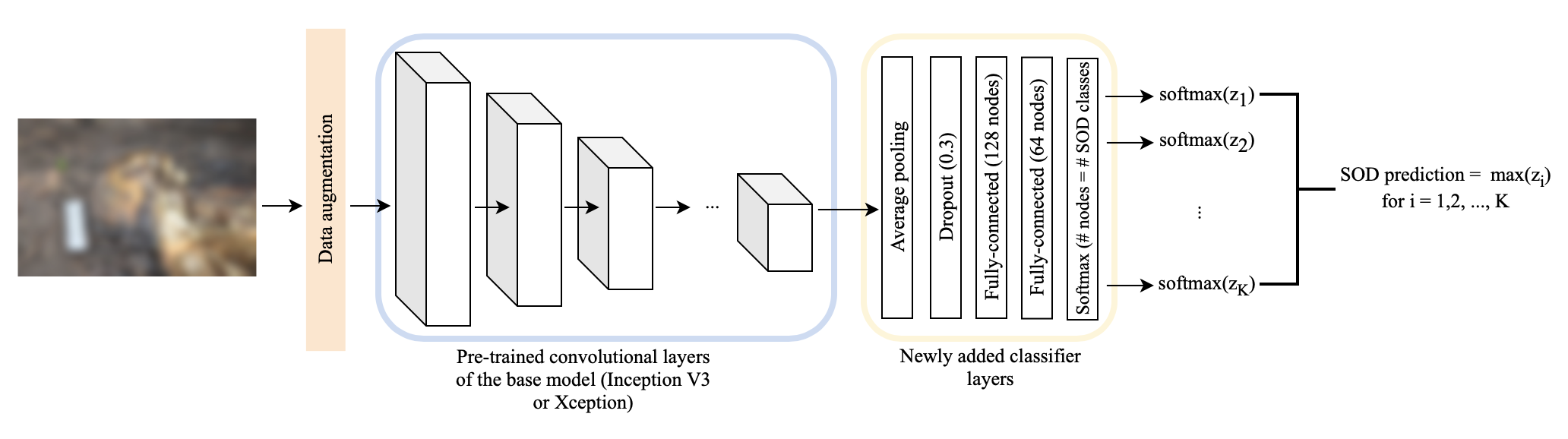
- 在包含150万张人类腐烂图像的大规模数据集上,对卷积神经网络(CNN)——特别是Inception V3和Xception——进行训练。
- 应用两种既定的SOD评分方法:Megyesi等人(四阶段)和Gelderman等人(六阶段),并对头部、躯干和四肢进行区域特定分类。
- 采用迁移学习,使用ImageNet预训练模型,并在腐烂图像数据集上进行微调,以提升泛化能力。
- 将宏平均F1分数作为多类别分类性能在不同解剖区域上的主要评估指标。
- 通过Cohen's kappa和组内相关系数,开展评分者间一致性研究,比较AI预测结果与人类法医检查员评分的一致性。
- 通过模型评估应对类别不平衡问题,并承认未来需通过标签传播技术进行数据增强。

实验结果
研究问题
- RQ1深度学习模型是否能在人类腐烂图像上实现与人类法医专家相当的可靠SOD分类性能?
- RQ2在使用Megyesi和Gelderman评分系统时,模型在不同解剖区域(头部、躯干、四肢)的SOD预测性能如何变化?
- RQ3SOD分类任务的复杂性(四阶段 vs. 六阶段)是否影响模型性能与可靠性?
- RQ4人工智能在SOD识别中在多大程度上能复现人类专家的评分者间一致性?
- RQ5当前人工智能模型在法医学图像分析中,因环境特异性与数据偏差所导致的局限性是什么?
主要发现
- Xception模型表现最佳,其在Megyesi SOD系统下的宏平均F1分数分别为:头部0.878,躯干0.881,四肢0.702。
- 在Gelderman六阶段系统下,Xception模型的F1分数分别为:头部0.872,躯干0.875,四肢0.760,表明其在类别复杂度增加的情况下仍具鲁棒性。
- 评分者间一致性分析显示,对于Megyesi系统,人类评分者与AI之间存在显著一致性(kappa > 0.6);对于Gelderman系统,一致性为中等水平(kappa ≈ 0.5)。
- 人工智能在SOD识别中的表现与人类专家一致,表明AI可作为人工评分的稳定且可扩展的替代方案。
- 研究发现存在局限性,包括单专家标注可能导致的标签偏差,以及环境特异性问题,因模型仅在户外、高湿亚热带条件下训练。
- 未来可通过采用领域感知的标签传播技术构建更大、更丰富、更均衡的数据集,以减轻标注负担与偏差,实现性能提升。
阅读本论文
在 Nubint 阅读器中打开原文,边读边就任意段落提问。
在 Nubint 中阅读本论文本解读由 AI 根据论文原文生成,引用前请核对原文。