
[论文解读] Towards Expressive Spectral-Temporal Graph Neural Networks for Time Series Forecasting
本文为时间序列预测中的谱时序图神经网络(SPTGNNs)建立了理论框架,证明在温和假设下线性SPTGNNs具有普遍性,并受时序1-WL测试的限制。本文提出TGC(时序图GegenConv),一种使用正交谱滤波器和独立频域模块的简单高效实例化方法,仅通过线性组件即优于现有模型。
Time series forecasting has remained a focal point due to its vital applications in sectors such as energy management and transportation planning. Spectral-temporal graph neural network is a promising abstraction underlying most time series forecasting models that are based on graph neural networks (GNNs). However, more is needed to know about the underpinnings of this branch of methods. In this paper, we establish a theoretical framework that unravels the expressive power of spectral-temporal GNNs. Our results show that linear spectral-temporal GNNs are universal under mild assumptions, and their expressive power is bounded by our extended first-order Weisfeiler-Leman algorithm on discrete-time dynamic graphs. To make our findings useful in practice on valid instantiations, we discuss related constraints in detail and outline a theoretical blueprint for designing spatial and temporal modules in spectral domains. Building on these insights and to demonstrate how powerful spectral-temporal GNNs are based on our framework, we propose a simple instantiation named Temporal Graph Gegenbauer Convolution (TGGC), which significantly outperforms most existing models with only linear components and shows better model efficiency. Our findings pave the way for devising a broader array of provably expressive GNN-based models for time series.
研究动机与目标
- 理解谱时序图神经网络(SPTGNNs)在时间序列预测中的理论表达能力。
- 解决关于SPTGNNs普遍性、局限性及设计原则的根本性问题。
- 基于理论洞见,设计一种可证明表达性强且高效的SPTGNN架构。
- 证明通过适当谱滤波的线性SPTGNNs可优于复杂的非线性模型。
提出的方法
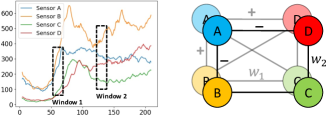
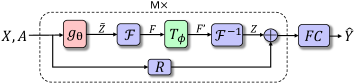
- 基于离散时间动态图(DTDGs)和谱GNNs,构建SPTGNNs的一般框架。
- 通过DTDGs的视角,证明在温和假设下线性SPTGNNs具有普遍性。
- 引入时序1-WL测试,以界定SPTGNNs的表达能力。
- 提出TGC(时序图GegenConv),采用正交函数基和图与时间频率域中的独立谱滤波器。
- 使用Gegenbauer多项式进行谱滤波,并通过低秩投影降低模型复杂度。
- 通过合成数据集和真实世界数据集上的消融实验与对比验证设计原则。
实验结果
研究问题
- RQ1谱时序图神经网络(SPTGNNs)的一般形式是什么?
- RQ2SPTGNNs在建模复杂、动态演变的时间序列依赖关系方面表达能力如何?
- RQ3在何种条件下SPTGNNs难以实现良好泛化?
- RQ4如何设计具有线性组件的可证明表达性强的SPTGNNs?
主要发现
- 在温和假设下,线性SPTGNNs对时间序列表征具有普遍性,能够建模任意时间序列模式。
- SPTGNNs的表达能力理论上受所提出的时序1-WL测试限制,该测试可识别动态图中的非同构节点。
- TGC作为简单线性SPTGNN的实例化,已在多个基准测试中达到最先进性能,且效率显著提升。
- 消融研究显示,正交函数基和独立谱滤波对性能至关重要。
- TGC在学习多样的空间相关性(包括正相关与负相关)方面优于MP-STGNNs如STGCN和Graph WaveNet。
- 该模型在短时和长时预测任务中均表现出良好泛化能力,在PeMS、Electricity、Weather和Solar数据集上持续取得改进。
阅读本论文
在 Nubint 阅读器中打开原文,边读边就任意段落提问。
在 Nubint 中阅读本论文本解读由 AI 根据论文原文生成,引用前请核对原文。