
[论文解读] Towards Federated RLHF with Aggregated Client Preference for LLMs
该论文提出 FedBiscuit,一种用于大语言模型(LLMs)强化学习人类反馈(RLHF)的联邦学习框架,通过聚合客户端偏好数据而非共享原始数据来实现。该框架引入 FedBis,通过客户端模型聚合训练全局二元选择器;并提出 FedBiscuit,通过按偏好相似性聚类客户端以提升鲁棒性与性能,在异构偏好数据上优于 FedBis 和集中式训练。
Reinforcement learning with human feedback (RLHF) fine-tunes a pretrained large language model (LLM) using user preference data, enabling it to generate content aligned with human preferences. However, due to privacy concerns, users may be reluctant to share sensitive preference data. To address this, we propose utilizing Federated Learning (FL) techniques, allowing large-scale preference collection from diverse real-world users without requiring them to transmit data to a central server. Our federated RLHF methods (i.e., FedBis and FedBiscuit) encode each client's preferences into binary selectors and aggregate them to capture common preferences. In particular, FedBiscuit overcomes key challenges, such as preference heterogeneity and reward hacking, through innovative solutions like grouping clients with similar preferences to reduce heterogeneity and using multiple binary selectors to enhance LLM output quality. To evaluate the performance of the proposed methods, we establish the first federated RLHF benchmark with a heterogeneous human preference dataset. Experimental results show that by integrating the LLM with aggregated client preferences, FedBis and FedBiscuit significantly enhance the professionalism and readability of the generated content.
研究动机与目标
- 解决在收集 LLM RLHF 微调所需客户端特定偏好数据时的隐私问题。
- 通过将标量奖励回归替换为二元选择,降低训练奖励模型的计算开销。
- 缓解联邦 RLHF 中因客户端间数据异构性导致的性能下降问题。
- 通过将具有相似偏好的客户端聚类,提升偏好建模的泛化能力与鲁棒性。
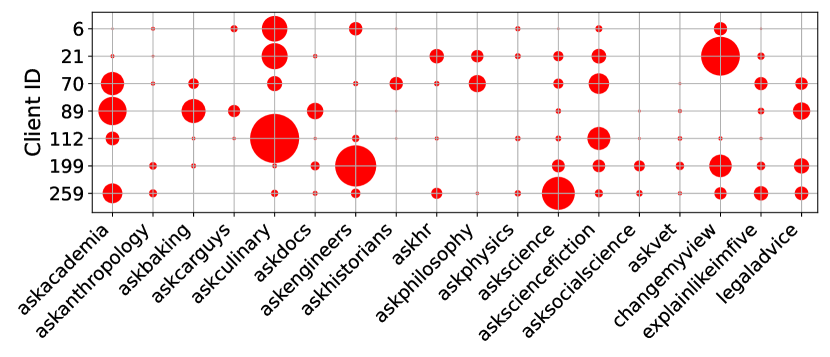
- 建立一个具有异构客户端数据划分的联邦人类偏好数据集基准。
提出的方法
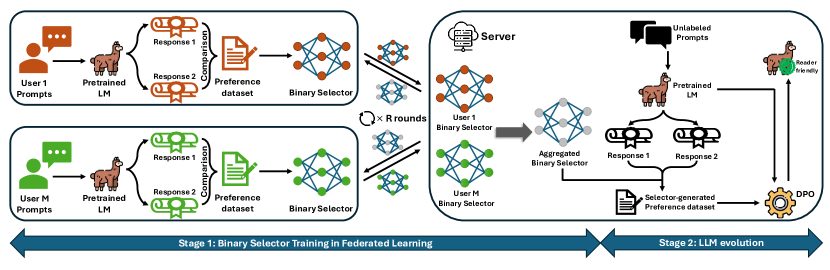
- 提出 FedBis,一种联邦二元选择器训练框架,其中每个客户端在本地偏好数据上训练二元分类器,服务器将这些分类器聚合为全局选择器。
- 引入 FedBiscuit,将客户端按偏好相似性组织为互不重叠的聚类,以训练多个本地化二元选择器。
- 利用客户端在所有选择器上的损失值作为偏好相似性的代理,以形成聚类,且无需共享原始数据。
- 采用直接偏好优化(DPO)方法,利用全局二元选择器的预测结果作为偏好信号,微调 LLM。
- 采用基于聚类的聚合策略,最终选择由每个聚类中最具准确性的本地选择器的多数投票决定。
- 使用公开的、任务特定的偏好数据集,对联邦学习与集中式训练设置下的性能进行基准测试。
实验结果
研究问题
- RQ1在客户端拥有私有偏好数据的前提下,跨客户端训练的联邦二元选择器能否有效模拟人类偏好排序?
- RQ2客户端偏好异构性如何影响联邦奖励模型训练的性能与收敛性?
- RQ3通过偏好相似性对客户端进行聚类,能否提升联邦 RLHF 中二元选择器的鲁棒性与泛化能力?
- RQ4FedBiscuit 在偏好选择准确率与 LLM 对齐方面是否优于 FedBis 和集中式训练?
- RQ5与传统 RLHF 相比,所提框架在缓解奖励欺骗与计算开销方面能达到何种程度?
主要发现
- FedBiscuit 在所提出的联邦人类偏好基准上优于 FedBis,甚至超越集中式训练,展现出对数据异构性的更强鲁棒性。
- FedBiscuit 的性能在通信轮次中持续提升,而集中式训练与 FedBis 均因奖励欺骗导致早期性能下降。
- FedBiscuit 避免了 FedBis 与集中式训练中出现的性能下降拐点,表明其具备更好的泛化能力与抗过拟合能力。
- 在分布外数据(如监督微调 LLM 的回复)上的泛化能力优于集中式训练,后者对特定数据分布产生过拟合。
- 基于损失值的客户端聚类实现了无需共享原始数据的有效偏好分组,提升了模型稳定性与性能。
- 二元选择器框架显著降低了传统标量奖励建模带来的计算开销,实现了高效的联邦训练。
阅读本论文
在 Nubint 阅读器中打开原文,边读边就任意段落提问。
在 Nubint 中阅读本论文本解读由 AI 根据论文原文生成,引用前请核对原文。