
[论文解读] Towards Open-Vocabulary Video Instance Segmentation
本文提出了开放词汇视频实例分割(OV-VIS)这一新任务,实现了对开放集类别(包括新类别)的端到端分割、跟踪与分类。提出OV2Seg模型,一种基于记忆增强的Transformer架构,采用与类别无关的查询和记忆增强的特征聚合机制,实现鲁棒的实时推理,在无需微调的情况下展现出强大的零样本泛化能力。
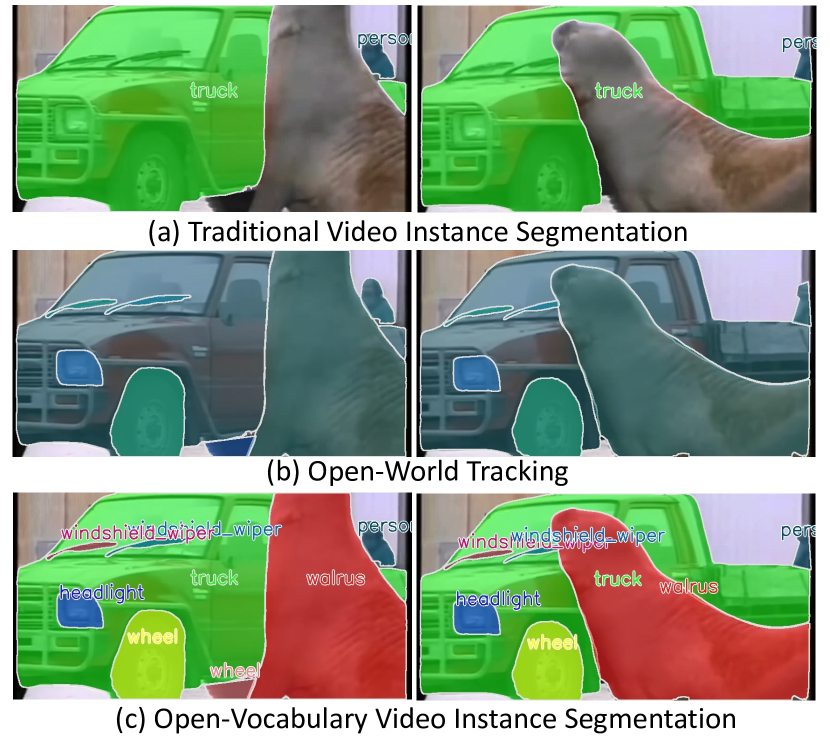
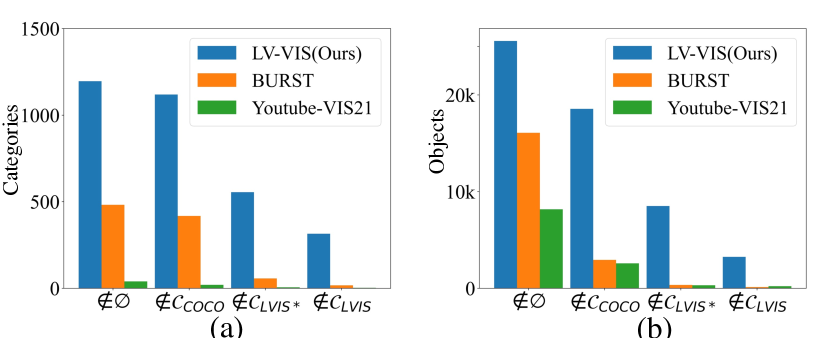
Video Instance Segmentation (VIS) aims at segmenting and categorizing objects in videos from a closed set of training categories, lacking the generalization ability to handle novel categories in real-world videos. To address this limitation, we make the following three contributions. First, we introduce the novel task of Open-Vocabulary Video Instance Segmentation, which aims to simultaneously segment, track, and classify objects in videos from open-set categories, including novel categories unseen during training. Second, to benchmark Open-Vocabulary VIS, we collect a Large-Vocabulary Video Instance Segmentation dataset (LV-VIS), that contains well-annotated objects from 1,196 diverse categories, significantly surpassing the category size of existing datasets by more than one order of magnitude. Third, we propose an efficient Memory-Induced Transformer architecture, OV2Seg, to first achieve Open-Vocabulary VIS in an end-to-end manner with near real-time inference speed. Extensive experiments on LV-VIS and four existing VIS datasets demonstrate the strong zero-shot generalization ability of OV2Seg on novel categories. The dataset and code are released here https://github.com/haochenheheda/LVVIS.
研究动机与目标
- 解决传统视频实例分割(VIS)在泛化到训练时未见的新类别对象方面的局限性。
- 提出一项新基准任务——开放词汇视频实例分割,实现对开放集类别的同时分割、跟踪与分类。
- 收集并发布LV-VIS数据集,该数据集包含1,196种多样化类别,显著提升了现有数据集在类别多样性和规模上的水平。
- 开发一种端到端模型OV2Seg,具备在接近实时推理速度下对新类别实现零样本泛化的能力。
- 在无需微调的情况下,于多个基准数据集上展示模型在新类别上的强大零样本性能。
提出的方法
- 提出一项新任务:开放词汇视频实例分割(OV-VIS),统一处理已见类别与新类别的分割、跟踪与分类。
- 引入LV-VIS数据集,包含4,828段视频、544k个实例掩码和1,196种多样化类别,在类别数量与多样性上超越现有数据集。
- 设计OV2Seg端到端架构,采用通用物体提议模块进行初始检测与分割。
- 利用记忆查询在帧间逐步编码并跟踪物体特征,实现长期时间感知能力,并增强对遮挡的鲁棒性。
- 使用语言Transformer编码器基于记忆增强的特征进行分类,可接受任意类别名称作为输入,实现零样本推理。
- 采用带有可学习因子α和物体置信度分数的记忆更新机制,以稳定特征聚合并提升跟踪精度。
实验结果
研究问题
- RQ1视频实例分割模型能否泛化到训练时未见的新类别对象?
- RQ2如何设计统一框架,实现在开放集类别上的视频分割、跟踪与分类?
- RQ3记忆增强的特征聚合对视频中长期跟踪与零样本分类有何影响?
- RQ4所提出的端到端架构在准确率与推理速度方面相较于流水线式方法有何差异?
- RQ5在封闭集图像数据集上训练的模型,能在多大程度上实现对多样化视频实例分割基准的强零样本性能?
主要发现
- OV2Seg在Youtube-VIS2019数据集上新类别达到11.1 mAP n,在Youtube-VIS2021数据集上达到7.3 mAP n,且无需任何微调,分别优于Detic-OWTB 6.6和1.5 mAP n。
- 在OVID数据集(存在严重遮挡)上,OV2Seg达到11.2 mAP,与MaskTrack和FEELVOS等全监督模型性能相当。
- 采用与类别无关的查询,OV2Seg在准确率上与类别相关查询相当,但推理速度快两个数量级,尤其在大规模开放词汇设置下至关重要。
- 当α = 0.7并结合物体置信度分数时,记忆更新机制表现最佳,在Youtube-VIS2019上达到27.2 mAP,在LV-VIS验证集上达到14.2 mAP。
- 记忆查询通过置信加权的特征聚合,优于简单平均每帧分类得分,能更有效地处理运动模糊与遮挡。
- OV2Seg在完全遮挡后仍能成功重新追踪物体,LV-VIS数据集的可视化结果已验证该能力。
阅读本论文
在 Nubint 阅读器中打开原文,边读边就任意段落提问。
在 Nubint 中阅读本论文本解读由 AI 根据论文原文生成,引用前请核对原文。