
[论文解读] Training Deep Boltzmann Networks with Sparse Ising Machines
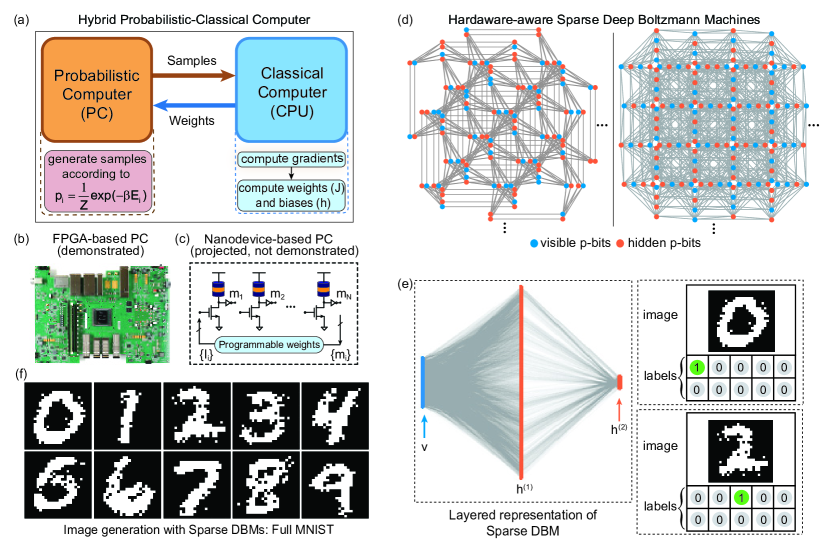
该论文提出了一种混合硬件-软件框架,利用在FPGA上实现的稀疏异步伊辛机,对深度玻尔兹曼机(DBMs)进行训练,实现了数量级的加速。通过利用概率比特(p-bit)架构实现快速马尔可夫链蒙特卡洛采样,该系统仅使用4,264个p-bit即实现了90%的MNIST分类准确率,性能与一个325万参数的软件RBMs相当,同时还能生成新样本,这是软件模型所不具备的能力。
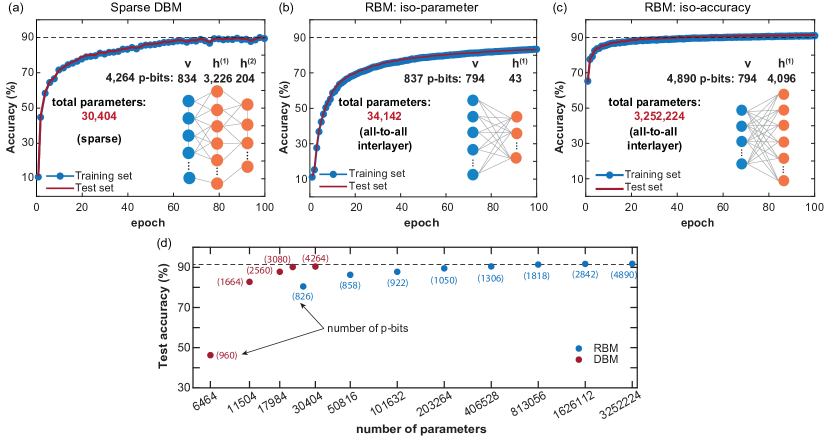
The slowing down of Moore's law has driven the development of unconventional computing paradigms, such as specialized Ising machines tailored to solve combinatorial optimization problems. In this paper, we show a new application domain for probabilistic bit (p-bit) based Ising machines by training deep generative AI models with them. Using sparse, asynchronous, and massively parallel Ising machines we train deep Boltzmann networks in a hybrid probabilistic-classical computing setup. We use the full MNIST and Fashion MNIST (FMNIST) dataset without any downsampling and a reduced version of CIFAR-10 dataset in hardware-aware network topologies implemented in moderately sized Field Programmable Gate Arrays (FPGA). For MNIST, our machine using only 4,264 nodes (p-bits) and about 30,000 parameters achieves the same classification accuracy (90%) as an optimized software-based restricted Boltzmann Machine (RBM) with approximately 3.25 million parameters. Similar results follow for FMNIST and CIFAR-10. Additionally, the sparse deep Boltzmann network can generate new handwritten digits and fashion products, a task the 3.25 million parameter RBM fails at despite achieving the same accuracy. Our hybrid computer takes a measured 50 to 64 billion probabilistic flips per second, which is at least an order of magnitude faster than superficially similar Graphics and Tensor Processing Unit (GPU/TPU) based implementations. The massively parallel architecture can comfortably perform the contrastive divergence algorithm (CD-n) with up to n = 10 million sweeps per update, beyond the capabilities of existing software implementations. These results demonstrate the potential of using Ising machines for traditionally hard-to-train deep generative Boltzmann networks, with further possible improvement in nanodevice-based realizations.
研究动机与目标
- 证明概率伊辛机能够高效训练深度生成模型(如深度玻尔兹曼机),克服传统软件训练的局限性。
- 通过利用p-bit伊辛机的海量并行、低延迟采样能力,解决在传统硬件上训练深度玻尔兹曼网络的计算不可行性。
- 表明稀疏、硬件感知的DBM拓扑结构可在极低硬件资源下实现高性能,从而实现深度生成模型的能效训练。
- 通过与标准数据集(如MNIST、FMNIST和CIFAR-10)上软件RBMs的实现进行对比,验证该混合方法的可扩展性与效率。
- 探索将该框架扩展至基于纳米器件的p-计算机的可行性,以实现未来能效更高的AI硬件。
提出的方法
- 系统采用混合架构,其中基于p-bit的伊辛机在FPGA上实现,用于从玻尔兹曼-吉布斯分布中快速进行概率采样,而CPU则负责梯度计算与权重更新。
- 伊辛机基于FPGA上的数字CMOS逻辑构建,每个p-bit由伪随机数生成器、tanh激活查表单元和用于二值输出的阈值单元组成。
- 网络拓扑为稀疏且异步,p-bit在无全局时钟的情况下动态并行更新,支持在多个颜色块之间实现高吞吐量采样。
- 系统采用硬件感知的稀疏DBM结构,利用Pegasus和Zephyr图拓扑,高效映射到FPGA的物理互连结构上。
- 通过PCIe接口实现FPGA与CPU之间的双向通信,支持定期的权重与偏置更新,p-bit状态在数据传输前保存至块RAM(BRAM)。
- 采样速度通过FPGA中的可编程计数器测量,将p-bit翻转次数与参考时钟进行比较,实时计算每纳秒的翻转次数。
实验结果
研究问题
- RQ1在FPGA上实现的稀疏异步伊辛机能否有效训练深度玻尔兹曼网络,性能与软件RBMs相当?
- RQ2与基于GPU/TPU的实现相比,该混合p-计算机架构是否在对比发散训练的随机采样中实现了显著加速?
- RQ3相同的硬件高效设置是否能在保持高分类准确率的同时生成新样本(如手写数字),而这是性能相当的软件RBMs所无法实现的?
- RQ4DBM的稀疏性与硬件感知拓扑在不牺牲模型性能的前提下,能在多大程度上减少参数数量与资源使用?
- RQ5p-计算机的采样速率(每秒翻转次数)与传统硬件相比如何?能否支持高阶对比发散(如CD-10^7)训练?
主要发现
- 基于FPGA的p-计算机实测采样速率达每秒500亿至640亿次概率翻转,比基于GPU/TPU的实现至少快一个数量级。
- 该系统仅使用4,264个p-bit和约30,000个参数,即可在完整MNIST数据集上实现90%的分类准确率,性能与一个325万参数的软件RBMs相当。
- 尽管准确率相同,325万参数的软件RBMs无法生成新的手写数字,而基于p-计算机训练的稀疏DBM则能成功生成逼真的样本。
- 混合训练流水线使用CD-10^5在约20小时内完成MNIST的100个训练周期,而等效的CPU-based RBM使用CD-10^4完成100个周期需约24天。
- 系统支持每轮更新高达n = 1000万次扫描的对比发散,其规模远超典型软件实现的范围。
- 结果在其他数据集上也具有可扩展性:在Fashion-MNIST和简化版CIFAR-10数据集上观察到相似性能,证实了该方法的通用性。
阅读本论文
在 Nubint 阅读器中打开原文,边读边就任意段落提问。
在 Nubint 中阅读本论文本解读由 AI 根据论文原文生成,引用前请核对原文。