
[论文解读] Transferability of datasets between Machine-Learning Interaction Potentials
本研究探讨了可微机器学习相互作用势(MLIPs)之间训练数据集的可迁移性,表明为某一模型(尤其是MACE)优化的数据可有效微调其他架构。关键结果表明,人工设计的数据能提升各类模型的性能,而某一算法主动学习生成的数据很少能惠及其他模型;MACE即使在极小数据集上也表现出优越的泛化能力。
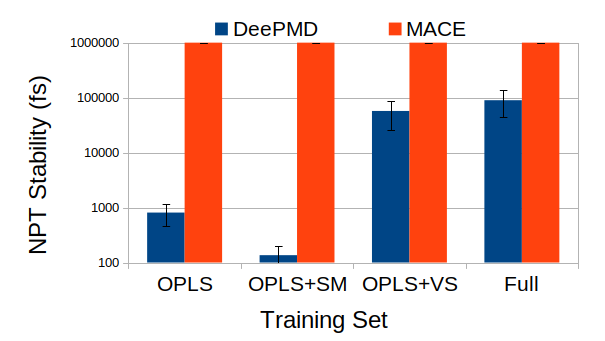
With the emergence of Foundational Machine Learning Interatomic Potential (FMLIP) models trained on extensive datasets, transferring data between different ML architectures has become increasingly important. In this work, we examine the extent to which training data optimised for one machine-learning forcefield algorithm may be re-used to train different models, aiming to accelerate FMLIP fine-tuning and to reduce the need for costly iterative training. As a test case, we train models of an organic liquid mixture that is commonly used as a solvent in rechargeable battery electrolytes, making it an important target for reactive MLIP development. We assess model performance by analysing the properties of molecular dynamics trajectories, showing that this is a more stringent test than comparing prediction errors for fixed datasets. We consider several types of training data, and several popular MLIPs - notably the recent MACE architecture, a message-passing neural network designed for high efficiency and smoothness. We demonstrate that simple training sets constructed without any ab initio dynamics are sufficient to produce stable models of molecular liquids. For simple neural-network architectures, further iterative training is required to capture thermodynamic and kinetic properties correctly, but MACE performs well with extremely limited datsets. We find that configurations designed by human intuition to correct systematic model deficiencies transfer effectively between algorithms, but active-learned data that are generated by one MLIP do not typically benefit a different algorithm. Finally, we show that any training data which improve model performance also improve its ability to generalise to similar unseen molecules. This suggests that trajectory failure modes are connected with chemical structure rather than being entirely system-specific.
研究动机与目标
- 评估一种MLIP架构的训练数据在其他模型上重用的有效性,以降低迭代训练成本。
- 评估在某一模型中通过主动学习生成的数据是否能惠及另一MLIP架构。
- 确定数据集大小与构成对模型泛化至未见分子体系能力的影响。
- 比较多种MLIP架构(尤其是MACE)在与电池电解质相关的复杂有机液体混合物上的性能。
- 识别利用可迁移训练数据加速基础MLIP微调的实际原则。
提出的方法
- 在来自电池相关有机液体混合物的共用配置数据集上,训练了多种MLIP架构,包括MACE、传统消息传递网络以及GAP/DeePMD。
- 通过人工指导的选择(针对模型缺陷)和主动学习(利用预测误差选择新配置)生成训练数据。
- 通过长时间分子动力学轨迹评估模型性能,重点关注热力学与动力学稳定性,而不仅限于局部预测误差。
- 通过从NVT轨迹中采样配置,并与参考DFT数据对比能量和力误差,验证预测结果。
- 采用MACE与DeePMD模型在相同数据集上训练的1:1对比,评估误差演化与扩散系数估算的准确性。
- 分析预测误差与参考DFT值之间的相关性,以评估模型在势能面高能区域探索中的可靠性。
实验结果
研究问题
- RQ1为某一MLIP架构优化的训练数据在多大程度上可成功迁移至其他架构以提升性能?
- RQ2当使用相同迁移数据集时,MACE与传统神经网络的性能相比如何,特别是在数据有限的情况下?
- RQ3由某一MLIP模型生成的主动学习数据是否能有效提升另一MLIP架构的性能?
- RQ4迁移数据集的大小与构成是否影响模型对未见分子构型的泛化能力?
- RQ5分子动力学轨迹中的失效模式主要是由化学结构还是系统特异性构型空间缺陷引起?
主要发现
- 针对系统性模型缺陷的人工设计训练数据可在不同MLIP架构间有效迁移,提升分子动力学中的稳定性和准确性。
- 由某一MLIP模型(如DeePMD)生成的主动学习数据在迁移至其他架构时表现出有限可迁移性,表明学习模式具有算法特异性。
- MACE在极小训练数据下即实现高精度与高稳定性,即使在相同小数据集上训练,也优于传统消息传递网络。
- DeePMD模型在MD轨迹中随时间推移预测误差显著增加,表明其偏离了训练良好的区域;而MACE保持低且稳定的误差(能量约4 meV/atom,力约25 meV/Å)。
- DeePMD比MACE更频繁地采样高DFT能量和大预测误差的构型,表明MACE更倾向于探索势能面的可靠区域。
- 任何能提升基础分子性能的训练数据,也能增强对相关未见分子的稳定性,表明轨迹失效模式与化学结构相关,而非系统特异性伪影。

阅读本论文
在 Nubint 阅读器中打开原文,边读边就任意段落提问。
在 Nubint 中阅读本论文本解读由 AI 根据论文原文生成,引用前请核对原文。