
[论文解读] Transformers and Large Language Models for Efficient Intrusion Detection Systems: A Comprehensive Survey
本综述分析Transformers和大型语言模型在入侵检测系统中的应用,涵盖架构、数据集、指标和开放挑战。
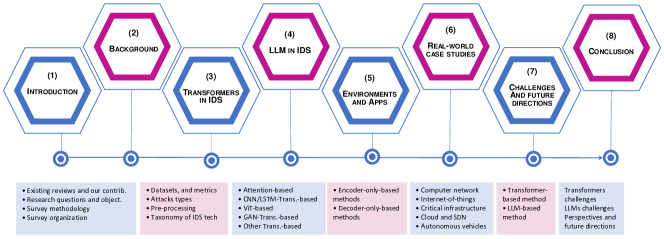
With significant advancements in Transformers LLMs, NLP has extended its reach into many research fields due to its enhanced capabilities in text generation and user interaction. One field benefiting greatly from these advancements is cybersecurity. In cybersecurity, many parameters that need to be protected and exchanged between senders and receivers are in the form of text and tabular data, making NLP a valuable tool in enhancing the security measures of communication protocols. This survey paper provides a comprehensive analysis of the utilization of Transformers and LLMs in cyber-threat detection systems. The methodology of paper selection and bibliometric analysis is outlined to establish a rigorous framework for evaluating existing research. The fundamentals of Transformers are discussed, including background information on various cyber-attacks and datasets commonly used in this field. The survey explores the application of Transformers in IDSs, focusing on different architectures such as Attention-based models, LLMs like BERT and GPT, CNN/LSTM-Transformer hybrids, emerging approaches like ViTs, among others. Furthermore, it explores the diverse environments and applications where Transformers and LLMs-based IDS have been implemented, including computer networks, IoT devices, critical infrastructure protection, cloud computing, SDN, as well as in autonomous vehicles. The paper also addresses research challenges and future directions in this area, identifying key issues such as interpretability, scalability, and adaptability to evolving threats, and more. Finally, the conclusion summarizes the findings and highlights the significance of Transformers and LLMs in enhancing cyber-threat detection capabilities, while also outlining potential avenues for further research and development.
研究动机与目标
- 解释将Transformers和LLMs应用于IDS的动机并与传统ML/DL模型进行比较。
- 评估在不同环境中用于IDS的基于Transformer的体系结构和LLM变体。
- catalog 数据集、指标以及基于Transformer/LLM的IDS的评估方法。
- 识别Transformer和LLM基础的IDS的挑战、差距和未来方向。
提出的方法
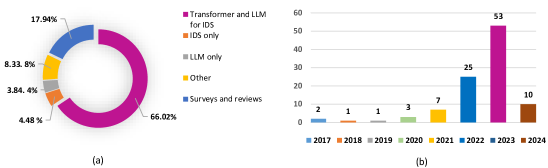
- 对2017年至2024年使用Scopus及其他来源的Transformer和LLM基础的IDS进行结构化文献综述。
- 提供IDS类型(HIDS/NIDS)和攻击类别的分类法,并将其映射到Transformer/LLM技术。
- 分析Transformer体系结构(基于注意力的模型、CNN/LSTM-Transformer、ViT、GAN-Transformer、GPT、BERT)及其在IDS中的应用。
- 回顾在基于Transformer/LLM的IDS研究中使用的数据集、评估指标和数据预处理步骤。
- 突出跨网络、物联网/工业物联网、关键基础设施、云/SDN以及自动驾驶等领域的应用,并讨论挑战与未来方向。
实验结果
研究问题
- RQ1RQ1: 究竟是什么驱动Transformers和LLMs在IDS中的使用,以及它们相较于传统ML/DL模型提供了哪些优势?
- RQ2RQ2: 当前基于Transformer/LLM的IDS方法在各种攻击类型上的应用是什么,它们的成功程度如何?
- RQ3RQ3: Transformer/LLM基础的IDS方法在准确性和效率方面与传统方法相比如何?
- RQ4RQ4: 如何改进Transformer/LLM基础的IDS的可解释性,目前的趋势与挑战是什么?
- RQ5RQ5: Transformer/LLM基础的IDS在多样化网络环境中的主要应用有哪些?
- RQ6RQ6: 对Transformer和LLM基础的IDS而言,哪些未来研究领域至关重要?
主要发现
- 提出Transformer和LLMs以解决传统IDS的局限性,包括处理网络数据中的序列性和时间模式。
- 综述 catalog 了在IDS中使用的基于注意力的模型、CNN/LSTM-Transformer 混合、ViT、GAN-Transformer、GPT和BERT变体等体系结构。
- 使用多样化的数据集和评估指标来评估IDS性能,在专门指标中突出 MCC 和 FPR。
- 论文讨论了在计算机网络、物联网/工业物联网、关键基础设施、云、SDN和自动驾驶等领域的应用。
- 开放挑战包括可解释性、可扩展性以及对不断演化威胁的适应性,并为未来研究方向提出建议。
阅读本论文
在 Nubint 阅读器中打开原文,边读边就任意段落提问。
在 Nubint 中阅读本论文本解读由 AI 根据论文原文生成,引用前请核对原文。