
[论文解读] TransXNet: Learning Both Global and Local Dynamics with a Dual Dynamic Token Mixer for Visual Recognition
介绍 Dual Dynamic Token Mixer (D-Mixer),以共同捕捉全局和局部信息,为视觉骨干网络,产生 TransXNet,在分类、检测和分割等任务上具有更高的准确性和效率。
Recent studies have integrated convolutions into transformers to introduce inductive bias and improve generalization performance. However, the static nature of conventional convolution prevents it from dynamically adapting to input variations, resulting in a representation discrepancy between convolution and self-attention as the latter computes attention maps dynamically. Furthermore, when stacking token mixers that consist of convolution and self-attention to form a deep network, the static nature of convolution hinders the fusion of features previously generated by self-attention into convolution kernels. These two limitations result in a sub-optimal representation capacity of the entire network. To find a solution, we propose a lightweight Dual Dynamic Token Mixer (D-Mixer) to simultaneously learn global and local dynamics via computing input-dependent global and local aggregation weights. D-Mixer works by applying an efficient global attention module and an input-dependent depthwise convolution separately on evenly split feature segments, endowing the network with strong inductive bias and an enlarged receptive field. We use D-Mixer as the basic building block to design TransXNet, a novel hybrid CNN-Transformer vision backbone network that delivers compelling performance. In the ImageNet-1K classification, TransXNet-T surpasses Swin-T by 0.3% in top-1 accuracy while requiring less than half of the computational cost. Furthermore, TransXNet-S and TransXNet-B exhibit excellent model scalability, achieving top-1 accuracy of 83.8% and 84.6% respectively, with reasonable computational costs. Additionally, our proposed network architecture demonstrates strong generalization capabilities in various dense prediction tasks, outperforming other state-of-the-art networks while having lower computational costs. Code is publicly available at https://github.com/LMMMEng/TransXNet.
研究动机与目标
- Motivate hybrid CNN-Transformer backbones to overcome static convolution bottlenecks by introducing input-dependent dynamics.
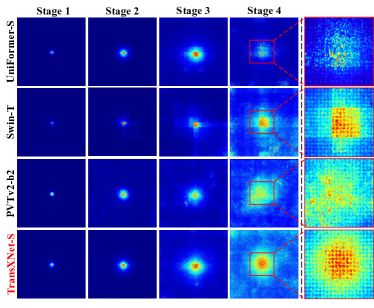
- Design a lightweight token mixer that integrates global and local information to enlarge effective receptive field (ERF).
- Build a hierarchical backbone (TransXNet) using D-Mixer and MS-FFN for visual recognition tasks.
- Show that TransXNet achieves state-of-the-art or competitive results with lower computational cost across classification, detection, and segmentation.
- Provide ablations and transferability analysis to validate components and generalization.
提出的方法
- Propose a Dual Dynamic Token Mixer (D-Mixer) that splits features into two channel halves processed by OSRA (global) and IDConv (input-dependent local) and then concatenates results.
- Introduce Input-dependent Depthwise Convolution (IDConv) to generate input-adaptive, spatially varying depthwise kernels.
- Introduce Overlapping Spatial Reduction Attention (OSRA) to capture global context with overlapping patches.
- Add Squeezed Token Enhancer (STE) to efficiently fuse channel information after token mixing.
- Incorporate Multi-scale Feed-forward Network (MS-FFN) with parallel depthwise convolutions of sizes {3,5,7} for multi-scale token aggregation.
- Provide four-stage hierarchical architecture with DPE layering, D-Mixer blocks, and MS-FFN blocks to form TransXNet variants (T, S, B).
实验结果
研究问题
- RQ1Do input-dependent dynamics via D-Mixer improve representation capacity and generalization compared to static convolutions in hybrid CNN-Transformer backbones?
- RQ2Can global attention across stages together with dynamic local convolution enlarge the receptive field and improve performance on vision tasks?
- RQ3How do D-Mixer components (OSRA, IDConv, STE) and MS-FFN contribute to performance on ImageNet-1K and downstream tasks (COCO, ADE20K)?
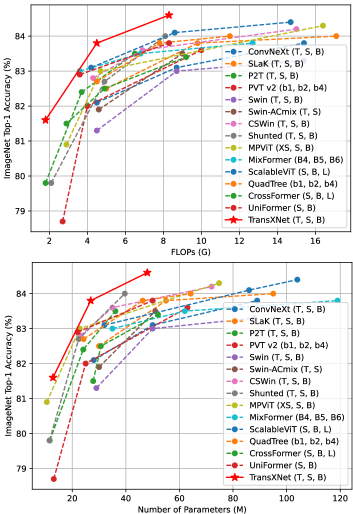
- RQ4What are the accuracy-cost trade-offs of TransXNet variants (T, S, B) relative to contemporary SOTA backbones?
- RQ5Do the gains transfer effectively to object detection, instance and semantic segmentation without specialized implementations?
主要发现
- TransXNet-T achieves 81.6% top-1 accuracy on ImageNet-1K with 1.8G FLOPs and 12.8M params, surpassing Swin-T by 0.3% while using less than half the cost.
- TransXNet-S achieves 83.8% top-1 on ImageNet-1K with competitive FLOPs and parameters, outperforming InternImage-T and several hybrid models at lower cost.
- TransXNet-B attains 84.6% top-1 on ImageNet-1K with 8.3G FLOPs and 48.0M params, delivering strong accuracy-cost balance and outperforming comparable backbones.
- On ImageNet-1K-V2, TransXNet variants show better generalization and transferability, with explicit gains in tiny/small/base configurations.
- In COCO object detection and Mask R-CNN segmentation, TransXNet backbones outperform peers at similar compute, especially in medium/large objects, demonstrating strong global-local dynamics advantages.
- On ADE20K semantic segmentation, TransXNet-T/S/B achieve mIoU of 45.5%/48.5%/49.9% respectively, with competitive or lower FLOPs compared to baselines.
阅读本论文
在 Nubint 阅读器中打开原文,边读边就任意段落提问。
在 Nubint 中阅读本论文本解读由 AI 根据论文原文生成,引用前请核对原文。