
[论文解读] Trigger-Level Event Reconstruction for Neutrino Telescopes Using Sparse Submanifold Convolutional Neural Networks
本文提出稀疏子流形卷积神经网络(SSCNNs)用于中微子望远镜中的触发级事件重建,解决了非规则几何结构、数据稀疏性以及高维性等挑战。SSCNNs 在 GPU 上实现亚微秒级推理,支持 kHz 触发速率下的实时处理——在角分辨率方面优于传统方法,并首次实现了触发级能量重建。
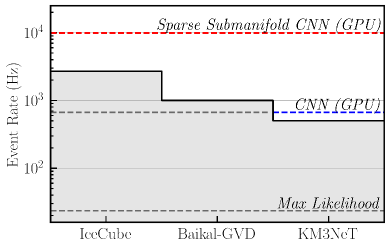
Convolutional neural networks (CNNs) have seen extensive applications in scientific data analysis, including in neutrino telescopes. However, the data from these experiments present numerous challenges to CNNs, such as non-regular geometry, sparsity, and high dimensionality. Consequently, CNNs are highly inefficient on neutrino telescope data, and require significant pre-processing that results in information loss. We propose sparse submanifold convolutions (SSCNNs) as a solution to these issues and show that the SSCNN event reconstruction performance is comparable to or better than traditional and machine learning algorithms. Additionally, our SSCNN runs approximately 16 times faster than a traditional CNN on a GPU. As a result of this speedup, it is expected to be capable of handling the trigger-level event rate of IceCube-scale neutrino telescopes. These networks could be used to improve the first estimation of the neutrino energy and direction to seed more advanced reconstructions, or to provide this information to an alert-sending system to quickly follow-up interesting events.
研究动机与目标
- 解决标准卷积神经网络在稀疏、高维、非规则采样中微子望远镜数据上的计算效率低下问题。
- 开发一种重建方法,能够跟上 IceCube 等大规模中微子望远镜中 kHz 触发速率的处理需求。
- 实现在触发级对中微子能量和方向的精确、实时估计,以提升下游分析和警报系统的性能。
- 为计算量更大的基于似然的重建方法提供快速、低延迟的初始种子。
- 通过统一框架证明其在冰基和水基中微子望远镜中的适用性。
提出的方法
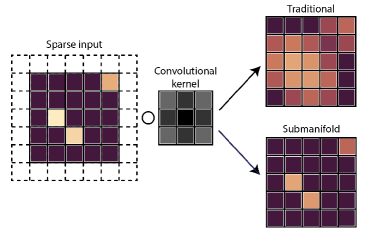
- 采用稀疏子流形卷积(SSCNNs)高效处理中微子望远镜的不规则、稀疏的 4D 传感器数据(3D 空间 + 时间)。
- 使用仅对活跃传感器击中点进行计算的稀疏张量表示,显著降低稀疏数据的计算量。
- 设计全连接网络架构,包含残差块和批量归一化层,以提升训练稳定性和性能。
- 在大规模模拟中微子事件数据集上端到端训练 SSCNN,数据包括光模块击中点和真实的中微子参数。
- 通过 GPU 加速的稀疏卷积核优化推理,实现微秒级推理时间。
- 应用数据增强和能量相关损失加权策略,以提升在整个能量谱范围内的性能。
实验结果
研究问题
- RQ1稀疏子流形 CNN 是否能在稀疏、非规则的中微子望远镜数据上实现高精度事件重建,同时保持实时推理?
- RQ2在触发级速率下,SSCNN 在角分辨率和能量重建方面与 LineFit 和最大似然等传统方法相比表现如何?
- RQ3SSCNN 的速度在多大程度上支持典型大规模中微子望远镜中 kHz 触发速率的处理?
- RQ4SSCNN 是否能实现触发级中微子能量重建?这是以往标准方法未能实现的能力。
- RQ5SSCNN 在不同中微子能量和事件类型(如起始事件与穿行事件)下的性能有多强的鲁棒性?
主要发现
- 对于高能中微子(高于 100 TeV),SSCNN 的中值角分辨率低于 4°,优于标准 LineFit 方法的 10° 分辨率。
- SSCNN 在 GPU 上的推理速度比标准 CNN 快约 16 倍,推理时间处于微秒量级,支持 kHz 触发速率下的处理。
- SSCNN 首次实现了触发级能量重建,在 100 GeV 至 1 TeV 范围内达到中值对数能量分辨率 ±0.4,低能时存在系统性高估,高能时存在低估。
- 应用质量筛选后,SSCNN 在所有能量范围内角分辨率均提升约 2°,表明其具有鲁棒性和一致性。
- SSCNN 在起始事件和穿行事件中表现一致,低能时分辨率较低,主要由于光子产额减少。
- 该方法适用于冰基(如 IceCube)和水基(如 KM3NeT)中微子望远镜,展现出广泛的兼容性和可扩展性。
阅读本论文
在 Nubint 阅读器中打开原文,边读边就任意段落提问。
在 Nubint 中阅读本论文本解读由 AI 根据论文原文生成,引用前请核对原文。