
[论文解读] Trustworthy Distributed AI Systems: Robustness, Privacy, and Governance
本文全面综述了可信分布式人工智能系统,重点关注联邦学习与分布式学习中的鲁棒性、隐私性和公平性。提出了一套统一的对抗性攻击、数据污染、模型反演和偏差放大等威胁的应对措施分类体系,为去中心化环境中安全、私密且公平的人工智能部署奠定了基础。
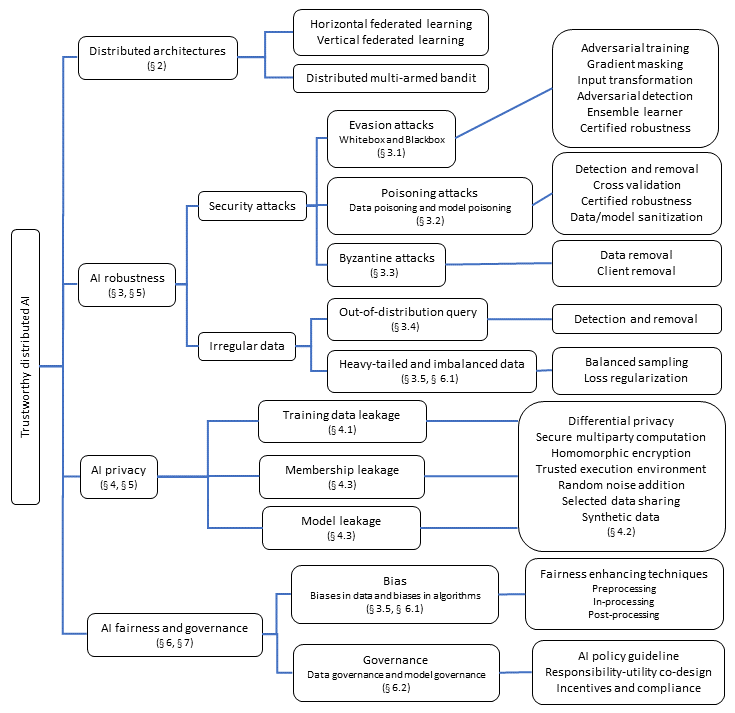
Emerging Distributed AI systems are revolutionizing big data computing and data processing capabilities with growing economic and societal impact. However, recent studies have identified new attack surfaces and risks caused by security, privacy, and fairness issues in AI systems. In this paper, we review representative techniques, algorithms, and theoretical foundations for trustworthy distributed AI through robustness guarantee, privacy protection, and fairness awareness in distributed learning. We first provide a brief overview of alternative architectures for distributed learning, discuss inherent vulnerabilities for security, privacy, and fairness of AI algorithms in distributed learning, and analyze why these problems are present in distributed learning regardless of specific architectures. Then we provide a unique taxonomy of countermeasures for trustworthy distributed AI, covering (1) robustness to evasion attacks and irregular queries at inference, and robustness to poisoning attacks, Byzantine attacks, and irregular data distribution during training; (2) privacy protection during distributed learning and model inference at deployment; and (3) AI fairness and governance with respect to both data and models. We conclude with a discussion on open challenges and future research directions toward trustworthy distributed AI, such as the need for trustworthy AI policy guidelines, the AI responsibility-utility co-design, and incentives and compliance.
研究动机与目标
- 应对去中心化学习环境中因安全、隐私和公平性漏洞而带来的日益增长的风险。
- 识别分布式学习架构中与数据不规则性、模型污染和对抗性操纵相关的固有漏洞。
- 为分布式人工智能系统中的鲁棒性、隐私保护和公平性构建统一的应对措施分类体系。
- 突出在基础模型时代,可信人工智能在治理、政策设计和合规性方面面临的开放挑战。
- 通过责任-效用协同设计与标准化治理框架,提供可信人工智能的研究路线图。
提出的方法
- 综述并分类代表性技术、算法和鲁棒性、隐私性与公平性在分布式学习中的理论基础。
- 将应对措施划分为三大支柱:(1) 抵御逃避攻击、污染攻击和拜占庭攻击的鲁棒性;(2) 训练与推理过程中的隐私保护机制;(3) 数据与模型完整性相关的公平性与治理。
- 分析由非独立同分布(non-IID)数据、梯度泄露和模型反演攻击引发的漏洞,尤其在推理阶段。
- 研究基础模型带来的风险,包括提示注入、后门触发和通过查询探测进行的数据提取。
- 提出可信人工智能政策指南框架,强调可解释性、来源验证和访问控制。
- 整合水印技术、毒性检测与偏差评估工具,以增强模型安全性与合规性。
实验结果
研究问题
- RQ1无论架构如何,分布式人工智能系统中固有的关键安全、隐私与公平性漏洞是什么?
- RQ2在分布式训练与推理中,如何确保对逃避攻击、数据污染和拜占庭行为的鲁棒性?
- RQ3在分布式模型训练与部署过程中,哪些隐私保护技术对抵抗梯度泄露和推理攻击是有效的?
- RQ4如何系统性地将公平性与偏差缓解机制整合到分布式学习中的数据与模型生命周期管理中?
- RQ5为确保基础模型的可信性与去中心化系统中负责任的人工智能部署,需要哪些治理与政策机制?
主要发现
- 由于去中心化、异构客户端及开放通信通道的存在,分布式学习天然暴露于新的攻击面。
- 非独立同分布(non-IID)和不平衡的数据分布会显著降低模型性能并放大偏差,需超越标准训练的鲁棒性机制。
- 梯度泄露与模型反演攻击可从模型更新或推理查询中重建敏感训练数据,因此需要强有力的隐私保护防御措施。
- 使用对抗性样本的逃避攻击可在输入扰动几乎不可察觉的情况下导致模型推理出现高影响性故障。
- 基础模型易受提示注入、后门触发和数据提取攻击,需通过水印技术与输入验证等多层防护机制加以应对。
- 可信、可扩展且合规的分布式人工智能系统,必须结合技术防御、治理框架以及责任-效用协同设计的综合方法。
阅读本论文
在 Nubint 阅读器中打开原文,边读边就任意段落提问。
在 Nubint 中阅读本论文本解读由 AI 根据论文原文生成,引用前请核对原文。