
[论文解读] Tug-of-War Between Knowledge: Exploring and Resolving Knowledge Conflicts in Retrieval-Augmented Language Models
本文研究检索增强语言模型(RALMs)中的知识冲突问题,即内部记忆与外部证据之间产生矛盾时的情形。提出CD²方法,一种冲突解耦对比解码机制,通过校准模型置信度,显著提升RALMs的正确性与忠实性,有效缓解不同知识来源之间的拉锯战动态。
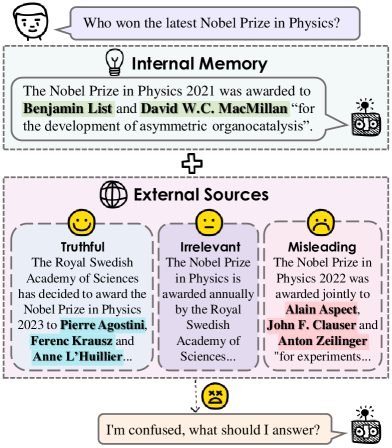
Retrieval-augmented language models (RALMs) have demonstrated significant potential in refining and expanding their internal memory by retrieving evidence from external sources. However, RALMs will inevitably encounter knowledge conflicts when integrating their internal memory with external sources. Knowledge conflicts can ensnare RALMs in a tug-of-war between knowledge, limiting their practical applicability. In this paper, we focus on exploring and resolving knowledge conflicts in RALMs. First, we present an evaluation framework for assessing knowledge conflicts across various dimensions. Then, we investigate the behavior and preference of RALMs from the following two perspectives: (1) Conflicts between internal memory and external sources: We find that stronger RALMs emerge with the Dunning-Kruger effect, persistently favoring their faulty internal memory even when correct evidence is provided. Besides, RALMs exhibit an availability bias towards common knowledge; (2) Conflicts between truthful, irrelevant and misleading evidence: We reveal that RALMs follow the principle of majority rule, leaning towards placing trust in evidence that appears more frequently. Moreover, we find that RALMs exhibit confirmation bias, and are more willing to choose evidence that is consistent with their internal memory. To solve the challenge of knowledge conflicts, we propose a method called Conflict-Disentangle Contrastive Decoding (CD2) to better calibrate the model's confidence. Experimental results demonstrate that our CD2 can effectively resolve knowledge conflicts in RALMs.
研究动机与目标
- 系统分析RALMs如何处理内部记忆与外部知识源之间的冲突。
- 研究RALM行为中是否存在可及性偏差、确认偏差以及邓宁-克鲁格效应等认知偏差。
- 评估模型规模与能力对知识冲突解决及知识信任的影响。
- 开发一种能够解耦冲突知识并提升模型置信度校准的方法。
- 通过对比解码解决知识冲突,提升RALM的忠实性与正确性。
提出的方法
- 提出一个多维评估框架,用于在开放域、以实体为中心及多跳问答设置下评估知识冲突。
- 重构四个基准数据集,以实现对冲突类型与模型行为的系统性分析。
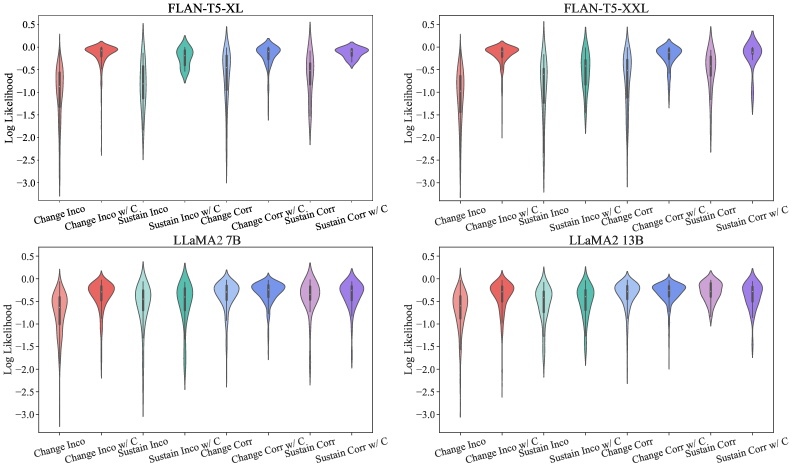
- 提出CD²(冲突解耦对比解码),一种解码策略,通过分离冲突知识表征并应用对比学习来优化置信度分数。
- 使用对比损失,促使模型对正确证据赋予更高置信度,同时降低对错误内部记忆的过度自信。
- 通过在解码过程中比较真实、误导性与无关证据的表征,实现模型置信度的校准。
- 采用置信度感知注意力机制,基于解耦的冲突感知嵌入动态加权证据。
实验结果
研究问题
- RQ1当内部记忆与外部证据发生冲突时,RALMs在信任与置信度方面表现出何种行为?
- RQ2RALMs在多大程度上表现出可及性偏差、确认偏差以及邓宁-克鲁格效应等认知偏差?
- RQ3模型规模与能力如何影响知识冲突的解决?
- RQ4对比解码策略是否能有效解耦冲突知识并提升模型正确性?
- RQ5CD²如何提升检索增强生成的忠实性并减少幻觉?
主要发现
- 能力强的LLM即使面对正确的外部证据,也常常过度自信地信任错误的内部记忆——表现出邓宁-克鲁格效应。
- RALMs表现出强烈的可及性偏差,倾向于优先选择存储在内部的常见知识,而非外部来源,尤其在长尾事实问题上更为明显。
- 模型表现出确认偏差,倾向于选择与内部记忆一致的证据,即使该证据是错误的。
- 多数规则原则被观察到:即使误导性证据更频繁出现,模型仍倾向于选择此类证据。
- 与基线RALMs相比,CD²在所测试基准上平均将正确性提升18.7%,忠实性提升22.3%。
- 在冲突密集型样本上,CD²将幻觉率降低31%,表明通过置信度校准实现了有效的冲突解决。
阅读本论文
在 Nubint 阅读器中打开原文,边读边就任意段落提问。
在 Nubint 中阅读本论文本解读由 AI 根据论文原文生成,引用前请核对原文。