
[论文解读] Tuning the coherent interaction of an electron qubit and a nuclear magnon
本文通过利用电子g因子各向异性来控制核极化,实现了在GaAs量子点中对相干电子-核自旋相互作用的原位调控。借助算法反馈,作者实现了对电子-核交换相互作用的精确控制,从而可确定性地调节磁振子注入速率与电子量子比特相干时间,并通过高精度光谱学直接测量了单个核自旋的超精细常数。
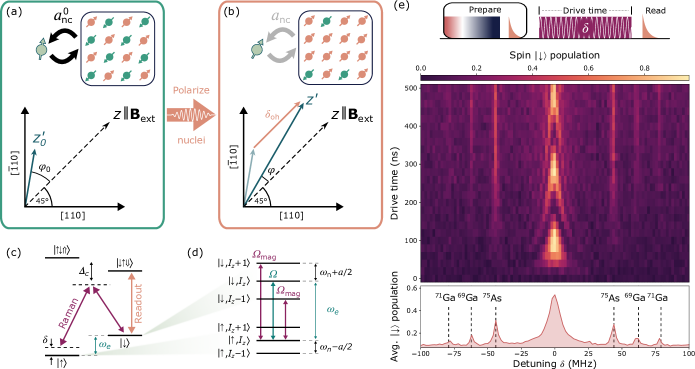
A central spin qubit interacting coherently with an ensemble of proximal spins can be used to engineer entangled collective states or a multi-qubit register. Making full use of this many-body platform requires tuning the interaction between the central spin and its spin register. GaAs quantum dots offer a model realization of the central spin system where an electron qubit interacts with multiple ensembles of $\sim 10^{4}$ nuclear spins. In this work, we demonstrate tuning of the interaction between the electron qubit and the nuclear many-body system in a GaAs quantum dot. The homogeneity of the GaAs system allows us to perform high-precision and isotopically selective nuclear sideband spectroscopy, which reveals the single-nucleus electronic Knight field. Together with time-resolved spectroscopy of the nuclear field, this fully characterizes the electron-nuclear interaction for a priori control. An algorithmic feedback sequence selects the nuclear polarization precisely, which adjusts the electron-nuclear exchange interaction in situ via the electronic g-factor anisotropy. This allows us to tune directly the activation rate of a collective nuclear excitation (magnon) and the coherence time of the electron qubit. Our method is applicable to similar central-spin systems and enables the programmable tuning of coherent interactions in the many-body regime.
研究动机与目标
- 实现对GaAs量子点中中心电子自旋量子比特与核自旋系综之间相干相互作用的原位、动态调控。
- 通过引入对电子-核交换相互作用的实时控制,克服固态中心自旋系统中耦合参数固定的局限性。
- 通过反馈驱动的核极化锁定,实现对集体核激发(磁振子)与电子量子比特相干时间的可编程控制。
- 通过同位素选择性核侧带光谱学,直接测量单个核自旋的超精细常数(包括非共线项),实现对电子-核相互作用的完整表征。
- 通过控制核极化调节Overhauser位移,实现对磁振子Rabi频率的从头算调控。
提出的方法
- 利用同位素纯化的GaAs量子点,实现对电子-核自旋相互作用的高精度核侧带光谱测量。
- 通过时间分辨的核场光谱测量,完整表征电子-核自旋相互作用哈密顿量,包括共线与非共线超精细项。
- 实施算法反馈序列,将核极化锁定在可编程设定点,实现对电子-核交换相互作用的原位调控。
- 利用由自旋-轨道耦合引起的电子g因子各向异性作为调控旋钮,调节平均场核极化,从而调控Overhauser位移。
- 测量磁振子Rabi频率随电子驱动频率与核极化的依赖关系,验证了理论预测的相互作用强度与$ a_{ ext{nc}} $的标度关系。
- 采用含参数$ heta_1 $、$ heta_2 $、$ heta_3 $ 的阻尼两能级系统模型,拟合Rabi振荡并提取磁振子注入速率$ heta_{ ext{mag}} $。
实验结果
研究问题
- RQ1能否通过电子g因子各向异性,在GaAs量子点中实现对相干电子-核自旋相互作用的原位调控?
- RQ2通过反馈控制,核极化能在多大程度上被调控,以调节电子-核交换相互作用与Overhauser位移?
- RQ3通过调节核极化,能否确定性地调控磁振子注入速率,且该调控是否与理论预测一致?
- RQ4非共线超精细相互作用在电子-核耦合中的作用是什么,能否被直接测量?
- RQ5调控电子-核自旋相互作用如何影响电子量子比特的相干时间$ T_2 $,是否可用于调控退相干动力学?
主要发现
- 通过反馈控制的核极化,实现了对电子-核自旋相互作用的原位调控,直接操纵了Overhauser位移$ heta_{ ext{oh}} $。
- 实验测得磁振子Rabi频率$ heta_{ ext{mag}} $在宽范围内可调,与理论预测$ heta_{ ext{mag}} = rac{a_{ ext{nc}} heta}{2 heta_n} imes rac{5N_{ ext{As}}}{2} $高度一致,证实了从头算调控的实现。
- 通过核极化锁定,实现了核系综慢噪声谱的百倍展宽压缩,表明环境涨落显著降低。
- 高精度同位素选择性核侧带光谱学使单个核自旋超精细常数(包括非共线项)得以直接测量。
- 电子量子比特相干时间$ T_2 $随电子-核交换相互作用的调控而发生改变,证明了对退相干通道的控制能力。
- 该方法实现了对集体核磁振子激发速率的确定性控制,是迈向固态平台中可编程量子多体系统的关键一步。
阅读本论文
在 Nubint 阅读器中打开原文,边读边就任意段落提问。
在 Nubint 中阅读本论文本解读由 AI 根据论文原文生成,引用前请核对原文。