
[论文解读] Two shell- and wing-shaped supernova remnants. Investigating the molecular environments around VRO 42.05.01 and G 350.0-2.0
本研究调查了两个混合形态超新星遗迹VRO 42.05.01和G 350.0-2.0的分子环境,这两个遗迹表现出极为相似的壳层-翅膀状射电形态。尽管形态相似,但CO观测显示仅VRO 42.05.01显示出与致密分子气体强烈相互作用的证据,而G 350.0-2.0则表现出极少的分子相互作用,表明壳层-翅膀形态并非主要由周围ISM密度梯度驱动,而可能源于前身恒星星风或内爆动力学。
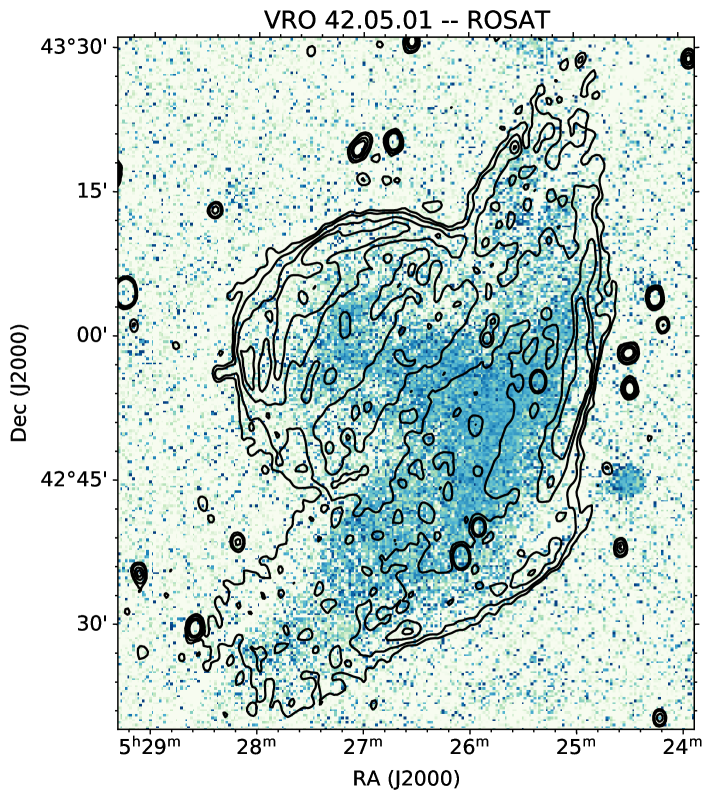
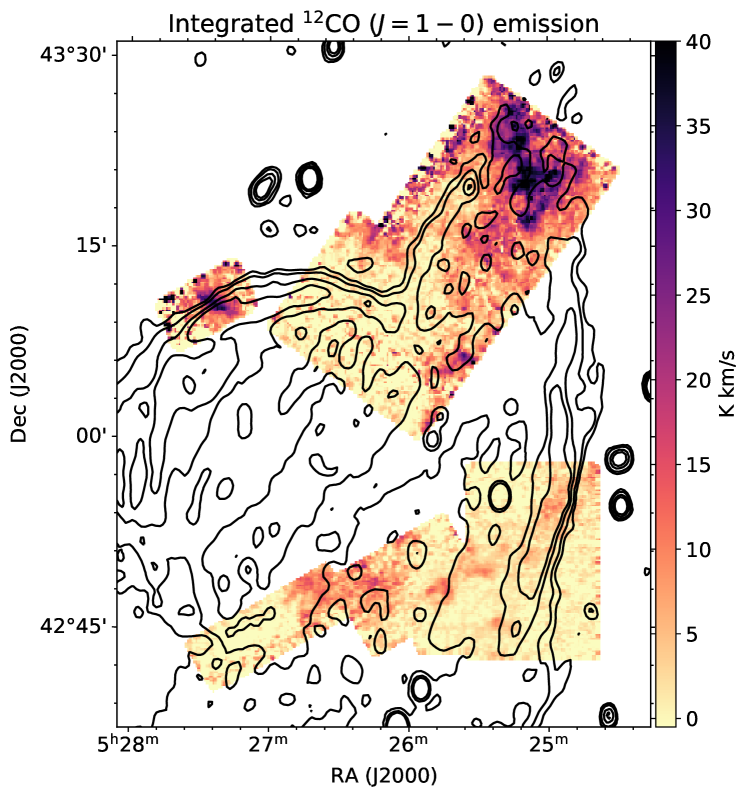
Supernova remnants (SNRs) are profoundly affected by their ambient medium. We present carbon monoxide (CO) observations around two mixed morphology SNRs, VRO 42.05.01 and G 350.0-2.0, that look remarkably similar in continuum radio emission, showing what we refer to as a shell and wing shape. It has been proposed that the shell and wing shape is the result of environmental effects, in the form of a sharp density gradient or discontinuity. Our motivation for studying these two sources jointly is that if the dense molecular environment causes the development of these sources' shell and wing shape, then these two sources' environments must be similar. This is contrary to what we observe. In the case of VRO 42.05.01, we have found direct evidence of an interaction with its molecular environment, in the form of broadened $^{12}$CO line profiles, high $(J=2-1)$ to $(J=1-0)$ line ratios, and arc features in position-velocity space. We interpret some of these features to be associated with the SNR shock, and some of them to be due to the presence of a pre-supernova stellar wind. We have found no such features in the abundant molecular gas surrounding G 350.0-2.0. We have also made a spectral index map of G 350.0-2.0, and we see that the radio spectrum of G 350.0-2.0 steepens significantly at frequencies $<200$~MHz, much like that of VRO 42.05.01. In spite of their spectral and morphological similarities, these two sources look substantially different in their optical and infrared emission. The lack of large-scale correspondence between the radio continuum and the molecular material, as well as the differences in the excitation and morphological properties of the molecular gas surrounding both sources, lead us to conclude that the shell and wing morphology of these two sources is not due to interactions with a similar ambient molecular ISM.
研究动机与目标
- 检验壳层-翅膀形态的混合形态超新星遗迹是否源于ISM中环境密度梯度的假设。
- 比较VRO 42.05.01和G 350.0-2.0这两个射电形态近乎相同的超新星遗迹的分子气体环境。
- 确定CO线中激波引起的分子激发和运动学特征是否与超新星遗迹形态相关。
- 评估两个超新星遗迹在光学、红外和射电发射形态上的差异是否表明其环境相互作用不同。
- 评估形态可能并非由外部ISM条件驱动,而是由前身恒星星风或内部爆炸动力学引起。
提出的方法
- 使用IRAM 30米望远镜对VRO 42.05.01进行12 CO (J=1-0)、12 CO (J=2-1)和13 CO (J=1-0)线观测,以探测分子气体的运动学和激发状态。
- 使用APEX望远镜对G 350.0-2.0进行12 CO (J=2-1)线观测,以评估其分子环境相互作用。
- 分析位置-速度图以识别激波气体、被扫积物质以及可能表明恒星风相互作用的特征。
- 计算12 CO (J=2-1)/(J=1-0)线强度比,以识别激发度升高的区域,这些区域表明存在激波加热。
- 利用档案的GLEAM和1.4 GHz射电连续谱数据,生成G 350.0-2.0的谱指数图,以研究低频射电谱行为。
- 比较两个超新星遗迹在光学、红外和射电发射方面的形态与光谱特性,以评估环境对应关系。
实验结果
研究问题
- RQ1VRO 42.05.01和G 350.0-2.0的壳层-翅膀形态是否由共同的周围分子ISM密度梯度引起?
- RQ2这些超新星遗迹周围的分子气体在多大程度上被超新星遗迹前导激波激波或压缩?
- RQ3CO线中是否存在表明与超新星爆发前恒星风相互作用的运动学或激发特征?
- RQ4G 350.0-2.0的低频射电谱特性与VRO 42.05.01相比如何?这对它们的辐射机制有何启示?
- RQ5为何两个形态相似的超新星遗迹在射电、光学和红外发射形态上表现出如此不同的对应关系?
主要发现
- VRO 42.05.01表现出展宽的12 CO线轮廓(Δv > 10 km s⁻¹)以及12 CO (J=2-1)/(J=1-0)线强度比超过1.8,表明分子气体受到激波加热和压缩。
- VRO 42.05.01的位置-速度图显示出弧状特征,可解释为超新星遗迹前导激波相互作用以及可能的前身恒星星风效应的证据。
- 尽管对G 350.0-2.0进行了广泛的CO观测,但未在其周围分子气体中检测到显著的激波或激发特征。
- G 350.0-2.0的射电谱指数从>200 MHz频率处的α ≈ -0.4变为88 MHz至200 MHz之间的α ≈ -0.7,与VRO 42.05.01相似。
- G 350.0-2.0的光学和红外发射在大尺度上与射电连续谱发射无形态对应关系,而VRO 42.05.01则存在这种对应。
- G 350.0-2.0缺乏分子相互作用,且环境形态存在差异,表明壳层-翅膀形态并非主要由周围ISM密度梯度引起。
阅读本论文
在 Nubint 阅读器中打开原文,边读边就任意段落提问。
在 Nubint 中阅读本论文本解读由 AI 根据论文原文生成,引用前请核对原文。