
[论文解读] Ultrabroadband thin-film lithium tantalate modulator for high-speed communications
本文展示了一款基于绝缘体上钽酸锂(LTOI)平台的110 GHz超宽带薄膜钽酸锂(LiTaO₃)马赫-曾德尔调制器,采用176 GBd的PAM8信号传输,实现了405 Gbit/s的净数据速率。该器件采用银电极以降低微波损耗,并展现出相较于铌酸锂器件更优的直流偏置稳定性,使LTOI成为高速、低功耗光通信中可扩展、低成本的替代方案。
The continuous growth of global data traffic over the past three decades, along with advances in disaggregated computing architectures, presents significant challenges for optical transceivers in communication networks and high-performance computing systems. Specifically, there is a growing need to significantly increase data rates while reducing energy consumption and cost. High-performance optical modulators based on materials such as InP, thin-film lithium niobate (LiNbO3), or plasmonics have been developed, with LiNbO3 excelling in high-speed and low-voltage modulation. Nonetheless, the widespread industrial adoption of thin film LiNbO3 remains compounded by the rather high cost of the underlying 'on insulator' substrates -- in sharp contrast to silicon photonics, which can benefit from strong synergies with high-volume applications in conventional microelectronics. Here, we demonstrate an integrated 110 GHz modulator using thin-film lithium tantalate (LiTaO3) -- a material platform that is already commercially used for millimeter-wave filters and that can hence build upon technological and economic synergies with existing high-volume applications to offer scalable low-cost manufacturing. We show that the LiTaO3 photonic integrated circuit based modulator can support 176 GBd PAM8 transmission at net data rates exceeding 400 Gbit/s. Moreover, we show that using silver electrodes can reduce microwave losses compared to previously employed gold electrodes. Our demonstration positions LiTaO3 modulator as a novel and highly promising integration platform for next-generation high-speed, energy-efficient, and cost-effective transceivers.
研究动机与目标
- 应对数据中心和通信网络中对更高数据速率、更低能耗和更低成本光收发器的日益增长需求。
- 克服薄膜铌酸锂(LNOI)调制器虽性能优异但基板成本过高而限制工业应用的障碍。
- 利用现有钽酸锂(LiTaO₃)毫米波滤波器的规模化制造生态系统,实现成本效益高、可扩展的光子集成电路。
- 通过改进电极与器件设计,在绝缘体上薄膜钽酸锂(LTOI)基板上实现高速、低损耗、稳定的电光调制器。
- 通过结合性能、稳定性与可制造性,确立LTOI作为下一代光收发器中LNOI与硅光子学的可行替代方案。
提出的方法
- 利用CMi与IPHYS洁净室设施,在绝缘体上钽酸锂(LTOI)基板上制备了薄膜钽酸锂(LiTaO₃)马赫-曾德尔调制器(MZM)。
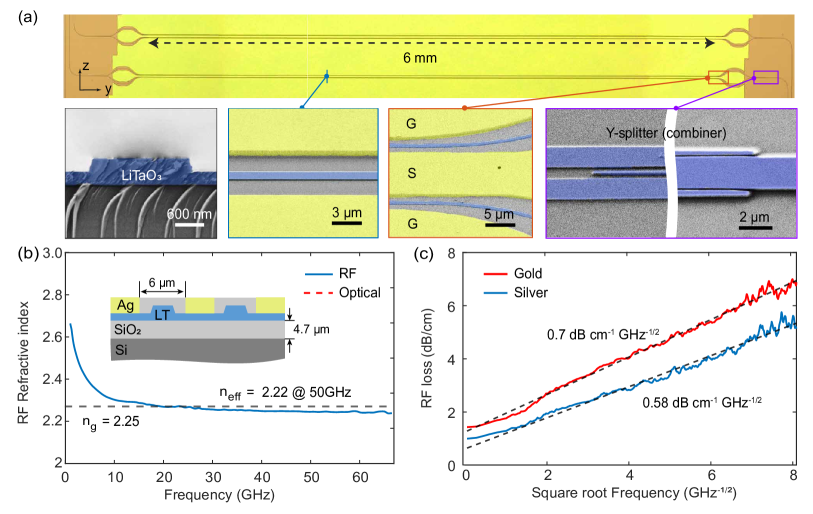
- 采用银电极替代金电极,以降低高频电信号路径中的微波传播损耗。
- 设计了接地-单-接地(GSG)电极结构,以提升阻抗匹配并减少高频下的信号失真。
- 采用Y型分束器与波导结构,实现MZM中高效的光功率分配与相位控制。
- 在符号速率高达176 GBd的条件下,开展强度调制直接检测(IMDD)传输实验,采用PAM信号(PAM2、PAM4、PAM8)。
- 通过对数似然比(LLR)与加性白高斯噪声(AWGN)信道建模,分析误码率(BER)、实现信息速率(AIR)与净数据速率(NDR)。
实验结果
研究问题
- RQ1基于LTOI平台的薄膜钽酸锂(LiTaO₃)调制器能否实现与先进LNOI器件相当的高带宽与低损耗?
- RQ2在LiTaO₃调制器中,将金电极替换为银电极是否能显著降低微波传播损耗?
- RQ3在高速运行条件下,LTOI调制器的直流偏置稳定性与LNOI调制器相比如何?
- RQ4采用先进信号处理技术,在基于LTOI的MZM上使用PAM信号可实现的最高净数据速率是多少?
- RQ5LTOI平台能否通过利用现有工业基础设施,实现高速光调制器的可扩展、低成本制造?
主要发现
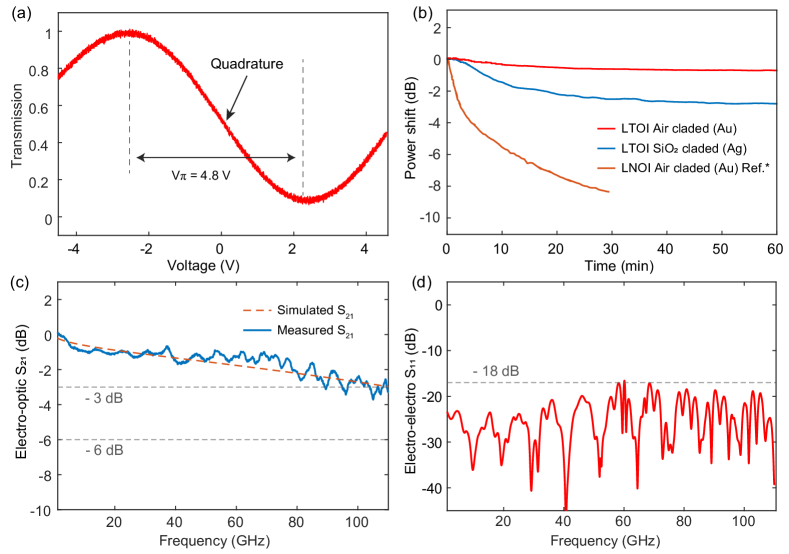
- 基于LTOI的MZM实现了110 GHz的电光3 dB带宽,支持适用于下一代光链路的高速运行。
- 采用银电极相比金电极降低了微波损耗,提升了高频下的信号完整性。
- 该器件表现出显著低于同类LNOI调制器的直流偏置漂移,增强了长期稳定性。
- 通过176 GBd的PAM8信号传输,实现了405 Gbit/s的净数据速率,误码率(BER)为3.8×10⁻²,仍低于25%软判决前向纠错(FEC)阈值。
- 实现的最高信息速率(AIR)达432 Gbit/s,展示了该平台在太比特级传输中的潜力。
- 结果表明,LTOI是LNOI与硅光子学的可扩展、低成本替代方案,凭借钽酸锂产业现有的制造协同优势,具有强大的工业应用前景。
阅读本论文
在 Nubint 阅读器中打开原文,边读边就任意段落提问。
在 Nubint 中阅读本论文本解读由 AI 根据论文原文生成,引用前请核对原文。