
[论文解读] UMD: Unsupervised Model Detection for X2X Backdoor Attacks
UMD 是首个针对 X2X 后门攻击的无监督模型检测方法——该攻击可将任意数量的源类别误分类为任意目标类别——通过联合推断对抗性(源,目标)类别对实现检测。它使用一种新颖的可迁移性统计量(TR)对潜在后门对进行聚类与选择,随后在聚合的触发器统计量上应用无监督异常检测,相较于 SOTA 方法在 CIFAR-10、GTSRB 和 Imagenette 上实现了 17–18% 的更高检测准确率。
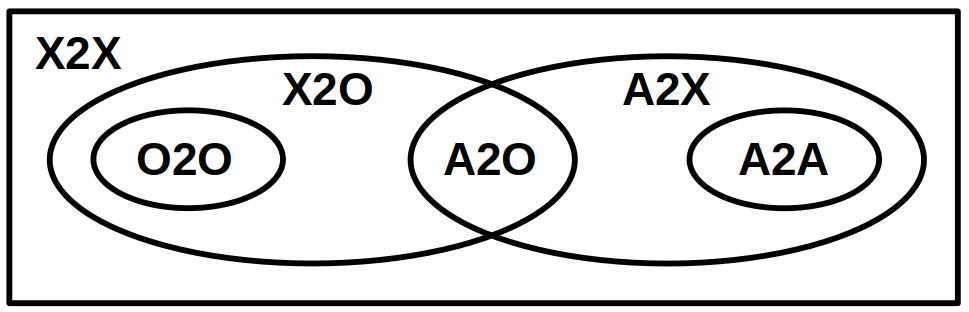
Backdoor (Trojan) attack is a common threat to deep neural networks, where samples from one or more source classes embedded with a backdoor trigger will be misclassified to adversarial target classes. Existing methods for detecting whether a classifier is backdoor attacked are mostly designed for attacks with a single adversarial target (e.g., all-to-one attack). To the best of our knowledge, without supervision, no existing methods can effectively address the more general X2X attack with an arbitrary number of source classes, each paired with an arbitrary target class. In this paper, we propose UMD, the first Unsupervised Model Detection method that effectively detects X2X backdoor attacks via a joint inference of the adversarial (source, target) class pairs. In particular, we first define a novel transferability statistic to measure and select a subset of putative backdoor class pairs based on a proposed clustering approach. Then, these selected class pairs are jointly assessed based on an aggregation of their reverse-engineered trigger size for detection inference, using a robust and unsupervised anomaly detector we proposed. We conduct comprehensive evaluations on CIFAR-10, GTSRB, and Imagenette dataset, and show that our unsupervised UMD outperforms SOTA detectors (even with supervision) by 17%, 4%, and 8%, respectively, in terms of the detection accuracy against diverse X2X attacks. We also show the strong detection performance of UMD against several strong adaptive attacks.
研究动机与目标
- 填补无监督检测 X2X 后门攻击的空白,此类攻击涉及任意数量的源类别与目标类别对。
- 克服现有检测器仅限于特定攻击类型(如全对一或一对一)的局限性。
- 实现在无训练数据、良性模型或攻击特定影子分类器的情况下进行检测。
- 开发一种对自适应和强后门攻击具有鲁棒性的方法,可规避先前检测机制。
提出的方法
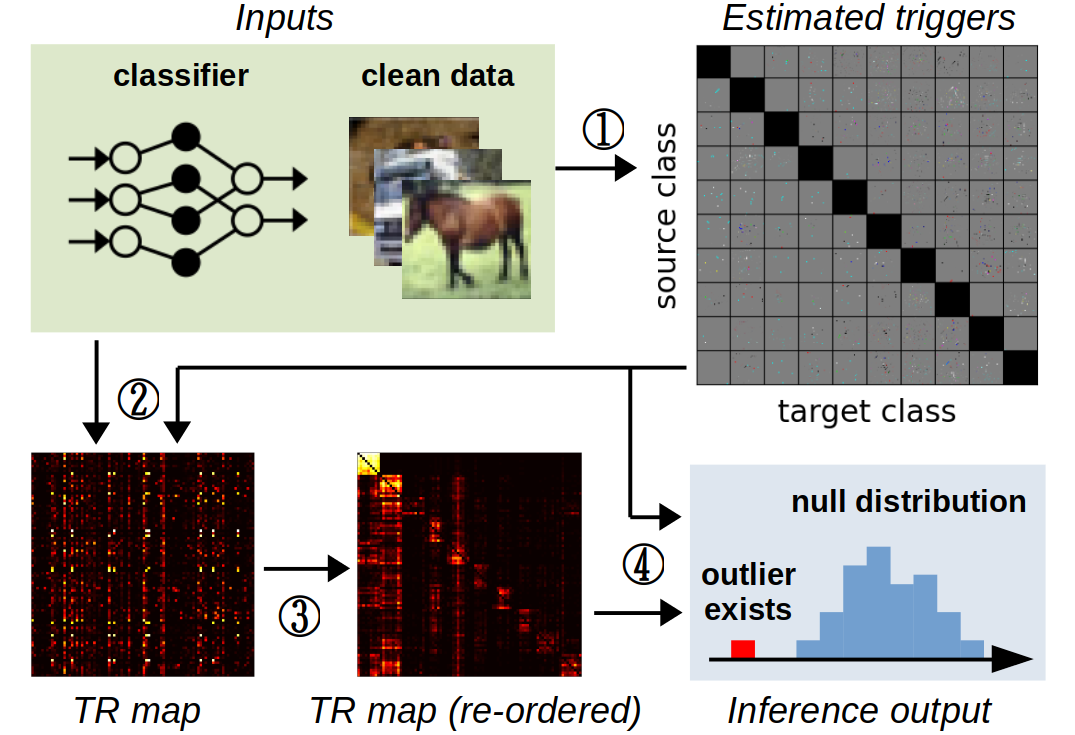
- 针对每个有序类别对 (i, j) 反向工程潜在触发器,以估计其对抗行为。
- 引入一种可迁移性统计量(TR),通过测量触发器向其他类别对的可迁移性,衡量某一类别对被后门攻击的可能性。
- 基于 TR 统计量构建一种新颖的聚类问题,以识别一组潜在的后门类别对。
- 对选定类别对上的聚合触发器统计量应用无监督、偏差减少的异常检测器,完成最终检测推理。
- 根据数据集中类别数量动态调整检测置信度阈值,以提升鲁棒性。
- 采用两阶段推理流水线:(1) 基于 TR 的聚类用于候选选择;(2) 在聚合的触发器特征上进行异常检测。
实验结果
研究问题
- RQ1无监督方法能否在无训练数据或影子模型访问的情况下,检测具有任意源类别与目标类别分配的 X2X 后门攻击?
- RQ2所提出的可迁移性统计量(TR)在区分真实后门类别对与非后门类别对方面效果如何?
- RQ3对 TR 统计量的聚类能否可靠地识别出参与 X2X 攻击的对抗性(源,目标)类别对集合?
- RQ4UMD 在面对可规避现有检测方法的强自适应后门攻击时表现如何?
- RQ5无监督异常检测组件是否能在多种数据集和攻击类型下保持高检测准确率?
主要发现
- UMD 在 CIFAR-10、GTSRB 和 Imagenette 上实现 100% 的模型推理准确率(MIA),相较于 SOTA 检测器在检测准确率上分别高出 17%、4% 和 8%。
- 在 CIFAR-10 上的 A2Ar(全对全)攻击中,UMD 实现 1.0 MIA 和 0.90 PDR,显著优于监督基线方法。
- 即使仅使用 1,500 张污染图像(PDR = 0.70),UMD 仍保持较强性能,尽管由于部分类别对的 ASR 较低,检测性能略有下降。
- 由于附带损害效应,UMD 能有效检测 O2O(一对一)攻击,即同一触发器导致非目标类别对也表现出高 ASR。
- 该方法对自适应攻击具有鲁棒性,在多种 X2X 攻击设置下性能无显著下降。
- 计算成本可接受,适用于离线检测,CIFAR-10 上每模型耗时约 0.3 小时,可通过优化技术进一步加速。
阅读本论文
在 Nubint 阅读器中打开原文,边读边就任意段落提问。
在 Nubint 中阅读本论文本解读由 AI 根据论文原文生成,引用前请核对原文。