
[论文解读] Uncertainty-Aware Reward-based Deep Reinforcement Learning for Intent Analysis of Social Media Information
本文提出了一种新颖的不确定性感知深度强化学习(DRL)框架,用于社交媒体虚假新闻中的意图分类,采用基于主观逻辑的奖励机制来优化推文中的词语选择。通过将空缺度(vacuity)和不和谐度(dissonance)不确定性度量整合到策略梯度(REINFORCE)智能体中,该模型在将输入序列长度减少高达30%的同时,实现了97%的多分类准确率,显著提升了效率与预测有效性。
Due to various and serious adverse impacts of spreading fake news, it is often known that only people with malicious intent would propagate fake news. However, it is not necessarily true based on social science studies. Distinguishing the types of fake news spreaders based on their intent is critical because it will effectively guide how to intervene to mitigate the spread of fake news with different approaches. To this end, we propose an intent classification framework that can best identify the correct intent of fake news. We will leverage deep reinforcement learning (DRL) that can optimize the structural representation of each tweet by removing noisy words from the input sequence when appending an actor to the long short-term memory (LSTM) intent classifier. Policy gradient DRL model (e.g., REINFORCE) can lead the actor to a higher delayed reward. We also devise a new uncertainty-aware immediate reward using a subjective opinion that can explicitly deal with multidimensional uncertainty for effective decision-making. Via 600K training episodes from a fake news tweets dataset with an annotated intent class, we evaluate the performance of uncertainty-aware reward in DRL. Evaluation results demonstrate that our proposed framework efficiently reduces the number of selected words to maintain a high 95\% multi-class accuracy.
研究动机与目标
- 为解决社交科学研究表明许多人无意中分享虚假内容这一挑战,识别虚假新闻传播背后的恶意与非恶意意图。
- 通过优化文本结构表示中的词语选择,提升虚假新闻检测中的意图分类性能。
- 在保持高分类准确率的同时,减少对推文中噪声性、无关词汇的依赖。
- 引入一种多维不确定性感知奖励机制,以增强DRL智能体在实时场景下的决策能力。
提出的方法
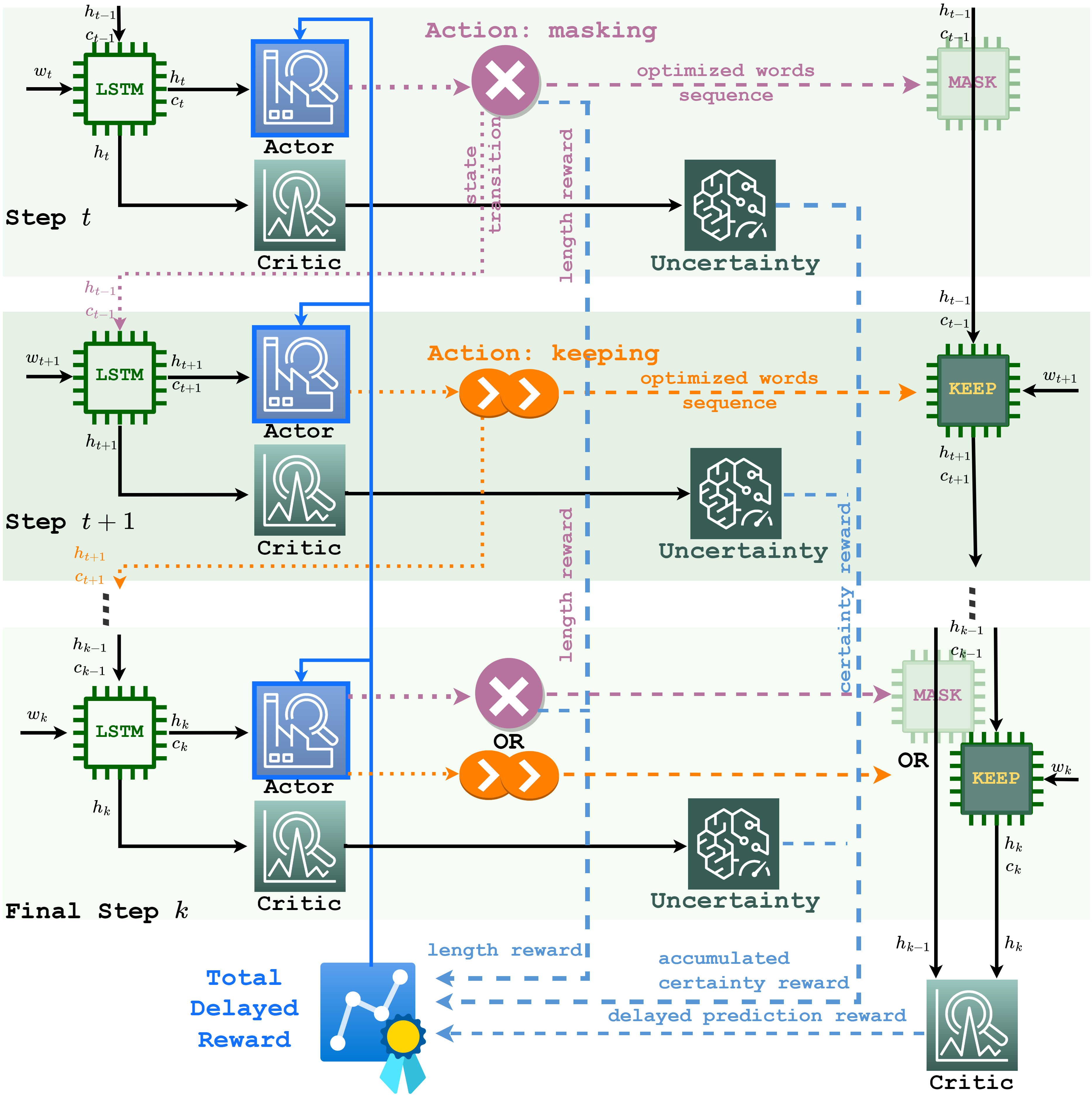
- 使用REINFORCE策略梯度算法训练DRL智能体,作为词语选择器,从输入推文中移除非必要标记。
- 基于主观逻辑设计不确定性感知的即时奖励,结合空缺度与不和谐度,量化预测中的信念不确定性。
- 通过带有超参数λ的加权和,使奖励函数在预测准确率(与真实类别匹配)和序列长度减少之间取得平衡。
- 使用DRL优化后的序列微调基于LSTM的意图分类器,智能体学习最大化延迟总奖励。
- 该框架评估了四种变体:标准DRL、使用确定性奖励的DRL(DRL-CV),以及使用不和谐度奖励的DRL(DRL-CD),每种变体均采用不同的λ与β值。
- 人工标注者将60万条推文划分为五种类别:信息分享、政治宣传、社交互动、谣言传播与娱乐。
实验结果
研究问题
- RQ1基于DRL的词语选择机制是否能在减少虚假新闻推文输入序列长度的同时,提升意图分类准确率?
- RQ2多维不确定性度量(空缺度与不和谐度)如何增强DRL智能体在意图分类中的有效性与效率?
- RQ3与标准DRL相比,引入不确定性感知奖励是否能提升模型在预测多样化意图类别时的泛化能力与鲁棒性?
- RQ4不确定性感知奖励在不降低多分类准确率的前提下,能在多大程度上减少所选词语数量?
- RQ5DRL智能体在不同意图类别上的表现如何,特别是在低资源或模糊情境下?
主要发现
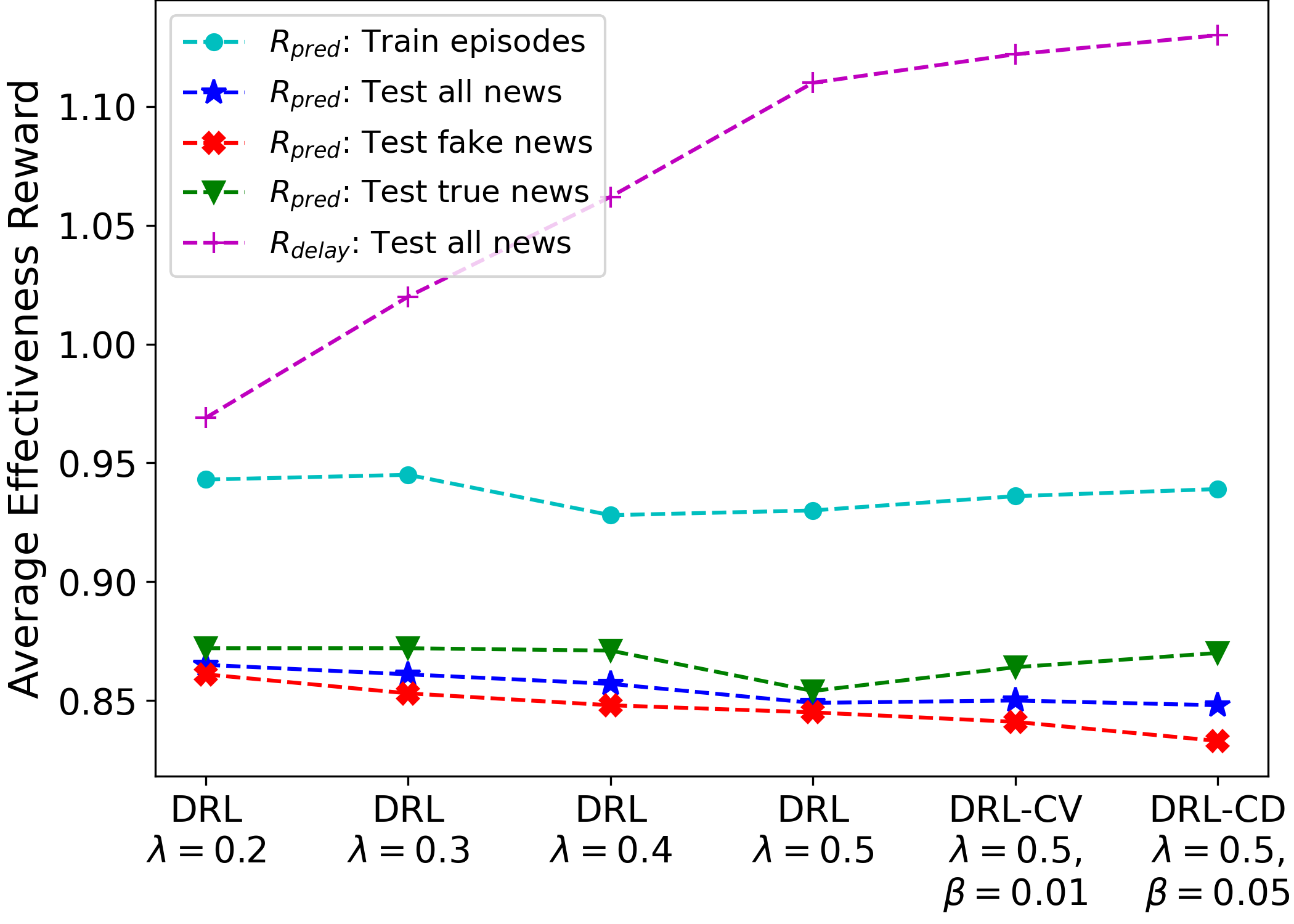
- 所提出的DRL-CV与DRL-CD模型在测试集上实现了97.0%的多分类准确率,显著优于基线LSTM模型(86.0%)。
- DRL-CV与DRL-CD模型在保持95%准确率的同时,将所选词语数量减少了高达30%,证明了其效率优势。
- 不确定性感知奖励机制提升了真实新闻预测的有效性,尤其显著改善了‘政治宣传’与‘信息分享’类别的F1分数。
- 在λ=0.5与β=0.05条件下,DRL-CD模型在测试集上获得了最高的总延迟奖励(0.983),表明其在准确率与序列长度之间实现了更优的优化。
- 该框架将虚假新闻的测试序列长度平均减少了25%,真实新闻减少了20%,且准确率损失极小,证明了不确定性引导剪枝的高效性。
- 在奖励函数中引入空缺度与不和谐度,使智能体能够探索更短但更具信息量的序列,从而获得更高的总奖励并实现更好的泛化能力。
阅读本论文
在 Nubint 阅读器中打开原文,边读边就任意段落提问。
在 Nubint 中阅读本论文本解读由 AI 根据论文原文生成,引用前请核对原文。