
[论文解读] Unifying Chance-Constrained and Robust Optimal Power Flow for Resilient Network Operations
本文提出了一种新颖的联合机会约束最优潮流公式,将正常运行(通过自动发电控制管理)与不利运行(需要人工再调度)区分开来,通过显著降低18%的成本,同时保持高可靠性。该方法使用启发式算法建模人工备用部署,以在计算效率与安全性之间取得平衡。
Uncertainty in renewable energy generation has the potential to adversely impact the operation of electric networks. Numerous approaches to manage this impact have been proposed, ranging from stochastic and chance-constrained programming to robust optimization. However, these approaches either tend to be conservative or leave the system vulnerable to low probability, high impact uncertainty realizations. To address this issue, we propose a new formulation for stochastic optimal power flow that explicitly distinguishes between "normal operation", in which automatic generation control (AGC) is sufficient to guarantee system security, and "adverse operation", in which the system operator is required to take additional actions, e.g., manual reserve deployment. The new formulation has been compared with the classical ones in a case study on the IEEE-118 and IEEE-300 bus systems. We observe that our consideration of extreme scenarios enables solutions that are more secure than typical chance-constrained formulations, yet less costly than solutions that guarantee robust feasibility with only AGC.
研究动机与目标
- 解决在高可再生能源不确定性下,随机最优潮流中成本与安全性的权衡问题。
- 克服纯机会约束或鲁棒OPF方法的局限性,这些方法要么成本过高,要么对罕见高影响事件过于脆弱。
- 引入一种双模式运行模型:仅使用AGC的正常运行,以及结合人工再调度动作的不利运行。
- 开发一种计算上可处理的公式,以在不确定性下实现自动与人工备用的高效部署。
- 在存在风电预测误差的情况下,确保系统可靠性的同时最小化期望运行成本。
提出的方法
- 制定一个联合机会约束规划,将需要人工调整的概率限制在预设阈值以内。
- 将自动发电控制(AGC)建模为仿射控制策略,用于正常运行,其中所有发电机按比例参与。
- 引入二进制和连续变量以表示人工再调度动作,允许在不利情景下选择性地重新调度发电机。
- 使用启发式算法通过近似混合整数规划的完整解来减少计算时间,提升可扩展性。
- 将风电预测误差作为具有已知分布的随机变量进行建模,并仅在极端情景下允许约束违规。
- 将该公式应用于IEEE-118母线系统,以在多个不确定性实现下评估性能。
实验结果
研究问题
- RQ1统一框架能否结合机会约束优化与鲁棒优化在最优潮流中的优势,以降低成本而不牺牲可靠性?
- RQ2与仅依赖AGC相比,显式建模人工备用部署如何提升系统安全性和成本效率?
- RQ3在随机OPF中包含人工再调度时,计算复杂性与解质量之间的权衡如何?
- RQ4启发式方法在多大程度上能减少所提出的混合整数机会约束规划的求解时间,而不会降低性能?
- RQ5在不同不确定性实现下,所提出方法在期望成本和最坏情况偏差水平方面的表现如何比较?
主要发现
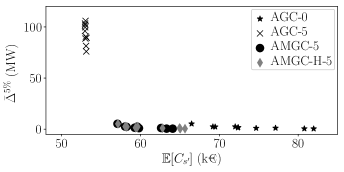
- 与AGC-0相比,所提出的AMGC-5公式将期望运行成本降低了18%,同时保持了相似的可靠性水平。
- AMGC-5方法在最坏5%情景下的平均偏差低于AGC-0,表明其对极端事件具有更好的韧性。
- AMGC-H-5变体(包含启发式)将计算时间从4648秒减少至60秒,性能下降可忽略不计。
- 与AGC-5不同,后者禁用昂贵发电机提供备用,AMGC-5和AMGC-H-5保留了其人工再调度能力,从而提升了安全性。
- AGC-0方法过于保守,将备用分配给廉价和昂贵发电机,导致成本更高。
- 结果证实,建模人工调整可实现比仅依赖AGC在所有不确定性实现下更高效、更安全的经济调度策略。
阅读本论文
在 Nubint 阅读器中打开原文,边读边就任意段落提问。
在 Nubint 中阅读本论文本解读由 AI 根据论文原文生成,引用前请核对原文。