
[论文解读] Universal Few-shot Learning of Dense Prediction Tasks with Visual Token Matching
本文提出视觉标记匹配(Visual Token Matching, VTM),一种用于密集预测任务的通用少样本学习框架,通过在图像和标签嵌入的补丁级上进行非参数匹配实现。该方法仅使用10个标注样本(全监督数据的0.004%)即达到具有竞争力的性能,在语义分割和深度估计等多样化密集预测任务中,通常优于全监督基线模型。
Dense prediction tasks are a fundamental class of problems in computer vision. As supervised methods suffer from high pixel-wise labeling cost, a few-shot learning solution that can learn any dense task from a few labeled images is desired. Yet, current few-shot learning methods target a restricted set of tasks such as semantic segmentation, presumably due to challenges in designing a general and unified model that is able to flexibly and efficiently adapt to arbitrary tasks of unseen semantics. We propose Visual Token Matching (VTM), a universal few-shot learner for arbitrary dense prediction tasks. It employs non-parametric matching on patch-level embedded tokens of images and labels that encapsulates all tasks. Also, VTM flexibly adapts to any task with a tiny amount of task-specific parameters that modulate the matching algorithm. We implement VTM as a powerful hierarchical encoder-decoder architecture involving ViT backbones where token matching is performed at multiple feature hierarchies. We experiment VTM on a challenging variant of Taskonomy dataset and observe that it robustly few-shot learns various unseen dense prediction tasks. Surprisingly, it is competitive with fully supervised baselines using only 10 labeled examples of novel tasks (0.004% of full supervision) and sometimes outperforms using 0.1% of full supervision. Codes are available at https://github.com/GitGyun/visual_token_matching.
研究动机与目标
- 解决计算机视觉中任意密集预测任务缺乏统一少样本学习框架的问题。
- 通过在少量标注数据下实现跨多样化任务的少样本泛化,降低像素级标注的高昂成本。
- 设计一种保持统一架构的同时,仅使用极少任务特定参数即可灵活适应未见任务的模型。
- 实现在语义分割、深度估计和表面法线预测等多样化密集预测任务上的鲁棒少样本泛化能力。
- 证明单一统一模型可仅使用远少于全监督所需标注样本的数量,实现与全监督基线模型相当的性能。
提出的方法
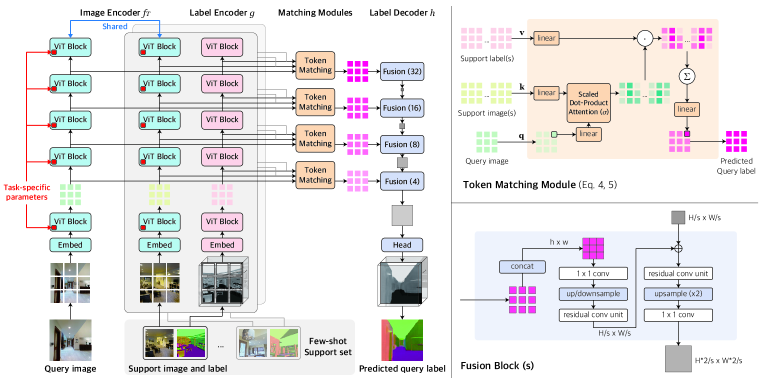
- 使用视觉变换器(Vision Transformer, ViT)编码器将输入图像和标签表示为可学习的补丁级标记。
- 基于其嵌入表示的相似性,在图像和标签标记之间执行非参数匹配。
- 引入一组少量任务特定参数以调节匹配机制,实现对未见任务语义的灵活适应。
- 采用分层编码器-解码器架构,利用自注意力机制实现多尺度特征匹配。
- 使用卷积解码器从匹配的标记特征中重建密集预测结果,以保持空间结构。
- 采用元学习中的任务周期训练方式,每个周期模拟一个具有少量标注支持图像的新任务。
实验结果
研究问题
- RQ1单一统一模型是否能仅使用少量标注样本即泛化到任意密集预测任务?
- RQ2与全监督基线相比,非参数视觉标记匹配在少样本密集预测中的有效性如何?
- RQ3支持集大小对多样化任务上少样本性能的影响如何?
- RQ4模型对支持集图像选择的差异有多大的鲁棒性?
- RQ5元训练数据量如何影响模型的少样本泛化能力?
主要发现
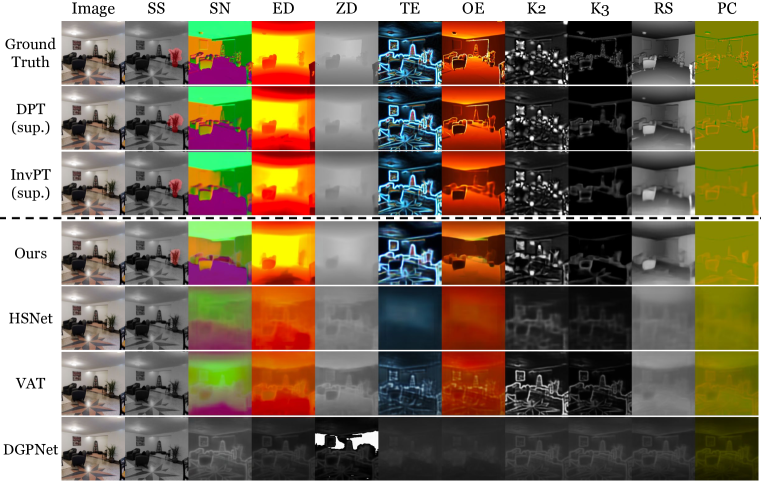
- VTM 仅需每项任务10个标注样本(全监督数据的0.004%)即可达到具有竞争力的性能,通常优于全监督基线模型。
- 当使用275个标注样本(全监督数据的0.1%)时,VTM 在多个密集预测任务上的性能超越或匹配全监督模型。
- 模型在不同随机采样的支持集上表现出微小的性能波动,表明对支持集选择具有鲁棒性。
- 随着元训练任务数量的增加,性能持续提升,表明在预训练阶段接触多样化任务具有显著优势。
- 即使在部分任务标注不完整的数据集上进行训练,模型仍能良好泛化,展现出实际应用中的鲁棒性。
- 注意力图显示,VTM 能够根据任务需求灵活调整其相似性关注区域(例如,语义分割关注物体,表面法线预测关注平面)。
阅读本论文
在 Nubint 阅读器中打开原文,边读边就任意段落提问。
在 Nubint 中阅读本论文本解读由 AI 根据论文原文生成,引用前请核对原文。