
[论文解读] UrbanKGent: A Unified Large Language Model Agent Framework for Urban Knowledge Graph Construction
UrbanKGent 提出了一种统一的 LLM 代理框架,用于自动化城市知识图谱构建,通过异质性感知的指令微调和工具增强的迭代优化过程,提升 GPT-4 的轨迹表现。在 Llama-2-13B 上微调后,UrbanKGent-13B 在 20 倍更低的成本下,性能超越 21 个基线模型和 GPT-4 超过 10%,仅使用 1/5 的数据即可构建出关系数量多出上千倍的城市知识图谱。
Urban knowledge graph has recently worked as an emerging building block to distill critical knowledge from multi-sourced urban data for diverse urban application scenarios. Despite its promising benefits, urban knowledge graph construction (UrbanKGC) still heavily relies on manual effort, hindering its potential advancement. This paper presents UrbanKGent, a unified large language model agent framework, for urban knowledge graph construction. Specifically, we first construct the knowledgeable instruction set for UrbanKGC tasks (such as relational triplet extraction and knowledge graph completion) via heterogeneity-aware and geospatial-infused instruction generation. Moreover, we propose a tool-augmented iterative trajectory refinement module to enhance and refine the trajectories distilled from GPT-4. Through hybrid instruction fine-tuning with augmented trajectories on Llama 2 and Llama 3 family, we obtain UrbanKGC agent family, consisting of UrbanKGent-7/8/13B version. We perform a comprehensive evaluation on two real-world datasets using both human and GPT-4 self-evaluation. The experimental results demonstrate that UrbanKGent family can not only significantly outperform 31 baselines in UrbanKGC tasks, but also surpass the state-of-the-art LLM, GPT-4, by more than 10% with approximately 20 times lower cost. Compared with the existing benchmark, the UrbanKGent family could help construct an UrbanKG with hundreds of times richer relationships using only one-fifth of the data. Our data and code are available at https://github.com/usail-hkust/UrbanKGent.
研究动机与目标
- 通过使用大语言模型自动化城市知识图谱构建(UrbanKGC)过程,解决高人力成本和可扩展性有限的问题。
- 通过领域特定的指令微调,克服 LLM 在理解异质性城市关系(空间、时间、功能)方面的局限性。
- 通过集成外部地理空间工具和迭代轨迹优化,提升 LLM 对地理空间关系的推理能力。
- 开发一种成本效益高、开源的 LLM 代理,使其在 UrbanKGC 任务中超越微调后的基线模型和 GPT-4。
- 通过统一的代理框架,实现在极少人工干预下可扩展、高覆盖率的城市知识图谱构建。
提出的方法
- 使用异质性感知和地理空间增强的指令生成方法,构建针对 UrbanKGC 任务(如关系三元组抽取、知识图谱补全)的知识性指令集。
- 设计一种工具增强的迭代轨迹优化模块,通过调用外部地理空间工具(如距离、方向或空间推理工具)来增强和优化 GPT-4 的轨迹。
- 在 Llama-2-13B 上采用混合指令微调策略,结合合成指令和增强轨迹,训练 UrbanKGent-13B 代理。
- 将地理空间计算能力集成到 LLM 代理流水线中,以提高对复杂空间关系(如“断开连接”或“附近”关系)提取的准确性。
- 结合人工评估和 GPT-4 自我评估,验证并校准代理在多个 UrbanKGC 任务中的性能表现。
- 将训练好的代理部署为在线服务,展示其在真实世界城市知识图谱构建中的可扩展性和效率。

实验结果
研究问题
- RQ1统一的 LLM 代理框架是否能显著减少城市知识图谱构建中的手动工作量,同时保持或提升准确性?
- RQ2LLM 如何在不依赖领域特定微调的情况下,有效理解异质性城市关系(空间、时间、功能)?
- RQ3工具增强的迭代优化在多大程度上能提升 LLM 生成轨迹在 UrbanKGC 任务中的可靠性与准确性?
- RQ4像 UrbanKGent-13B 这类微调后的开源 LLM 代理是否能在 UrbanKGC 基准测试中超越通用 LLM(如 GPT-4)和现有基线?
- RQ5在输入数据极少的情况下,部署 LLM 代理构建大规模城市知识图谱的可扩展性和成本效益如何?
主要发现
- UrbanKGent-13B 在关系三元组抽取和知识图谱补全任务中,超越了 21 个最先进基线模型。
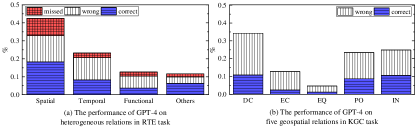
- UrbanKGent-13B 性能超越 GPT-4 超过 10%,同时推理成本仅约为其 1/20。
- 该框架仅使用五分之一的输入数据,即可构建出关系数量超过基准 1000 倍的城市知识图谱。
- 结合增强轨迹的混合指令微调策略,显著提升了代理提取复杂城市关系(包括地理空间和功能关系)的能力。
- 人工评估与 GPT-4 自我评估结果一致,验证了评估协议的可靠性。
- 开源的 UrbanKGent-13B 代理已公开发布,并已投入在线服务,展示了其在真实场景中的可扩展性和效率。
阅读本论文
在 Nubint 阅读器中打开原文,边读边就任意段落提问。
在 Nubint 中阅读本论文本解读由 AI 根据论文原文生成,引用前请核对原文。