
[论文解读] Valuing Distributed Energy Resources for Non-Wires Alternatives
本文提出了一种双层优化框架,通过确定最优的协同设计价格信号,激励分布式能源资源(DER)投资,同时最小化系统运营商成本。通过将DER投资者的预期回报与系统效率对齐,该框架减少了对传统升级的需求,降低了资本和运营成本,并在20年内相比传统升级方案实现了近300万美元的净现值节省。
Distributed energy resources (DER) as non-wires alternatives, regardless of owner, have the potential to reduce system operating costs and delay system upgrades. However, it is difficult to determine the appropriate economic signal to incentivize DER investors to install capacity that will benefit both the DER investors and the system operator. In an attempt to determine this co-optimal price signal, we present a bilevel optimization framework for determining the least cost solution to distribution system over-loads. A key output of the framework is a spatiotemporal price signal to DER owners that simultaneously guarantees the DER owners' required rate of return and minimizes the system operation costs. The framework is demonstrated with a case by which the system operator considers utility owned battery energy storage systems, traditional system upgrades, and energy purchase from DER owners. The results show that by valuing DER for non-wires alternatives the utility owned storage system sizes can be reduced, less hardware upgrades are necessary, and upfront capital costs as well as operating costs are reduced.
研究动机与目标
- 解决配电系统运营商(DSOs)与分布式能源资源(DER)投资者在非线路替代方案中激励对齐的挑战。
- 开发一种经济信号,确保DER投资者实现其要求的回报率,同时最小化总系统运行成本。
- 展示将DER视为非线路替代方案如何减少对传统基础设施升级的依赖,并降低全生命周期成本。
提出的方法
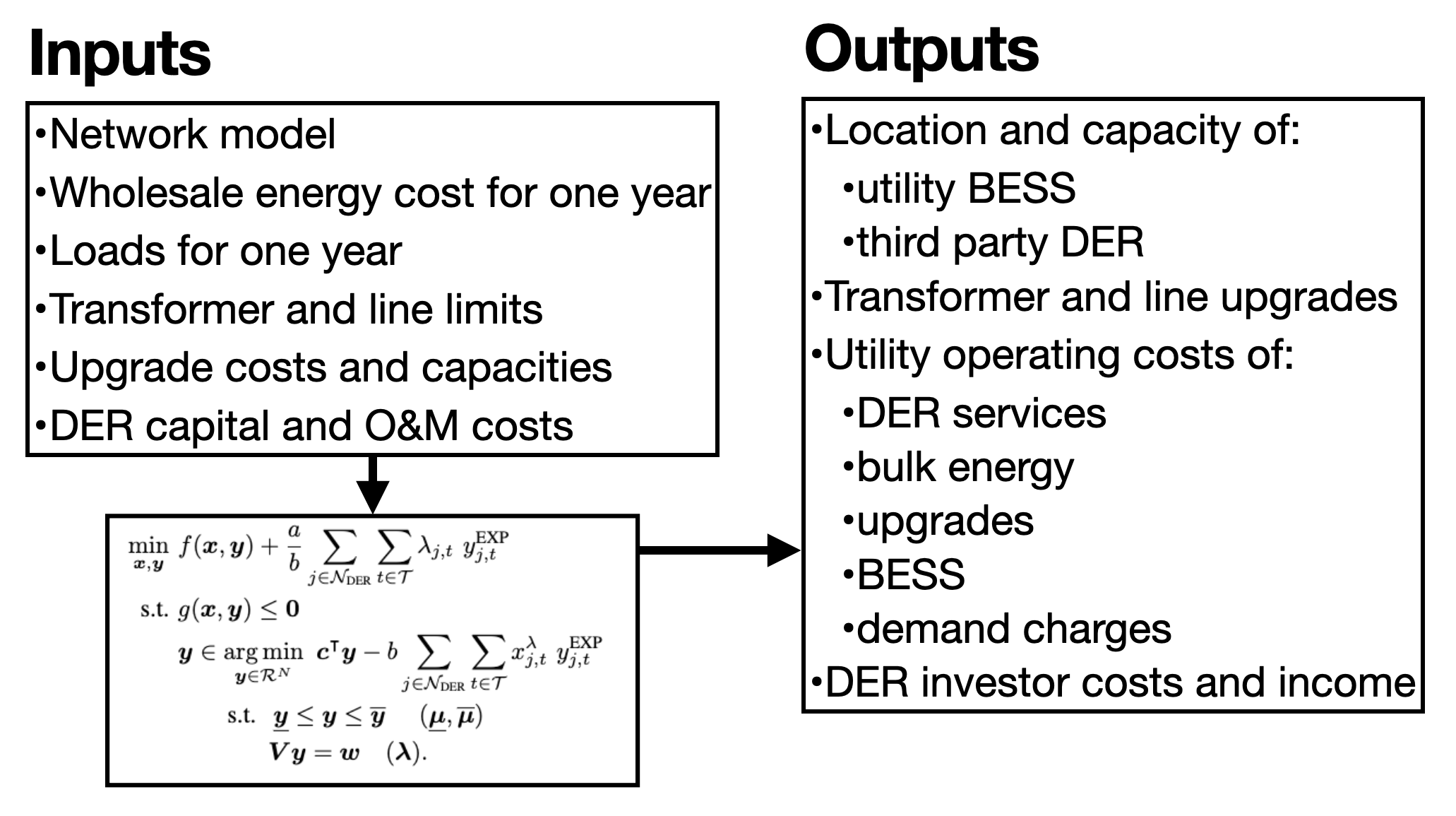
- 该框架采用双层优化结构:上层最小化系统成本,包括DER投资和升级成本;下层确保DER投资者实现其要求的回报率。
- 上层包括配电公司拥有电池储能、变压器和线路升级,以及从DER所有者购买电能的决策。
- 下层对DER投资者行为进行建模,最大化其净现值,同时满足技术约束和潮流限制。
- 该框架整合了反映节点位置价值和配电网络节点间随时间变化的电能流动的空间-时间价格信号。
- 下层使用线性规划,上层使用混合整数规划,包含用于设备升级决策的二进制变量。
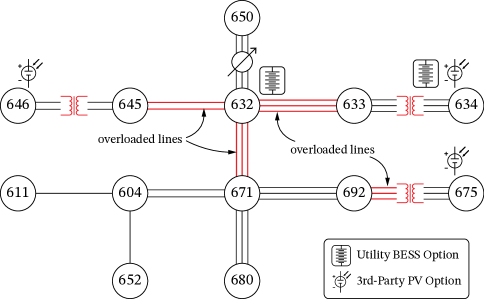
- 该模型在包含123个母线的真实配电馈线系统上进行了测试,整合了光伏系统、电池储能以及到2040年的负荷增长预测。
实验结果
研究问题
- RQ1如何设计一种协同最优价格信号,以同时满足DER投资者的预期回报率并最小化系统运行成本?
- RQ2将DER视为非线路替代方案对传统配电升级需求有何影响?
- RQ3与仅依赖配电公司拥有储能相比,纳入第三方DER投资在全生命周期成本节约方面有何差异?
- RQ4在电气化程度不断提高和负荷增长的背景下,该框架在多大程度上可减少配电系统的资本和运营支出?
主要发现
- 该框架减少了对传统基础设施升级的需求,在测试案例中避免了对大多数过载元件的升级。
- 通过将DER视为非线路替代方案,与传统升级路径相比,系统在20年内实现了近300万美元的净现值节省。
- 通过协同最优价格信号实现的第三方DER投资,相比仅使用配电公司拥有电池的场景,额外实现了约100万美元的净现值节省。
- 无论是否采用价格信号,DER投资者的净现值成本均保持不变(279万美元),证实其要求的回报率在两种情况下均得到满足。
- 价格信号支持更大规模的DER安装(在母线675处最高达550千瓦),通过电能销售和节省抵消更高的资本成本,从而提升系统效率。
- 尽管计算复杂,该双层模型在标准笔记本电脑上一小时内求解的最优性间隙小于2%,表明其具有实际可行性。
阅读本论文
在 Nubint 阅读器中打开原文,边读边就任意段落提问。
在 Nubint 中阅读本论文本解读由 AI 根据论文原文生成,引用前请核对原文。