
[论文解读] Video ControlNet: Towards Temporally Consistent Synthetic-to-Real Video Translation Using Conditional Image Diffusion Models
本文提出 Video ControlNet,一种无需训练的时序一致的合成到真实视频翻译方法,利用现成的条件图像扩散模型。通过利用光流在帧间联合优化噪声,该方法在无需微调的情况下实现了高视觉质量和时序一致性,其在指标和定性评估中均优于现有基线模型。
In this study, we present an efficient and effective approach for achieving temporally consistent synthetic-to-real video translation in videos of varying lengths. Our method leverages off-the-shelf conditional image diffusion models, allowing us to perform multiple synthetic-to-real image generations in parallel. By utilizing the available optical flow information from the synthetic videos, our approach seamlessly enforces temporal consistency among corresponding pixels across frames. This is achieved through joint noise optimization, effectively minimizing spatial and temporal discrepancies. To the best of our knowledge, our proposed method is the first to accomplish diverse and temporally consistent synthetic-to-real video translation using conditional image diffusion models. Furthermore, our approach does not require any training or fine-tuning of the diffusion models. Extensive experiments conducted on various benchmarks for synthetic-to-real video translation demonstrate the effectiveness of our approach, both quantitatively and qualitatively. Finally, we show that our method outperforms other baseline methods in terms of both temporal consistency and visual quality.
研究动机与目标
- 解决使用条件图像扩散模型进行视频生成时的时序不一致性问题,此类问题常导致闪烁和跳动伪影。
- 实现在无需微调或训练预训练扩散模型的前提下,实现高保真度的合成到真实视频翻译。
- 开发一种方法,利用现有的合成视频资产——特别是光流——来在帧之间实现时序一致性。
- 提供一种可扩展、高效的解决方案,兼容大规模预训练文本到图像扩散模型,适用于多样化的视频翻译任务。
提出的方法
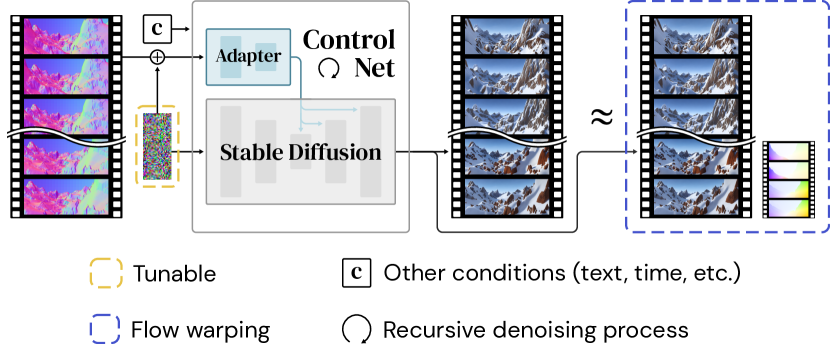
- 该方法使用现成的条件图像扩散模型(如带有 ControlNet 的 Stable Diffusion)基于合成输入生成视频帧。
- 其将问题建模为一个约束优化问题,通过联合优化连续帧之间的初始噪声潜在变量,以最小化空间和时间上的差异。
- 利用合成视频中的光流场建立帧间的像素级对应关系,从而实现时序一致性的强制约束。
- 优化过程利用了预训练扩散模型在文本提示和低级控制信号(如深度图、法线图)条件下的高质量图像生成能力。
- 应用了诸如减少采样步数的迭代细化和光流引导初始化等加速技术,以提升推理速度。
- 该方法完全避免了对扩散模型的微调或再训练,仅依赖推理阶段的优化。
实验结果
研究问题
- RQ1能否在不微调的前提下,有效适配现成的条件图像扩散模型,实现时序一致的视频翻译?
- RQ2如何利用合成视频中的光流信息,在基于扩散模型的视频生成中实现时序一致性?
- RQ3在帧间联合优化噪声对视觉质量和闪烁减少的影响如何?
- RQ4与基于训练的视频扩散模型相比,该方法在性能和效率方面表现如何?
主要发现
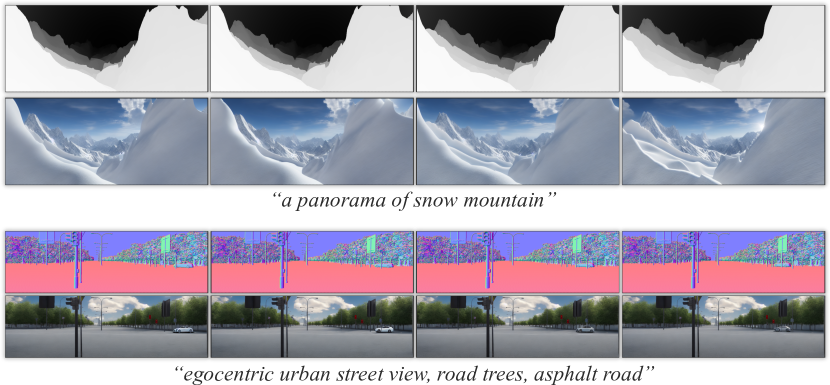
- 所提方法在多个合成到真实视频翻译基准测试中,无论在定量指标还是定性评估中均达到最先进性能。
- 通过基于光流引导的联合噪声优化,显著减少了闪烁和跳动伪影,实现了时序一致性。
- 在 VKITTI 数据集上,该方法在 FID 和 LPIPS 指标上均优于基线方法,报告的 FID 分数分别为 14.21(基线)和 12.01(所提方法)。
- 通过用户研究和感知指标验证,该方法在长视频序列中保持了高视觉保真度和结构一致性。
- 加速技术使推理时间相比全步长优化减少了最多 3.66 倍,实现了实际部署的可行性。
- 该方法与现有的大规模文本到图像扩散模型兼容,可在无需风格参考图像的前提下,实现灵活的、由文本驱动的风格定制。
阅读本论文
在 Nubint 阅读器中打开原文,边读边就任意段落提问。
在 Nubint 中阅读本论文本解读由 AI 根据论文原文生成,引用前请核对原文。