
[论文解读] VideoMAE V2: Scaling Video Masked Autoencoders with Dual Masking
VideoMAE V2 引入双重屏蔽和渐进式训练,将视频掩码自编码器扩展到十亿参数的 ViT,在动作识别、检测和时序定位等任务上达到SOTA。
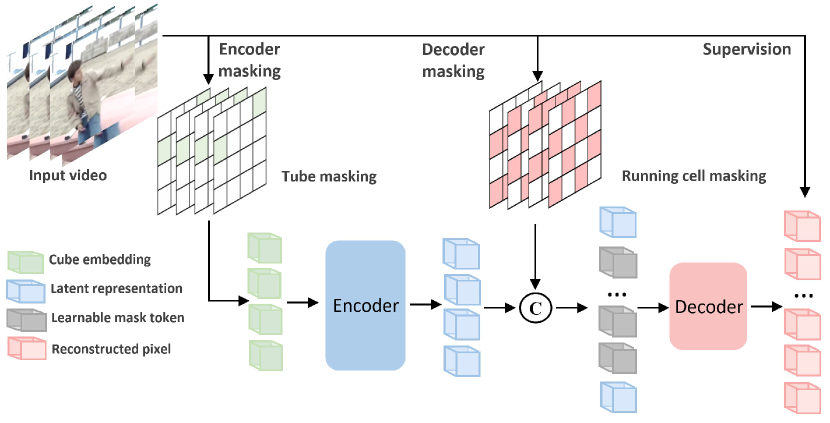
Scale is the primary factor for building a powerful foundation model that could well generalize to a variety of downstream tasks. However, it is still challenging to train video foundation models with billions of parameters. This paper shows that video masked autoencoder (VideoMAE) is a scalable and general self-supervised pre-trainer for building video foundation models. We scale the VideoMAE in both model and data with a core design. Specifically, we present a dual masking strategy for efficient pre-training, with an encoder operating on a subset of video tokens and a decoder processing another subset of video tokens. Although VideoMAE is very efficient due to high masking ratio in encoder, masking decoder can still further reduce the overall computational cost. This enables the efficient pre-training of billion-level models in video. We also use a progressive training paradigm that involves an initial pre-training on a diverse multi-sourced unlabeled dataset, followed by a post-pre-training on a mixed labeled dataset. Finally, we successfully train a video ViT model with a billion parameters, which achieves a new state-of-the-art performance on the datasets of Kinetics (90.0% on K400 and 89.9% on K600) and Something-Something (68.7% on V1 and 77.0% on V2). In addition, we extensively verify the pre-trained video ViT models on a variety of downstream tasks, demonstrating its effectiveness as a general video representation learner. The code and model is available at \url{https://github.com/OpenGVLab/VideoMAEv2}.
研究动机与目标
- 推动视频基础模型的可扩展自监督预训练,使其能在多样化任务上实现泛化。
- 开发一种双屏蔽方案,使十亿参数的视频变换模型的预训练更高效。
- 组装百万级无标签并混合有标签的视频数据,以支持大规模预训练。
- 采用渐进式训练流程,包括无监督预训练随后有监督后预训练。
- 展示 VideoMAE V2 表征在多个下游视频任务中的可迁移性。
提出的方法
- 采用双屏蔽策略:高比率的编码器屏蔽和一个解码器屏蔽,以降低解码器输入长度。
- 使用一个轻量解码器,仅重建解码器可见标记的子集。
- 在解码器可见标记上使用均方誤差信重建损失进行训练,同时防止来自编码器可见标记的信息泄漏。
- 通过使用巨型 ViT 骨干网络(如 ViT-g)来扩大模型容量,并通过百万级无标签视频数据集丰富预训练数据。
- 构建渐进式训练体系:在 UnlabeledHybrid 上进行无监督预训练,在 LabeledHybrid 上进行有监督后预训练,然后进行任务特定微调。
- 组装并利用混合的多源无标签数据集以及带标签的数据集,以支持十亿级预训练和跨任务迁移。
实验结果
研究问题
- RQ1Can VideoMAE-style masked autoencoding be effectively scaled to billion-parameter video transformers?
- RQ2Does dual masking (encoder and decoder) significantly improve training efficiency without compromising representation quality?
- RQ3How do data scale and diversity impact the performance of large-scale video masked pre-training?
- RQ4Can progressive supervised fine-tuning on a hybrid labeled dataset bridge the gap between large pre-training data and smaller downstream datasets?
- RQ5To what extent do VideoMAE V2 representations transfer to action recognition, spatial and temporal action detection across diverse benchmarks?
主要发现
- VideoMAE V2 successfully trains a video transformer with one billion parameters (ViT-g).
- Dual masking reduces FLOPs and memory while maintaining or improving accuracy compared to encoder-only masking.
- Pre-training on a million-level unlabeled hybrid video dataset plus post-pre-training on a 0.66M clip, 710-category labeled hybrid dataset yields strong downstream performance.
- VideoMAE V2 achieves new SOTA on Kinetics-400 (90.0%), Kinetics-600 (89.9%), Something-Something V1/V2 (68.7%, 77.0%), and shows strong results on AVA and temporal action datasets.
- Progressive pre-training and data diversification mitigate overfitting and improve transfer to downstream tasks across action recognition and detection benchmarks.
阅读本论文
在 Nubint 阅读器中打开原文,边读边就任意段落提问。
在 Nubint 中阅读本论文本解读由 AI 根据论文原文生成,引用前请核对原文。