
[论文解读] VLM See, Robot Do: Human Demo Video to Robot Action Plan via Vision Language Model
SeeDo 使用视觉-语言模型管线,结合关键帧选择和视觉感知提示,将人类演示视频转换为机器人任务计划,通过在仿真和真实机器人上执行的语言模型程序来实现。
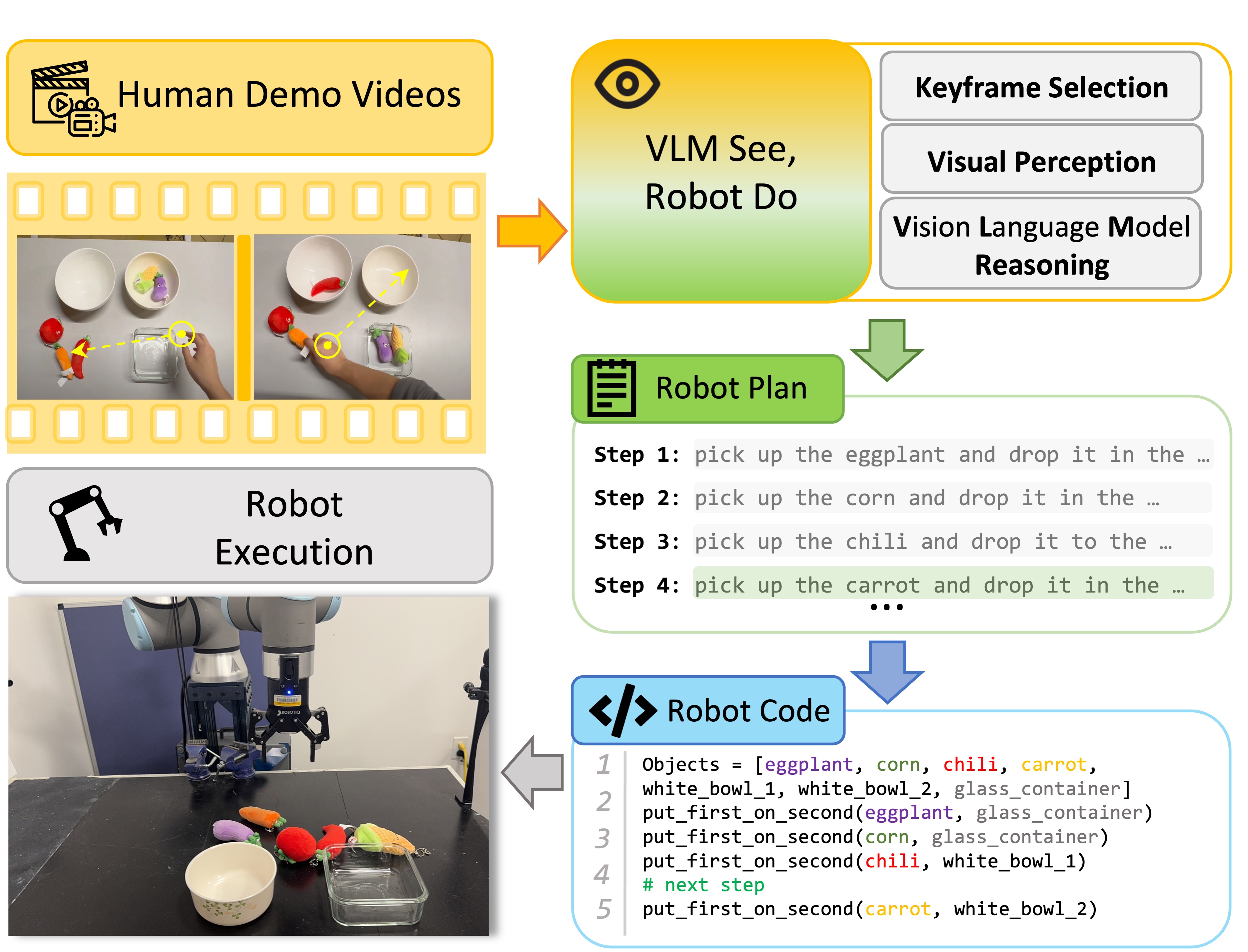
Vision Language Models (VLMs) have recently been adopted in robotics for their capability in common sense reasoning and generalizability. Existing work has applied VLMs to generate task and motion planning from natural language instructions and simulate training data for robot learning. In this work, we explore using VLM to interpret human demonstration videos and generate robot task planning. Our method integrates keyframe selection, visual perception, and VLM reasoning into a pipeline. We named it SeeDo because it enables the VLM to ''see'' human demonstrations and explain the corresponding plans to the robot for it to ''do''. To validate our approach, we collected a set of long-horizon human videos demonstrating pick-and-place tasks in three diverse categories and designed a set of metrics to comprehensively benchmark SeeDo against several baselines, including state-of-the-art video-input VLMs. The experiments demonstrate SeeDo's superior performance. We further deployed the generated task plans in both a simulation environment and on a real robot arm.
研究动机与目标
- 通过使用视觉-语言模型激发来自长时程人类演示视频的机器人学习。
- 开发一个通过子任务分解将视频解读为机器人任务计划的管线。
- 通过感知增强推理来缓解VLMs在视频处理和空间关系方面的挑战。
- 在多样化的长时任务上将SeeDo与最先进的视频VLM进行基准比较。
提出的方法
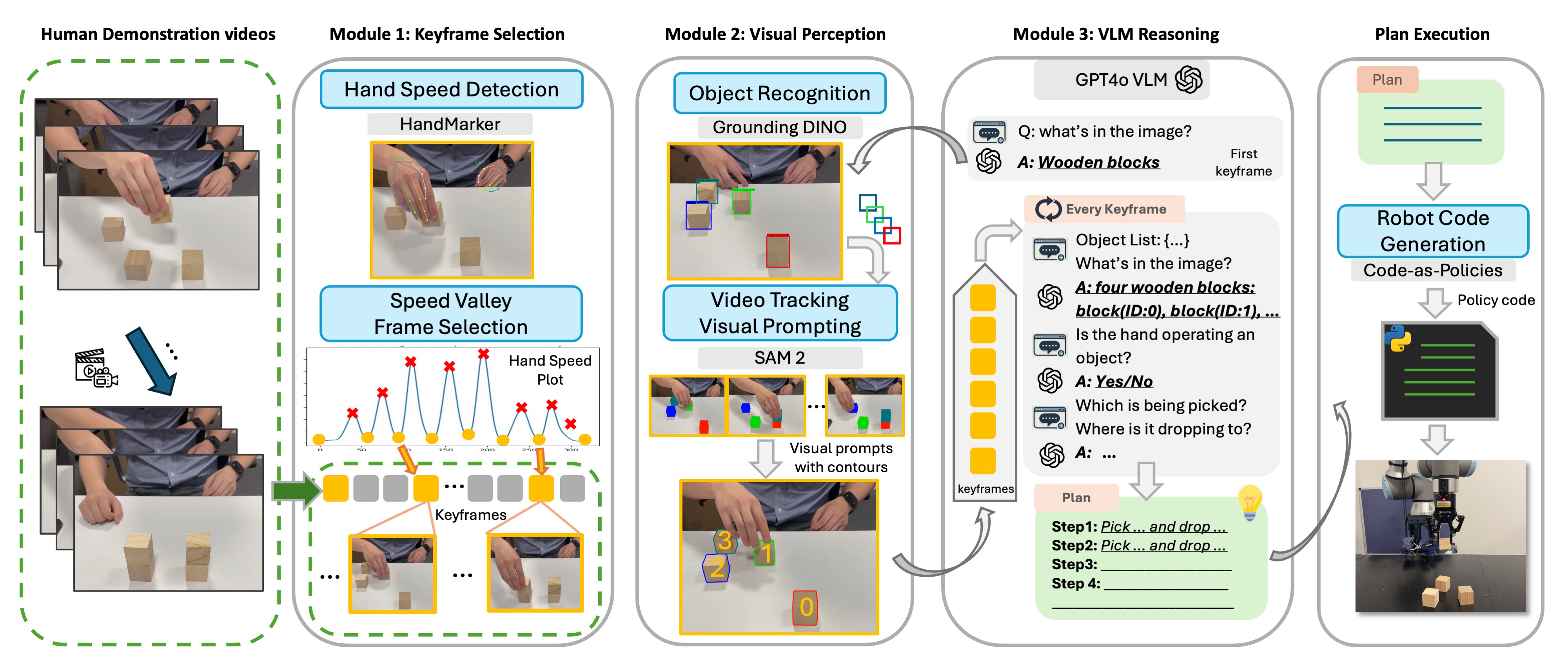
- 引入一个三模块的SeeDo管线:关键帧选择、视觉感知与VLM推理。
- 使用基于手速的关键帧提取以捕捉关键动作帧。
- 应用目标跟踪和视觉提示(轮廓、ID、中心点)来增强VLM感知。
- 采用带有思路链的提示的GPT-4o来生成任务计划。
- 将生成的计划转换为语言模型程序(LMPs),以通过机器人API执行。
- 在三个任务上用仿真(Pybullet)和UR10e真实机器人进行评估。
实验结果
研究问题
- RQ1视觉-语言模型是否能解释人类演示视频以生成可执行的机器人计划?
- RQ2添加关键帧选择和视觉感知模块是否能改善基于VLM的规划中的时序与空间推理?
- RQ3在长时任务上,SeeDo与最先进的视频VLM相比如何?
- RQ4生成的任务计划是否能够同时在仿真和真实硬件上迁移?
主要发现
- SeeDo在所有任务的 TSR、FSR 和 SSR 上均优于基线(闭源和开源视频VLM)。
- 在SeeDo配置下,SSRs在木块上保持在52.48%以上,在服装整理上超过66.50%。
- SeeDo在蔬菜整理任务上达到60.53% TSR和FSR,以及80.40% SSR,超过其他模型。
- 视觉提示显著提升空间推理,与未使用提示的SeeDo相比,空间误差率下降。
- 消融研究表明,关键帧采样与基于手检测的关键帧对维持上下文和性能至关重要。
- 生成的任务计划可以在仿真和真实UR10e设置上通过LMP执行。
阅读本论文
在 Nubint 阅读器中打开原文,边读边就任意段落提问。
在 Nubint 中阅读本论文本解读由 AI 根据论文原文生成,引用前请核对原文。