
[论文解读] Vorticity Suppression by Particle Lag Effects in Shock-Driven Multiphase Instability
本研究通过使用固体、非变形颗粒隔离动量传递动力学,探究粒子滞后效应在激波驱动多相不稳定性(SDMI)中抑制涡度与混合的机制。通过保持有效密度比恒定而改变颗粒尺寸,实验表明增加颗粒松弛时间可减少涡量和混合,进而提出一种新的理论模型,用于基于激波特性和、有效密度比及颗粒响应时间预测涡量沉积。
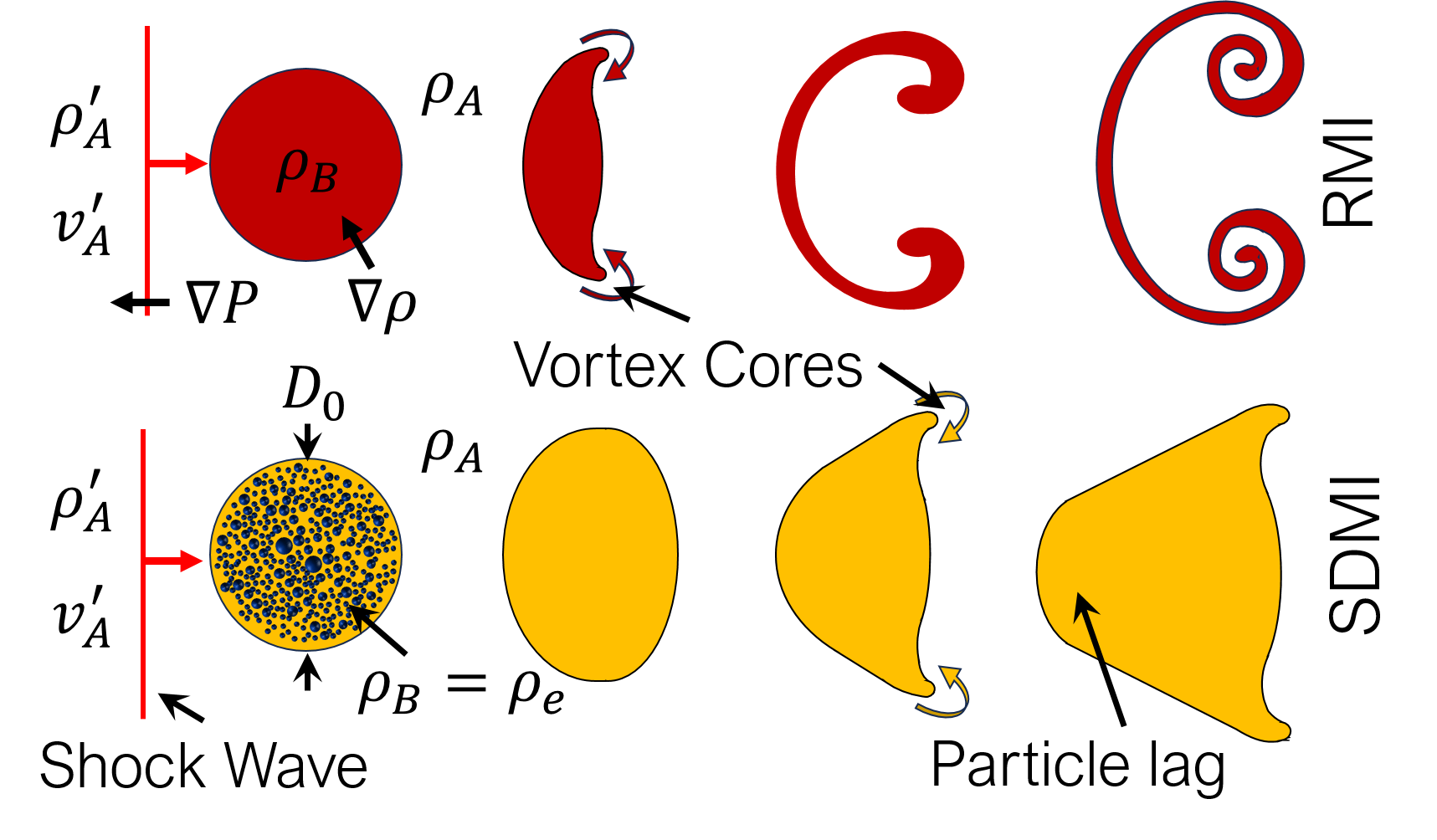
Shock-driven multiphase mixing occurs in many physical systems such as explosive dispersal of chemical or biological agents, in the evolution of supernova remnants, and in supersonic and detonative combustion engines. This mixing process is driven by the Shock Driven Multiphase Instability (SDMI), a derivative of the canonical Richtmyer-Meshkov Instability (RMI). The SDMI deviates from the RMI as particle lag effects become significant, where a higher momentum deficit leads to longer equilibration times and a reduction in hydrodynamic mixing. In this work, the effect of particle lag (rate of momentum transfer) on the SDMI evolution was isolated and investigated utilizing solid nondeforming and nonevaporating particles of differing sizes while holding the effective density ratio (mass of particles in the interface) constant. Three particle sizes were selected with increasing velocity relaxation times. Experiments were conducted by accelerating a cylindrical interface comprised of air and seeded particles surrounded by clean (particle-free) air with a Mach 1.35 shock wave. The development of the multiphase interface was measured using particle imaging velocimetry (PIV). Circulation measurements showed a decrease in mixing with increasing particle size. Finally, a new model, derived from theory, is proposed to predict circulation deposition, mixing energy, in the SDMI based on shock strength, effective density ratio, and particle response times.
研究动机与目标
- 为独立于液滴破碎、蒸发或形变,隔离并量化粒子滞后(动量传递速率)对激波驱动多相不稳定性(SDMI)中涡度与混合的影响。
- 研究增大颗粒尺寸(导致更长的速度松弛时间)对受激波作用的圆柱形界面中流体混合与涡量发展的影响。
- 建立并验证一种考虑有限颗粒响应时间的SDMI中涡量沉积理论模型,扩展经典Richtmyer-Meshkov不稳定性(RMI)理论。
- 为预测超燃冲压发动机和惯性约束聚变等应用中颗粒载流体的混合抑制提供理论框架,这些应用中颗粒载流体至关重要。
提出的方法
- 实验采用马赫数约为1.35的激波,对由空气与三种不同尺寸(1–10 μm)的固体、非变形、非蒸发颗粒组成的圆柱形界面进行瞬时加速,同时保持有效密度比恒定。
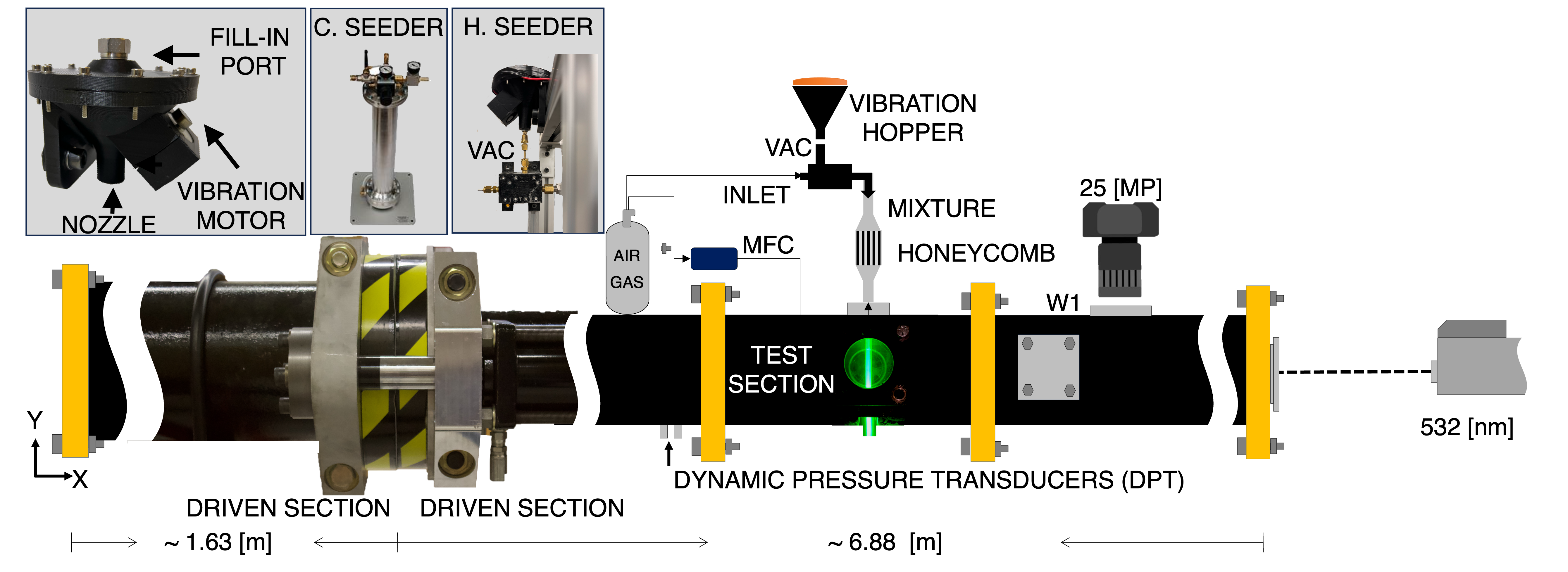
- 利用粒子成像测速法(PIV)对颗粒场的Mie散射图像进行处理,测量速度场,并通过涡核周围闭合路径的线积分计算涡度与涡量。
- 涡量被量化为围绕包含涡结构的闭合轮廓的速度线积分,结果基于十组实验取平均以保证统计可靠性。
- 理论模型由多相涡度方程推导得出,包含压强梯度引起的涡度生成项与作为体力的颗粒阻力项,分别给出局部与总涡量的表达式。
- 模型通过与实验数据、先前研究的模拟结果以及其他来源的实验数据进行对比验证,同时对分辨率和破碎效应进行调整。
- 颗粒尺寸通过扫描电子显微镜进行体外表征,并通过相位多普勒颗粒测速法进行原位测量,以确保颗粒松弛时间估算的准确性。
实验结果
研究问题
- RQ1增大颗粒尺寸(特别是颗粒松弛时间)如何影响激波驱动多相不稳定性中的涡度生成与涡量?
- RQ2粒子滞后在受激波作用的颗粒载流界面中,对流体混合与涡核发展的抑制程度如何?
- RQ3基于涡度方程与动量传递动力学的理论模型能否准确预测由粒子滞后引起的涡量减少?
- RQ4所提出的模型预测结果与实验数据及先前模拟结果相比如何,特别是在无破碎与蒸发效应的条件下?
- RQ5涡度与体势力源项的对齐在多相流中对涡量随时间持续存在方面起何作用?
主要发现
- 随着颗粒尺寸增大,涡量显著降低,表明更长的颗粒松弛时间导致更强的涡度与混合抑制。
- 小颗粒情况(1 μm)表现出与经典Richtmyer-Meshkov不稳定性(RMI)一致的行为,显示强涡结构形成与高涡量。
- 大颗粒情况(10 μm)显示涡核发展极弱,且颗粒后方形成长尾流,表明流体混合受到严重抑制。
- 所提出的局部涡量模型与实验数据及先前模拟结果高度一致,尤其在考虑涡度扩散与输运涡度耗散时表现更优。
- 大颗粒情况下涡量差异的归因于先前模拟与实验中颗粒破碎与蒸发效应,这些效应会缩短有效粒子滞后时间。
- 本研究表明,仅在界面附近局部生成的涡度能随时间持续存在,支持采用局部涡量模型预测颗粒载流体中混合抑制的可行性。
阅读本论文
在 Nubint 阅读器中打开原文,边读边就任意段落提问。
在 Nubint 中阅读本论文本解读由 AI 根据论文原文生成,引用前请核对原文。