
[论文解读] Weak baselines and reporting biases lead to overoptimism in machine learning for fluid-related partial differential equations
本文研究了机器学习(ML)在流体相关偏微分方程(PDEs)研究中的过度乐观现象,揭示了79%声称实现ML加速的研究使用了薄弱基线,并存在报告偏差。作者表明,这些问题是由于研究人员的自由度以及对正面结果的偏好所驱动,导致性能宣称被夸大,呼吁在文化与结构层面进行改革,以提升ML用于PDE研究的可重现性。
One of the most promising applications of machine learning (ML) in computational physics is to accelerate the solution of partial differential equations (PDEs). The key objective of ML-based PDE solvers is to output a sufficiently accurate solution faster than standard numerical methods, which are used as a baseline comparison. We first perform a systematic review of the ML-for-PDE solving literature. Of articles that use ML to solve a fluid-related PDE and claim to outperform a standard numerical method, we determine that 79% (60/76) compare to a weak baseline. Second, we find evidence that reporting biases, especially outcome reporting bias and publication bias, are widespread. We conclude that ML-for-PDE solving research is overoptimistic: weak baselines lead to overly positive results, while reporting biases lead to underreporting of negative results. To a large extent, these issues appear to be caused by factors similar to those of past reproducibility crises: researcher degrees of freedom and a bias towards positive results. We call for bottom-up cultural changes to minimize biased reporting as well as top-down structural reforms intended to reduce perverse incentives for doing so.
研究动机与目标
- 调查机器学习在流体相关偏微分方程(PDEs)研究中过度乐观现象的程度。
- 评估声称优于标准数值求解器的ML-for-PDE研究中,薄弱基线的普遍性。
- 考察报告偏差(尤其是结果偏差和发表偏差)在扭曲ML用于PDE求解性能认知方面的作用。
- 识别导致ML-for-PDE研究可重现性问题的系统性因素,如研究人员的自由度以及对正面结果的激励。
- 倡导自下而上的文化变革与自上而下的结构改革,以减少偏差报告并提升该领域科学严谨性。
提出的方法
- 对76篇声称在流体相关PDE中优于标准数值方法的ML-for-PDE文章进行了系统性回顾。
- 根据两项标准评估每项研究的基线:(1) 在固定自由度或迭代次数下进行比较(作为运行时间的代理指标),以及(2) 使用高效且最先进的数值方法。
- 若两项标准均满足,则将比较分类为“公平”;否则标记为“薄弱”或“不公平”。
- 分析报告实践以检测结果偏差和发表偏差,特别是对负面结果的报告不足。
- 从文献中识别并引用证据,表明如物理信息神经网络(PINNs)等方法通常比标准求解器更慢。
- 采用结构化评估框架,评估涵盖泊松方程、亥姆霍兹方程、伯吉斯方程和纳维-斯托克斯方程等多种PDE类型的基线强度与方法严谨性。
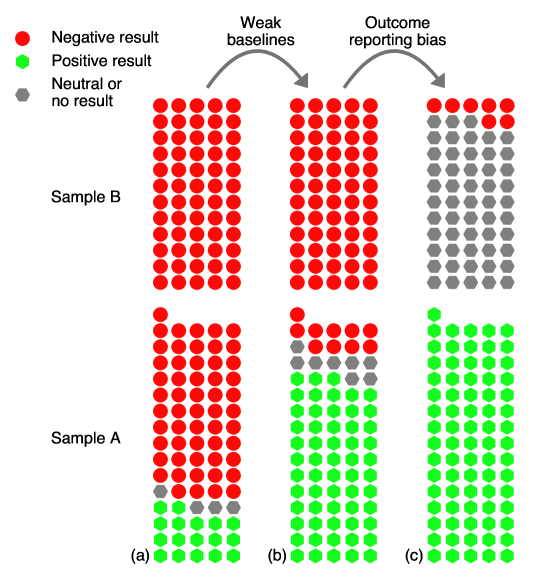
实验结果
研究问题
- RQ1当ML-for-PDE研究声称优于标准数值求解器时,其使用薄弱基线的程度如何?
- RQ2在流体相关PDE的ML研究中,报告偏差(尤其是结果偏差和发表偏差)的普遍性如何?
- RQ3导致ML-for-PDE研究过度乐观的系统性因素有哪些?它们与过去其他科学领域可重现性危机的相似之处是什么?
- RQ4为何许多基于ML的PDE求解器(包括PINNs)尽管声称实现加速,却未能优于标准求解器?
- RQ5为提升ML-for-PDE研究的可重现性并减少偏差报告,需要哪些文化与结构改革?
主要发现
- 79%(76项中的60项)声称优于标准求解器的ML-for-PDE研究使用了薄弱基线,削弱了其性能宣称的有效性。
- 许多研究将ML模型与低效或过时的数值方法(如有限元法或共轭梯度求解器)进行比较,而非最先进的替代方法(如多重网格或谱方法)。
- 物理信息神经网络(PINNs)在前向PDE问题中被发现比标准求解器慢数个数量级,与加速宣称相矛盾。
- 若干研究报告了负面结果或未能实现加速,但这些发现在文献中被报告不足或被省略,表明存在结果报告偏差。
- 薄弱基线和报告偏差的根源在于研究人员的自由度以及系统性地鼓励发表正面结果的激励机制,与过去其他科学领域出现的可重现性危机如出一辙。
- 本研究结论认为,该领域因方法论缺陷和系统性激励而过度乐观,呼吁通过文化与结构改革提升科学诚信与可重现性。
阅读本论文
在 Nubint 阅读器中打开原文,边读边就任意段落提问。
在 Nubint 中阅读本论文本解读由 AI 根据论文原文生成,引用前请核对原文。