
[论文解读] Weakly-Supervised HOI Detection from Interaction Labels Only and Language/Vision-Language Priors
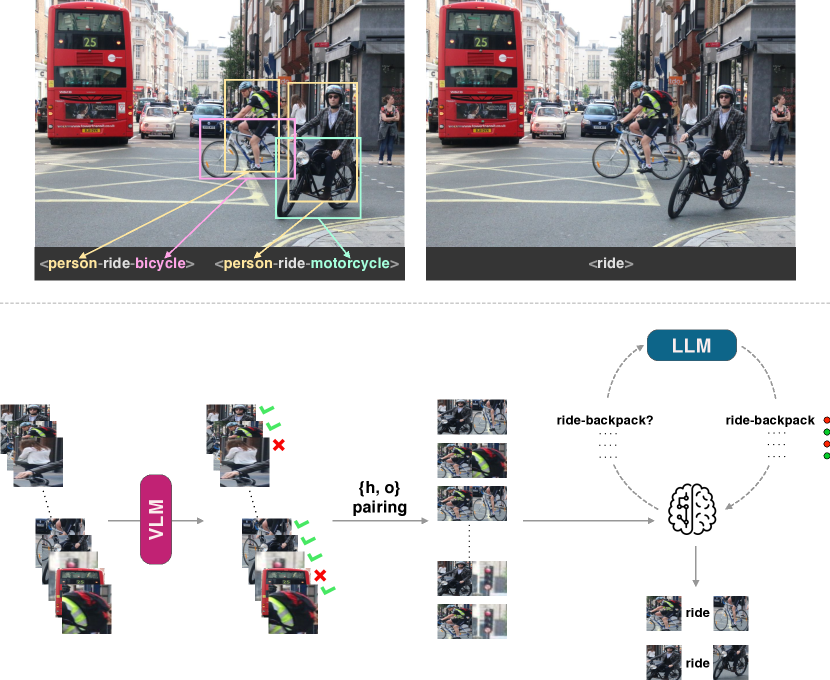
该论文提出了一种仅使用图像级交互标签(例如,'ride'、'eat')和自由形式图像描述的弱监督HOI检测框架,利用视觉语言模型进行候选框筛选,利用大语言模型过滤不合理的交互,并引入弱监督的介词预测任务以增强空间推理能力。该方法在弱监督设置下实现了最先进性能,在V-COCO数据集上的Agent AP指标上相比基线模型最高提升8.12%。
Human-object interaction (HOI) detection aims to extract interacting human-object pairs and their interaction categories from a given natural image. Even though the labeling effort required for building HOI detection datasets is inherently more extensive than for many other computer vision tasks, weakly-supervised directions in this area have not been sufficiently explored due to the difficulty of learning human-object interactions with weak supervision, rooted in the combinatorial nature of interactions over the object and predicate space. In this paper, we tackle HOI detection with the weakest supervision setting in the literature, using only image-level interaction labels, with the help of a pretrained vision-language model (VLM) and a large language model (LLM). We first propose an approach to prune non-interacting human and object proposals to increase the quality of positive pairs within the bag, exploiting the grounding capability of the vision-language model. Second, we use a large language model to query which interactions are possible between a human and a given object category, in order to force the model not to put emphasis on unlikely interactions. Lastly, we use an auxiliary weakly-supervised preposition prediction task to make our model explicitly reason about space. Extensive experiments and ablations show that all of our contributions increase HOI detection performance.
研究动机与目标
- 通过引入仅使用图像级交互标签的新弱监督设置,解决强监督设置下HOI检测的高标注成本问题。
- 通过使用大语言模型过滤不合理的交互-对象对,降低人-对象交互的组合复杂度。
- 通过弱监督的介词预测头,提升HOI检测中的空间推理能力。
- 仅使用图像-描述对端到端训练HOI检测器,通过语言解析提取图像级标签,实现可扩展的弱监督。
提出的方法
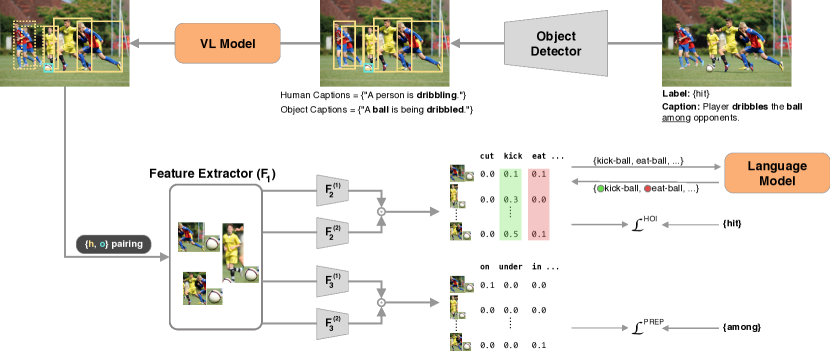
- 利用应用于图像描述的视觉语言模型提供的定位信号,对非交互的人-对象候选框进行筛选。
- 使用大语言模型验证预测的$<$交互, 对象$>$对的合理性,抑制不合理的交互。
- 引入弱监督的介词预测头,显式建模人与对象之间的空间关系。
- 通过语言解析器从描述中提取图像级交互标签,实现完全弱监督的图像-描述对监督。
- 在图像-描述对上端到端训练HOI检测模型,监督信号来源于图像级标签和辅助任务。
- 在统一框架中整合所有组件,联合优化交互分类、候选框筛选、合理性过滤和空间推理。
实验结果
研究问题
- RQ1是否可以仅使用图像级交互标签,而无需边界框或成对标注,有效训练HOI检测器?
- RQ2如何利用视觉语言模型提升弱监督HOI检测中的候选框质量?
- RQ3大语言模型在多大程度上能缩小合理交互的搜索空间并提升检测准确率?
- RQ4弱监督的介词预测任务是否能增强HOI检测中的空间推理能力?
- RQ5该方法对描述质量与来源(如网络爬取 vs. 人工标注)的变化具有多强的鲁棒性?
主要发现
- 所提方法在V-COCO数据集上相比基线弱监督HOI检测模型,Agent AP提升8.12%,Role AP提升9.54%。
- 消融实验证实,每个组件——候选框筛选、交互合理性过滤和介词预测——均对性能提升有显著贡献。
- 尽管交互类别数量高达117种,导致组合复杂度更高,该方法在HICO-DET数据集上仍比基线弱监督SCG模型绝对提升1.33%。
- 模型在不同描述来源上泛化良好:在V-COCO、HICO-DET和Conceptual Captions上性能增益一致,表明对描述质量具有鲁棒性。
- 介词预测头显著增强了空间推理能力,尤其在具有明确空间约束的交互(如'坐于'马匹上)中表现更优。
- 通过语言解析从描述中提取图像级标签,实现了完全弱监督,显著降低了对昂贵标注的依赖。
阅读本论文
在 Nubint 阅读器中打开原文,边读边就任意段落提问。
在 Nubint 中阅读本论文本解读由 AI 根据论文原文生成,引用前请核对原文。