
[论文解读] WildFake: A Large-scale Challenging Dataset for AI-Generated Images Detection
本文介绍了WildFake,一个大规模、多样化的数据集,用于检测AI生成的图像,涵盖来自GAN、扩散模型及其他生成器的高质量伪造图像,涉及多种风格和真实应用场景。该数据集支持在跨权重、跨版本及降级场景下的鲁棒性评估,结果表明基于ViT的模型在鲁棒性方面优于ResNet-50,尤其在几何变换和色彩变换下表现更优。
The extraordinary ability of generative models enabled the generation of images with such high quality that human beings cannot distinguish Artificial Intelligence (AI) generated images from real-life photographs. The development of generation techniques opened up new opportunities but concurrently introduced potential risks to privacy, authenticity, and security. Therefore, the task of detecting AI-generated imagery is of paramount importance to prevent illegal activities. To assess the generalizability and robustness of AI-generated image detection, we present a large-scale dataset, referred to as WildFake, comprising state-of-the-art generators, diverse object categories, and real-world applications. WildFake dataset has the following advantages: 1) Rich Content with Wild collection: WildFake collects fake images from the open-source community, enriching its diversity with a broad range of image classes and image styles. 2) Hierarchical structure: WildFake contains fake images synthesized by different types of generators from GANs, diffusion models, to other generative models. These key strengths enhance the generalization and robustness of detectors trained on WildFake, thereby demonstrating WildFake's considerable relevance and effectiveness for AI-generated detectors in real-world scenarios. Moreover, our extensive evaluation experiments are tailored to yield profound insights into the capabilities of different levels of generative models, a distinctive advantage afforded by WildFake's unique hierarchical structure.
研究动机与目标
- 解决当前缺乏全面、大规模数据集以覆盖多样化生成模型及真实世界图像分布的问题,以支持AI生成图像检测研究。
- 提升检测器在不同模型架构、权重和版本之间的泛化能力,特别是在未见过或演进中的生成模型上。
- 评估检测器在常见图像降级类型(如压缩、下采样、水印、色彩变换)下的鲁棒性。
- 基于生成器类型、架构、权重和模型版本,提供分层的多级伪造图像分类体系,以支持检测性能的细粒度分析。
- 通过公开发布一个多样化、高质量的数据集,支持学术界推进合成图像检测领域的研究。
提出的方法
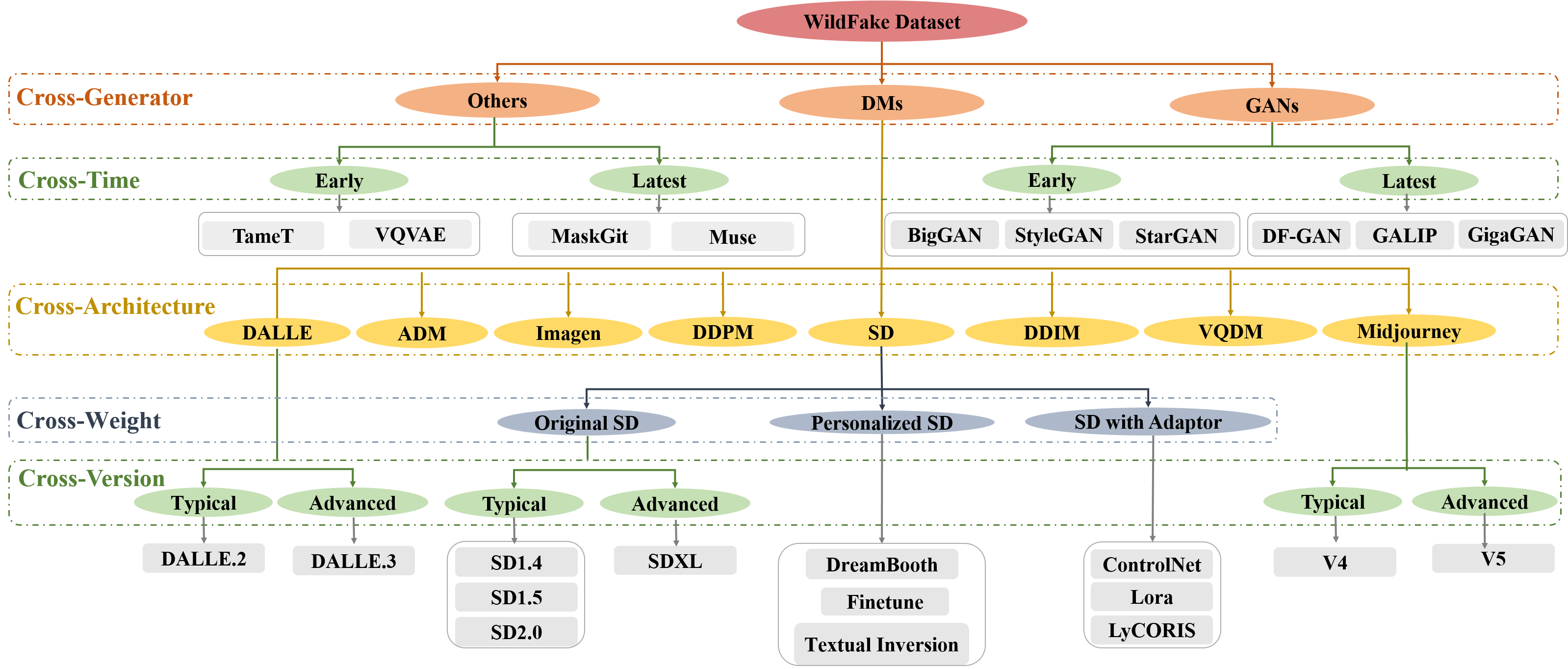
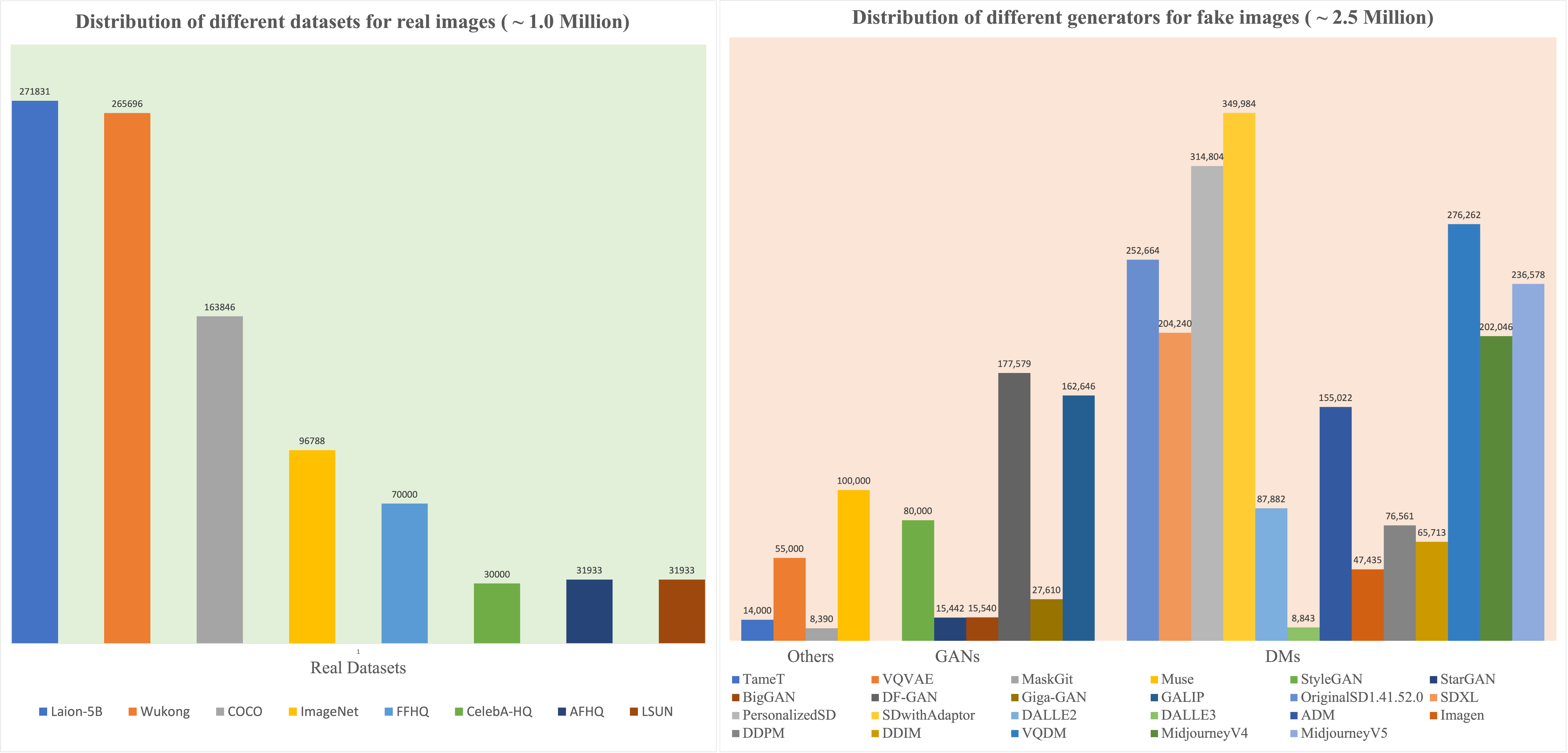
- 从开源社区收集伪造图像,并通过使用前沿GAN、扩散模型(DMs)及其他生成模型的综合流水线生成图像。
- 从用于图像字幕、生成和分类任务的多样化公开数据集中收集真实图像,以确保风格和内容的广泛多样性。
- 将数据集划分为四个分层级别:生成器类型(GANs、DMs、Others)、模型架构、模型权重和模型版本,以支持交叉比较评估。
- 应用降级技术——下采样、JPEG压缩、几何变换(翻转、裁剪)、水印(文字和视觉)以及色彩调整(亮度、对比度、饱和度、色相)——以测试检测器的鲁棒性。
- 在WildFake上训练并评估多种检测器(如基于ViT和ResNet-50的模型),重点关注Stable Diffusion、Midjourney和GAN模型在跨权重、跨版本和跨时间的泛化能力。
- 开展消融研究和对比实验,分析检测器在不同降级类型和模型演化阶段下的性能表现。
实验结果
研究问题
- RQ1AI生成图像检测器在相同生成模型架构的不同权重之间(如Stable Diffusion)的泛化能力如何?
- RQ2当在更新或更先进的生成模型版本上评估时,检测器的泛化性能相较于早期版本如何?
- RQ3在真实部署场景中,检测器对常见图像降级类型(如压缩、下采样、水印)的鲁棒性如何?
- RQ4在跨版本和跨权重评估下,检测器在不同生成模型类型(GANs、扩散模型、其他)上的表现有何差异?
- RQ5架构选择(如ViT与ResNet-50)在图像降级条件下对检测器鲁棒性的影响有多大?
主要发现
- 在WildFake上训练的检测器在同一系列模型(如Stable Diffusion)的不同权重之间展现出强大的泛化能力,其性能与权重内评估相当。
- 跨版本评估表明,检测器在扩散模型(如Stable Diffusion和Midjourney)的演进版本中保持稳定性能,表明核心架构的稳定性有助于保留可检测的模式。
- 基于ViT的检测器在处理几何变换和色彩变换时优于基于ResNet-50的检测器,显示出在这些降级条件下的更强鲁棒性。
- 两种检测器在处理带有图像或文本水印的图像时均出现显著性能下降,表明水印影响样本存在关键脆弱性。
- 较低的图像分辨率和质量(如64×64或低JPEG质量)对检测准确率有显著负面影响,凸显输入质量对可靠检测的重要性。
- 在最新GAN模型上训练的检测器相比在早期GAN版本上训练的检测器展现出更优的泛化能力,表明新型模型可能留下更一致或更易检测的伪影。
阅读本论文
在 Nubint 阅读器中打开原文,边读边就任意段落提问。
在 Nubint 中阅读本论文本解读由 AI 根据论文原文生成,引用前请核对原文。