
[论文解读] You Only Segment Once: Towards Real-Time Panoptic Segmentation
YOSO 是一种实时全景分割框架,通过在学习到的全景核与特征图之间使用动态卷积,将实例分割和语义分割统一到单次前向传播中。它实现了最先进的速度-精度权衡,在 COCO 上达到 46.4 PQ(45.6 FPS),在 Cityscapes 上达到 52.5 PQ(22.6 FPS),并在 ADE20K 和 Mapillary Vistas 上取得具有竞争力的结果,得益于卷积优先聚合模块和参数共享跨注意力的可分离动态解码器。
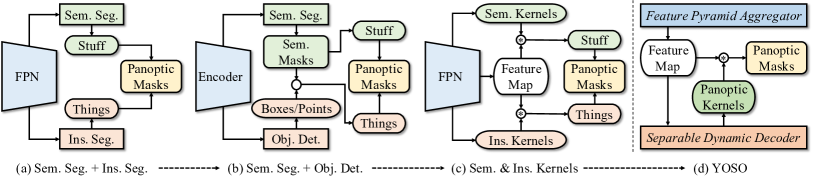
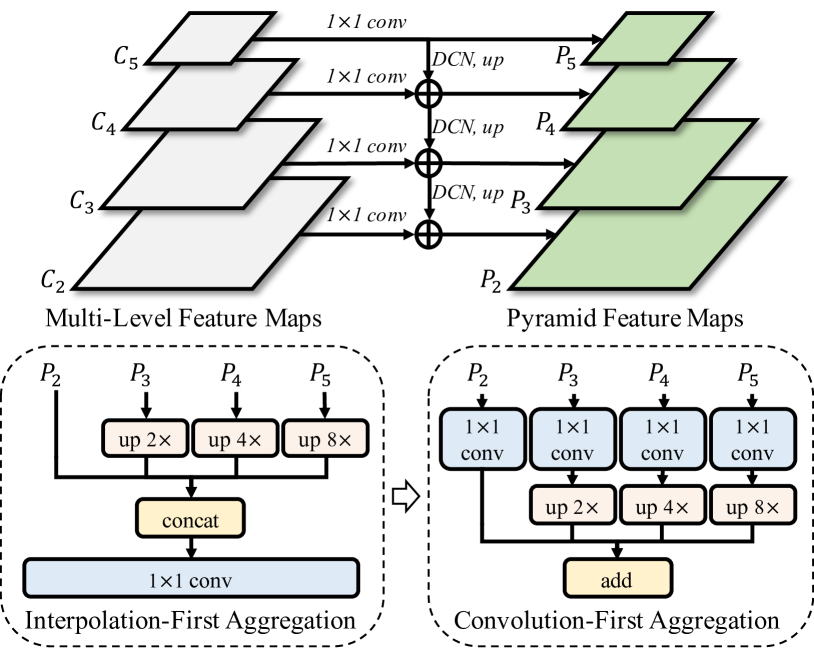
In this paper, we propose YOSO, a real-time panoptic segmentation framework. YOSO predicts masks via dynamic convolutions between panoptic kernels and image feature maps, in which you only need to segment once for both instance and semantic segmentation tasks. To reduce the computational overhead, we design a feature pyramid aggregator for the feature map extraction, and a separable dynamic decoder for the panoptic kernel generation. The aggregator re-parameterizes interpolation-first modules in a convolution-first way, which significantly speeds up the pipeline without any additional costs. The decoder performs multi-head cross-attention via separable dynamic convolution for better efficiency and accuracy. To the best of our knowledge, YOSO is the first real-time panoptic segmentation framework that delivers competitive performance compared to state-of-the-art models. Specifically, YOSO achieves 46.4 PQ, 45.6 FPS on COCO; 52.5 PQ, 22.6 FPS on Cityscapes; 38.0 PQ, 35.4 FPS on ADE20K; and 34.1 PQ, 7.1 FPS on Mapillary Vistas. Code is available at https://github.com/hujiecpp/YOSO.
研究动机与目标
- 为解决在单次推理过程中实现高精度实时全景分割的挑战,将实例分割和语义分割统一到一个框架中。
- 在不牺牲性能的前提下,减少特征提取和核生成中的计算开销。
- 设计一种轻量化、高效的架构,以在多种数据集上保持泛化能力。
- 引入新颖模块,以改善全景分割流水线中的速度与精度权衡。
提出的方法
- 提出一种基于卷积优先聚合(CFA)的特征金字塔聚合器,将插值优先模块重参数化为卷积优先形式,实现约 2.6 倍的延迟降低,且无性能损失。
- 引入一种可分离的动态解码器,结合可分离动态卷积注意力(SDCA),通过参数共享实现多头跨注意力,提升效率与精度。
- 利用学习到的全景核与图像特征图之间的动态卷积,在单次分割过程中同时生成“stuff”和“things”的掩码。
- 采用参数共享的轻量化头部,减少 FLOPs 同时保持表示能力。
- 采用两阶段细化过程,设置 100 个提议核和 5×5 的核大小,作为速度-精度平衡的最优配置。
- 用高效替代方案取代标准的 FPN 颈部结构和重型解码器,实现在标准硬件上的实时推理。
实验结果
研究问题
- RQ1统一的全景分割框架是否能在保持高精度的同时实现实时推理?
- RQ2将插值优先模块重参数化为卷积优先形式是否能降低延迟而不降低性能?
- RQ3具有参数共享的可分离动态卷积是否能同时提升多头跨注意力在全景核中的速度与精度?
- RQ4在实时全景分割中,阶段数、提议核数量和核大小的最优配置是什么,以实现速度与精度的平衡?
- RQ5所提出的框架在 COCO、Cityscapes、ADE20K 和 Mapillary Vistas 等多样化数据集上的泛化能力如何?
主要发现
- YOSO 在 COCO 上实现 46.4 PQ(45.6 FPS),创下实时全景分割的新 SOTA 记录。
- 在 Cityscapes 上,YOSO 达到 52.5 PQ(22.6 FPS),展现出在高分辨率城市场景数据集上的强大性能。
- 在 ADE20K 上,YOSO 实现 38.0 PQ(35.4 FPS),表明其在细粒度、复杂场景数据集上的鲁棒性。
- 在 Mapillary Vistas 上,YOSO 达到 34.1 PQ(7.1 FPS),表明其在大规模、多样化数据集上的可扩展性,尽管速度较低。
- CFA 模块相比标准插值优先模块,将 GPU 延迟降低了约 2.6 倍,且无性能下降。
- SDCA 模块相比标准多头跨注意力,将 PQ 提升 +1.0,延迟降低约 1.2 倍。
阅读本论文
在 Nubint 阅读器中打开原文,边读边就任意段落提问。
在 Nubint 中阅读本论文本解读由 AI 根据论文原文生成,引用前请核对原文。