
[论文解读] Zero-Shot Text-Guided Object Generation with Dream Fields
Dream Fields 提出了一种零样本文本引导的3D物体生成方法,通过基于CLIP的图像-文本相似度优化神经辐射场(NeRF),仅利用自然语言提示即可合成细节丰富、多视角一致的3D几何与色彩。通过结合CLIP监督与诸如透射率正则化和场景边界等几何先验,该方法在无需任何3D训练数据的情况下实现了高保真度、多样化的3D物体生成,从而实现了开放词汇的3D合成,支持来自多样化描述的生成。
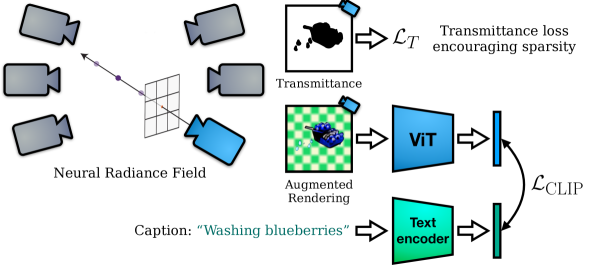
We combine neural rendering with multi-modal image and text representations to synthesize diverse 3D objects solely from natural language descriptions. Our method, Dream Fields, can generate the geometry and color of a wide range of objects without 3D supervision. Due to the scarcity of diverse, captioned 3D data, prior methods only generate objects from a handful of categories, such as ShapeNet. Instead, we guide generation with image-text models pre-trained on large datasets of captioned images from the web. Our method optimizes a Neural Radiance Field from many camera views so that rendered images score highly with a target caption according to a pre-trained CLIP model. To improve fidelity and visual quality, we introduce simple geometric priors, including sparsity-inducing transmittance regularization, scene bounds, and new MLP architectures. In experiments, Dream Fields produce realistic, multi-view consistent object geometry and color from a variety of natural language captions.
研究动机与目标
- 实现无需3D标注训练数据的自然语言描述到3D物体的生成。
- 克服先前3D生成模型在ShapeNet等预定义类别上的泛化能力受限的问题。
- 利用预训练的图文模型(如CLIP)实现零样本、文本引导的3D合成,且具有强感知对齐性。
- 通过引入简单而有效的几何先验,提升在文本监督下基于NeRF的3D生成保真度。
- 通过组合式语言提示,在多样化的现实世界物体类别上展示开放集3D生成能力。
提出的方法
- 优化神经辐射场(NeRF),以最大化渲染图像与给定文本提示之间CLIP的图像-文本相似度得分。
- 使用冻结的CLIP模型对来自随机相机姿态的渲染图像进行评分,从而在无3D监督的情况下实现NeRF的可微分优化。
- 应用透射率正则化以增强稀疏性并减少辐射场中的伪影,提升几何真实感。
- 施加场景边界以约束3D空间范围,防止不合理的物体延伸。
- 采用带位置编码的改进型MLP架构,以提升特征表示能力和训练稳定性。
- 在完整的360°方位角范围内采样相机姿态,以确保多视角一致性与泛化能力。
实验结果
研究问题
- RQ1是否可以仅通过文本提示和基于CLIP的图像-文本相似度,有效优化NeRF,而无需任何3D监督或多视角图像?
- RQ2诸如透射率正则化和场景边界等几何先验如何影响文本引导3D生成的逼真度与保真度?
- RQ3语言的组合特性在多大程度上能够实现跨开放词汇类别的多样化与可控3D物体生成?
- RQ4预训练图文模型的选择(如CLIP与LiT)如何影响生成3D物体的质量与对齐程度?
- RQ5相机姿态采样策略对文本到3D生成中多视角一致性与视角泛化能力有何影响?
主要发现
- 在使用CLIP B/32进行评估时,Dream Fields 达到高达86.6%的R-Precision检索精度,表明生成的3D物体与输入描述之间具有强大的语义对齐性。
- CLIP B/32在检索指标上优于CLIP B/16,表明更大的图像块尺寸可能对低分辨率渲染更有利。
- 使用LiT${}_{\text{uu}}$ B/32作为检索模型可获得最高的R-Precision(88.9%),表明其在开放集提示下具有强大的泛化能力。
- 采用多样化相机姿态(360°方位角采样)显著提升了多视角一致性,减少了侧视和后视图像中的伪影。
- 透射率正则化与场景边界在缺乏多视角监督的情况下,对减少NeRF伪影并提升几何真实感至关重要。
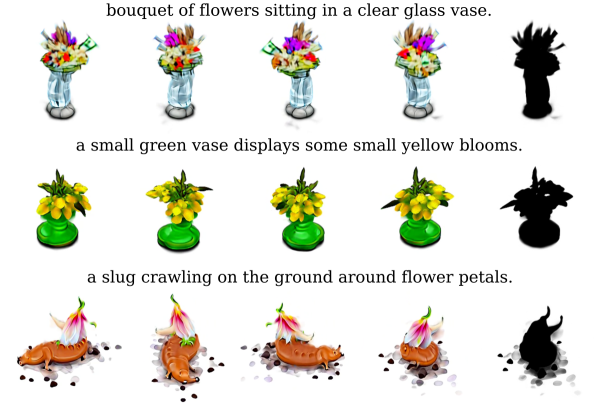
- 定性结果表明,Dream Fields 能够从复杂且组合式的描述(如“一个红色花朵放在蓝色花瓶中,周围有绿色叶子”)生成细节丰富、带纹理且多样的3D物体。
阅读本论文
在 Nubint 阅读器中打开原文,边读边就任意段落提问。
在 Nubint 中阅读本论文本解读由 AI 根据论文原文生成,引用前请核对原文。