
[论文解读] A Bayesian Spatio-Temporal Level Set Dynamic Model and Application to Fire Front Propagation
本文提出了一种贝叶斯时空水平集动态模型,通过将机理动力学与随机速度建模相结合,实现对不确定条件下野火火线传播的预测。通过结合符号距离函数表示法、层次化先验分布与数据同化方法,该方法能够对火线边界实现稳健的、具有不确定性量化的预测,并在2017年托马斯与海普雷斯野火事件中得到验证,预测精度与可信区间均得到提升。
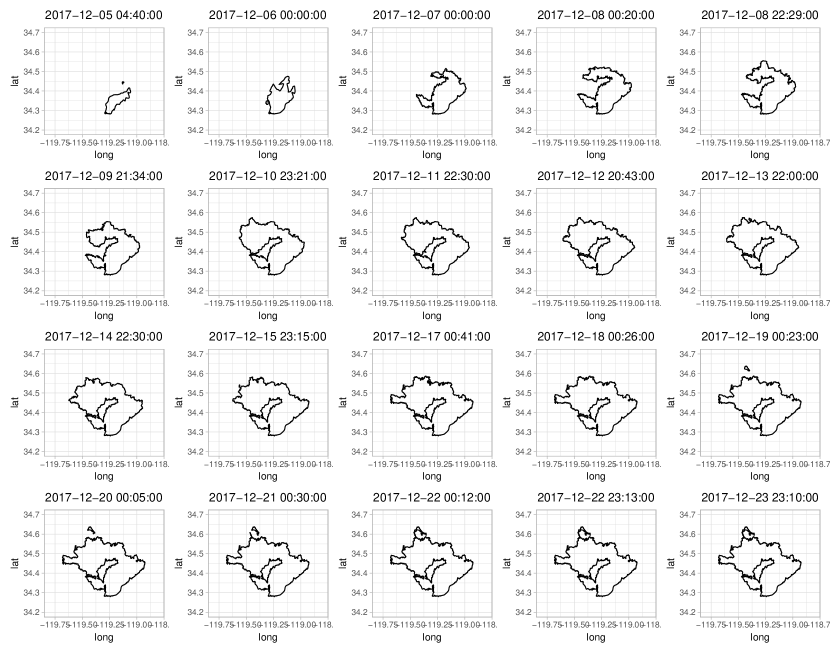
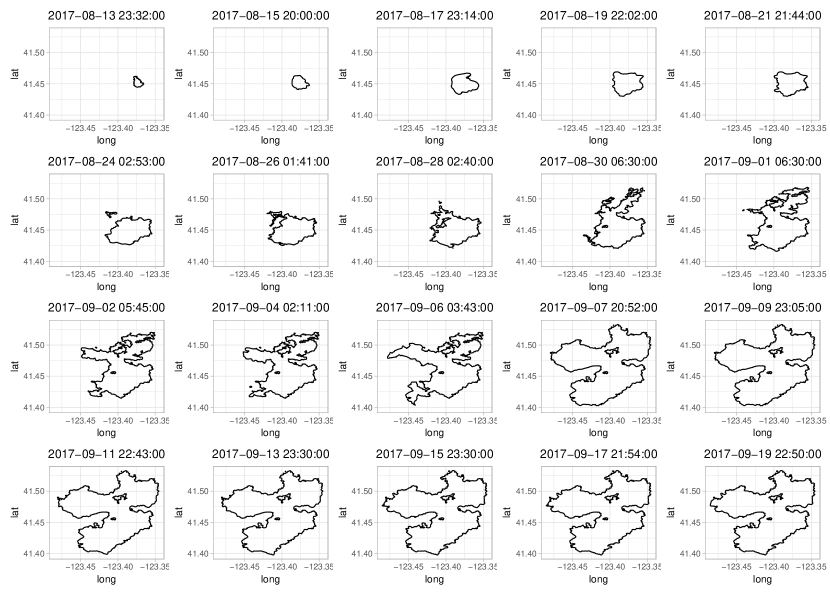
Intense wildfires impact nature, humans, and society, causing catastrophic damage to property and the ecosystem, as well as the loss of life. Forecasting wildfire front propagation is essential in order to support fire fighting efforts and plan evacuations. The level set method has been widely used to analyze the change in surfaces, shapes, and boundaries. In particular, a signed distance function used in level set methods can readily be interpreted to represent complicated boundaries and their changes in time. While there is substantial literature on the level set method in wildfire applications, these implementations have relied on a heavily-parameterized formula for the rate of spread. These implementations have not typically considered uncertainty quantification or incorporated data-driven learning. Here, we present a Bayesian spatio-temporal dynamic model based on level sets, which can be utilized for forecasting the boundary of interest in the presence of uncertain data and lack of knowledge about the boundary velocity. The methodology relies on both a mechanistically-motivated dynamic model for level sets and a stochastic spatio-temporal dynamic model for the front velocity. We show the effectiveness of our method via simulation and with forecasting the fire front boundary evolution of two classic California megafires - the 2017-2018 Thomas fire and the 2017 Haypress.
研究动机与目标
- 开发一种动态模型,用于在复杂真实场景下对野火火线演化进行预测,并实现恰当的不确定性量化。
- 克服传统水平集模型依赖高度参数化、半经验性蔓延速率公式的局限,这些公式缺乏不确定性传播机制。
- 将机理驱动的水平集动力学与随机时空速度模型相结合,实现数据驱动学习与稳健推断。
- 为野火-城市交界区域的火灾管理与疏散规划提供可操作的、概率性的预测结果。
提出的方法
- 该模型使用符号距离函数隐式表示火线边界,并通过带有速度场的偏微分方程(PDE)演化该边界,其中速度场被建模为潜在的时空过程。
- 采用层次化贝叶斯框架,将火线速度建模为高斯马尔可夫随机场,并引入固有高斯先验,实现空间与时间上的平滑。
- 速度动力学由具有转移矩阵 Mξ 和协方差结构 Σ 的随机时空状态空间模型控制,可捕捉非平稳与异质性蔓延模式。
- 通过共轭先验与吉布斯采样,推导出模型参数(ξ, γ, Σ⁻¹, Mξ)的完整条件后验分布,实现基于MCMC的后验推断。
- 通过将观测到的火线边界点与水平集函数关联的似然函数实现数据同化,测量误差通过精度 σ²ₚ 建模。
- 该方法利用向量化运算与克罗内克积(例如在 D 和 b 矩阵中),高效计算高维状态向量的完整条件后验分布。
实验结果
研究问题
- RQ1与依赖固定蔓延参数的确定性模型相比,贝叶斯时空水平集模型能否提升野火火线预测的准确性?
- RQ2当观测数据稀疏或存在噪声时,该模型在火线演化不确定性量化方面表现如何?
- RQ3在超级野火过程中,面对复杂非均质地形与快速变化的大气条件,该模型的适应能力如何?
- RQ4该模型的随机速度分量能否在不依赖预设经验公式的情况下,有效从观测到的野火推进数据中学习?
- RQ5对速度动力学施加的层次化先验在提升模型鲁棒性与泛化能力方面起到多大作用?
主要发现
- 该模型成功捕捉了2017年托马斯与海普雷斯野火的复杂非均匀蔓延模式,包括V形火线以及在干燥陡坡地形中的快速扩张。
- 后验预测分布提供了校准良好的可信区间,表明即使在观测数据有限的情况下,也能有效实现不确定性量化。
- 引入数据驱动的随机速度模型显著优于固定参数模型,在边界距离度量指标下展现出更高的预测精度。
- 速度动力学的层次化先验结构使模型能够从稀疏观测中稳健学习,并减少过拟合。
- 吉布斯采样收敛迅速,且完整条件后验分布具有解析可解性,从而实现了对高维火线状态的可扩展推断。
- 通过从数据中学习空间异质的速度模式,该模型在异质燃料类型与变化的风速条件下表现出强大的适应能力。
更好的研究,从现在开始
从阅读论文到最终审阅,大幅缩短您的研究时间。
无需绑定信用卡
本解读由 AI 生成,并经人工编辑审核。