
[论文解读] A comprehensive evaluation of ChatGPT's zero-shot Text-to-SQL capability
本文在12个基准上评估了 ChatGPT 的零-shot Text-to-SQL 性能,显示出强大的能力和鲁棒性,但与最先进模型仍存在一些差距;在对抗性和多轮场景中取得了显著优势。
This paper presents the first comprehensive analysis of ChatGPT's Text-to-SQL ability. Given the recent emergence of large-scale conversational language model ChatGPT and its impressive capabilities in both conversational abilities and code generation, we sought to evaluate its Text-to-SQL performance. We conducted experiments on 12 benchmark datasets with different languages, settings, or scenarios, and the results demonstrate that ChatGPT has strong text-to-SQL abilities. Although there is still a gap from the current state-of-the-art (SOTA) model performance, considering that the experiment was conducted in a zero-shot scenario, ChatGPT's performance is still impressive. Notably, in the ADVETA (RPL) scenario, the zero-shot ChatGPT even outperforms the SOTA model that requires fine-tuning on the Spider dataset by 4.1\%, demonstrating its potential for use in practical applications. To support further research in related fields, we have made the data generated by ChatGPT publicly available at https://github.com/THU-BPM/chatgpt-sql.
研究动机与目标
- 在多样的数据集和语言环境中评估 ChatGPT 的零-shot Text-to-SQL 能力。
- 在多种鲁棒性场景下,将零-shot 的 ChatGPT 与经过微调的 SOTA 模型进行对比。
- 识别 ChatGPT 擅长的场景,包括对抗性和多轮设置。
- 提供洞见,以指导文本到 SQL 任务的未来提示设计和数据增强。
提出的方法
- 采用固定的、OpenAI 演示式的 Text-to-SQL 提示(单轮和多轮变体)。
- 在 12 个公开的 Text-to-SQL 基准上评估 ChatGPT,覆盖 Spider 家族、现实世界变体、对抗性、多语言和多轮数据集。
- 采用基于执行的评测指标(Valid SQL、Execution Accuracy、Test-Suite),而非精确匹配。
- 与基于受限解码和骨架引导解码(PICARD、RASAT、RESDSQL)构建的基线进行比较,且不使用 ChatGPT 微调。
- 在同义词替换、知识需求、对抗性列名变更以及跨语言设置等方面分析数据集的鲁棒性。
- 提供案例研究,说明常见错误类型及潜在改进。
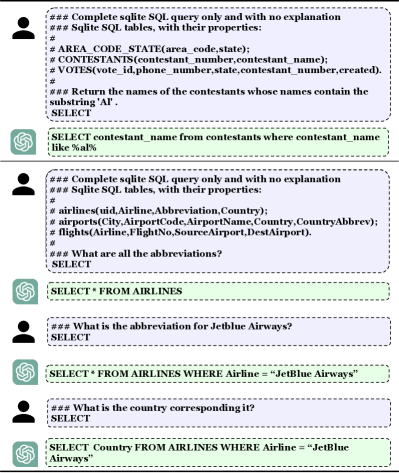
实验结果
研究问题
- RQ1与经过微调的 SOTA 模型相比,零-shot 的 ChatGPT 在标准 Text-to-SQL 基准上的表现如何?
- RQ2对于同义词替换、额外知识需求以及对抗性列名变更等鲁棒性挑战,ChatGPT 的鲁棒性如何?
- RQ3在多轮和跨语言的 Text-to-SQL 设置下,ChatGPT 的表现如何?
- RQ4ChatGPT 会犯哪些错误,提升其零-shot Text-to-SQL 能力的实际方向是什么?
主要发现
- ChatGPT 在零-shot Text-to-SQL 上表现强劲,在执行准确率方面与在 Spider 数据上训练的 SOTA 模型仅有 14% 的差距。
- 在某些鲁棒性场景下,ChatGPT 缩小甚至接近甚至超过 SOTA 方法(例如 ADVETA(RPL),其超越 SOTA 4.1%)。
- ChatGPT 展现出强鲁棒性,在鲁棒性基准上的差距小于在标准 Spider 数据集上的差距(例如,在某些 Spider 鲁棒性设置中差距为 7.8%)。
- 在多轮设置(SParC、CoSQL)中,ChatGPT 仍具竞争力,相对于单轮结果的差距更小,表明其上下文建模有效。
- 在中文 Text-to-SQL 数据集(CSpider、DuSQL)中,ChatGPT 表现良好,但当表名/列名也为中文时差距更大,突出跨语言泛化的挑战。
- 对于 SQL,基于精确匹配的评估是薄弱的,因此强调基于执行的度量;尽管语法不同,ChatGPT 的输出通常在语义上等价。
更好的研究,从现在开始
从论文设计到论文写作,大幅缩短您的研究时间。
无需绑定信用卡
本解读由 AI 生成,并经人工编辑审核。