
[Paper Review] A crowdsourcing approach to video quality assessment
This paper presents an open-source, crowdsourced implementation of ITU-T Rec. P.910 for video quality assessment, enabling accurate, scalable, and cost-effective subjective testing via Amazon Mechanical Turk. It achieves lab-level accuracy and high reproducibility by enforcing rater, device, environment, and network qualifications, along with gold and trapping questions, validating its consistency across ACR, ACR-HR, DCR, and CCR methods.
The gold standard for measuring video quality is the subjective test, and the most prevalent is the ITU-T Rec. P.910, a lab-based subjective standard in use for the past two decades. However, in practice using ITU-T Rec. P.910 is slow, expensive, and requires a lab, which all create barriers to usage. As a result, most research papers that need to measure video quality don't use ITU-T Rec. P.910 but rather metrics that are not well correlated to subjective opinion. We provide an open-source extension of ITU-T Rec. P.910 based on crowdsourcing principles which address the speed, usage cost, and barrier to usage issues. We implement Absolute Category Rating (ACR), ACR with hidden reference (ACR-HR), Degradation Category Rating (DCR), and Comparison Category Rating (CCR). It includes rater, environment, hardware, and network qualifications, as well as gold and trapping questions to ensure quality. We have validated that the implementation is both accurate and highly reproducible compared to existing ITU-T Rec. P.910 lab studies.
Motivation & Objective
- Address the high cost, slow speed, and logistical barriers of lab-based ITU-T Rec. P.910 subjective video quality testing.
- Enable scalable, accurate, and reproducible video quality assessment using crowdsourcing platforms like Amazon Mechanical Turk.
- Ensure data quality through rater, environment, hardware, and network qualifications, along with gold and trapping questions.
- Validate the crowdsourced framework against traditional lab studies to confirm reliability and consistency.
- Provide a production-ready, open-source tool for use in academic and industrial video codec evaluation, including the CVPR 2022 CLIC challenge.
Proposed method
- Implement four standardized subjective test methods: Absolute Category Rating (ACR), ACR with Hidden Reference (ACR-HR), Degradation Category Rating (DCR), and Comparison Category Rating (CCR).
- Enforce rater qualification via vision acuity and color blindness tests to ensure participant suitability.
- Apply environmental and hardware qualification checks to standardize viewing conditions across diverse crowd worker setups.
- Include network quality checks to ensure stable video streaming during testing.
- Integrate gold and trapping questions to detect and filter out low-effort or inattentive raters.
- Log video playback frequency to monitor and account for repeated viewing in uncontrolled environments.
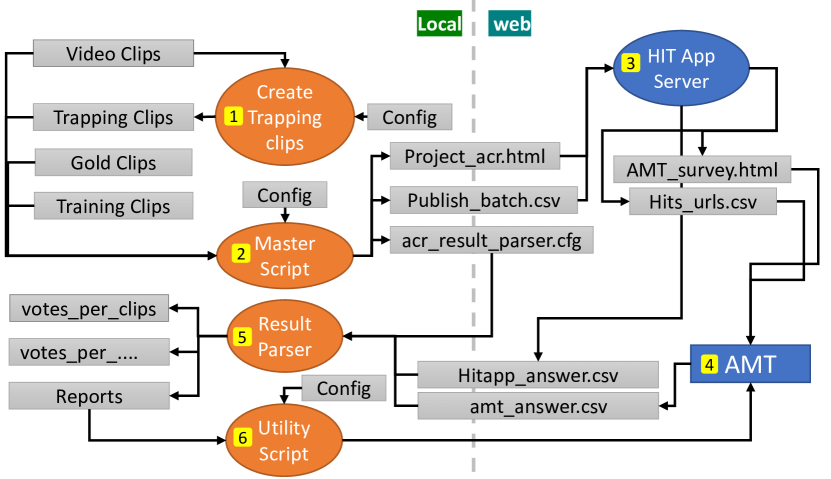
Experimental results
Research questions
- RQ1Can a crowdsourced platform replicate the accuracy and reproducibility of lab-based ITU-T Rec. P.910 subjective video quality assessments?
- RQ2How do rater, environment, hardware, and network qualifications impact the reliability and validity of crowdsourced video quality ratings?
- RQ3What is the correlation between ratings collected via crowdsourced ACR, DCR, CCR, and ACR-HR methods and those from traditional lab studies?
- RQ4How do objective metrics like PSNR, MS-SSIM, and VMAF correlate with subjective ratings collected via the proposed crowdsourced framework?
- RQ5To what extent does allowing repeated video playback in crowdsourcing improve data quality in uncontrolled environments?
Key findings
- The crowdsourced framework achieves high correlation (Pearson r > 0.96) between ratings collected via ACR and ACR-HR, and between DCR and CCR, indicating strong consistency across test methods.
- The framework demonstrated high reproducibility, with correlation coefficients between different test methods exceeding 0.91 at both clip and model levels.
- Objective metrics like PSNR, MS-SSIM, and VMAF showed poor correlation with subjective ratings (Pearson r < 0.73), confirming their limited predictive power for modern video codecs.
- Only 6.3% of video sequences were played back more than once, indicating minimal disruption from uncontrolled environments despite flexible viewing policies.
- The tool was successfully deployed in the CVPR 2022 CLIC challenge, collecting 27 sets of compressed video clips with 12.1 to 21.6 valid ratings per sequence.
- The inclusion of qualification and validation steps significantly improved data quality, making large-scale, reliable video quality assessment feasible outside lab settings.

Read this paper
Open the full text in the Nubint reader and ask about any passage as you read.
Read this paper on NubintThis review was generated by AI from the original paper. Please check the paper before citing it.