
[论文解读] A fast-rotator post-starburst galaxy quenched by supermassive black-hole feedback at z=3
本 JWST 研究展示了对 z=3.064 的大质量静止星系的 NIRSpec IFU 观测,显示 SMBH 驱动的抛出型反馈与快速旋转盘,证实在不毁坏恒星盘的前提下实现星形成抑制。
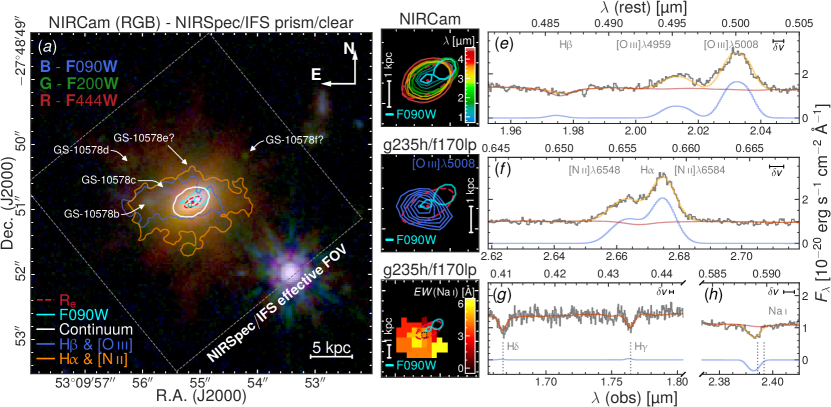
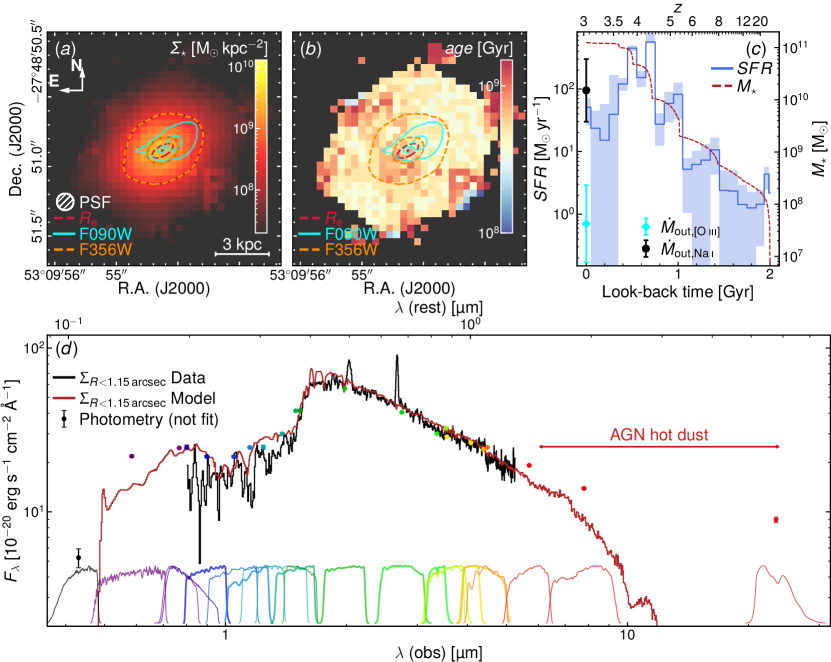
There is compelling evidence that the most massive galaxies in the Universe stopped forming stars due to the time-integrated feedback from their central super-massive black holes (SMBHs). However, the exact quenching mechanism is not yet understood, because local massive galaxies were quenched billions of years ago. We present JWST/NIRSpec integral-field spectroscopy observations of GS-10578, a massive, quiescent galaxy at redshift z=3.064. From the spectrum we infer that the galaxy has a stellar mass of $M_*=1.6\pm0.2 imes 10^{11}$ MSun and a dynamical mass $M_{ m dyn}=2.0\pm0.5 imes 10^{11}$ MSun. Half of its stellar mass formed at z=3.7-4.6, and the system is now quiescent, with the current star-formation rate SFR<9 MSun/yr. We detect ionised- and neutral-gas outflows traced by [OIII] emission and NaI absorption. Outflow velocities reach $v_{ m out}\approx$1,000 km/s, comparable to the galaxy escape velocity and too high to be explained by star formation alone. GS-10578 hosts an Active Galactic Nucleus (AGN), evidence that these outflows are due to SMBH feedback. The outflow rates are 0.14-2.9 and 30-300 MSun/yr for the ionised and neutral phases, respectively. The neutral outflow rate is ten times higher than the SFR, hence this is direct evidence for ejective SMBH feedback, with mass-loading capable of interrupting star formation by rapidly removing its fuel. Stellar kinematics show ordered rotation, with spin parameter $λ_{Re}=0.62\pm0.07$, meaning GS-10578 is rotation supported. This study shows direct evidence for ejective AGN feedback in a massive, recently quenched galaxy, thus clarifying how SMBHs quench their hosts. Quenching can occur without destroying the stellar disc.
研究动机与目标
- 理解最 massive 的星系如何达到星形成抑制以及抑制是否需要通过 AGN 反馈移除气体的动机与理解
- 在 z~3 静止星系中量化恒星质量、动力学质量、恒星形成历史以及当前星形成速率
- 检测并表征气体喷出(电离气体和中性气体)及评估它们与 AGN 活动的联系
- 评估恒星动力学以确定旋转支撑和在抑制过程中的动力学状态
提出的方法
- 在 prism/clear 与高分辨率 g235h/f170lp 配置下获取 JWST/NIRSpec IFS 数据,以绘制全星系的恒星和气体性质
- 逐像素进行完整光谱能量分布(SED)建模,以推导表面恒星质量密度、恒星族群年龄和恒星形成历史
- 使用发射线诊断(包括 BPT 图)来识别 AGN 光致电离与外流特征;从 O III 和 Hα+nII 估算离子化外流速率
- 通过 Na I 吸收探测并绘制中性气体,以追踪快速、尺度较大的中性外流;推断速度与质量装载
- 测量恒星动力学以推导旋转(lambda_R(Re))并评估星系是否为快速旋转体;比较动力学质量与恒星质量
实验结果
研究问题
- RQ1这个 z~3 的大质量星系的抑制是否由 SMBH 反馈驱动,而非由恒星形成驱动的风?
- RQ2气体外流(电离与中性)是否携带足够的质量与动量来抑制未来的星形成?
- RQ3星系是否为旋转支撑(快速旋转体),这对其演化至 z=0 有何含义?
- RQ4恒星族群年龄以及相对于观测时点的主要星形成事件时间窗口是多长?
- RQ5AGN 如何影响该系统的 ISM/CGM 的形态与动力学?
主要发现
- 恒星质量 Mstar = 1.6 ± 0.2 × 10^11 solar masses,动力学质量 Mdynvalue;主要星形成事件发生在 z = 3.7–4.6,当前 SFR < 9 solar masses per year。
- 在电离气体(O III)与中性气体(Na I)中探测到外流,速度高达 ~1000 km/s,接近逃逸速度并超过仅靠恒星形成所能驱动的规模。
- 电离气体外流速率为 0.14–2.9 solar masses per year,而中性气体外流速率为 30–300 solar masses per year,中性装载远超 SFR,表明具备可将星形成燃料带走的喷射性 SMBH 反馈。
- 证据表明存在AGN,包括 X 射线光度与中红外 SED 增益;AGN 对功率的光度 L_AGN ≈ 2.6 ± 0.9 × 10^45 erg/s。
- 恒星动力学显示有序旋转,自旋参数 lambda_R(Re) = 0.62 ± 0.07,表明星系在抑制和紧凑性条件下仍是旋转支撑(快速旋转体)。
- 该星系极为紧凑,在局部宇宙中若放在质量-尺寸关系上将成为强异常点;比较显示在 z ≈ 3 与现在之间需要显著的动力学和形态演化以增大尺寸并降低角动量。
更好的研究,从现在开始
从论文设计到论文写作,大幅缩短您的研究时间。
无需绑定信用卡
本解读由 AI 生成,并经人工编辑审核。