
[Paper Review] A Geometric Perspective on Diffusion Models
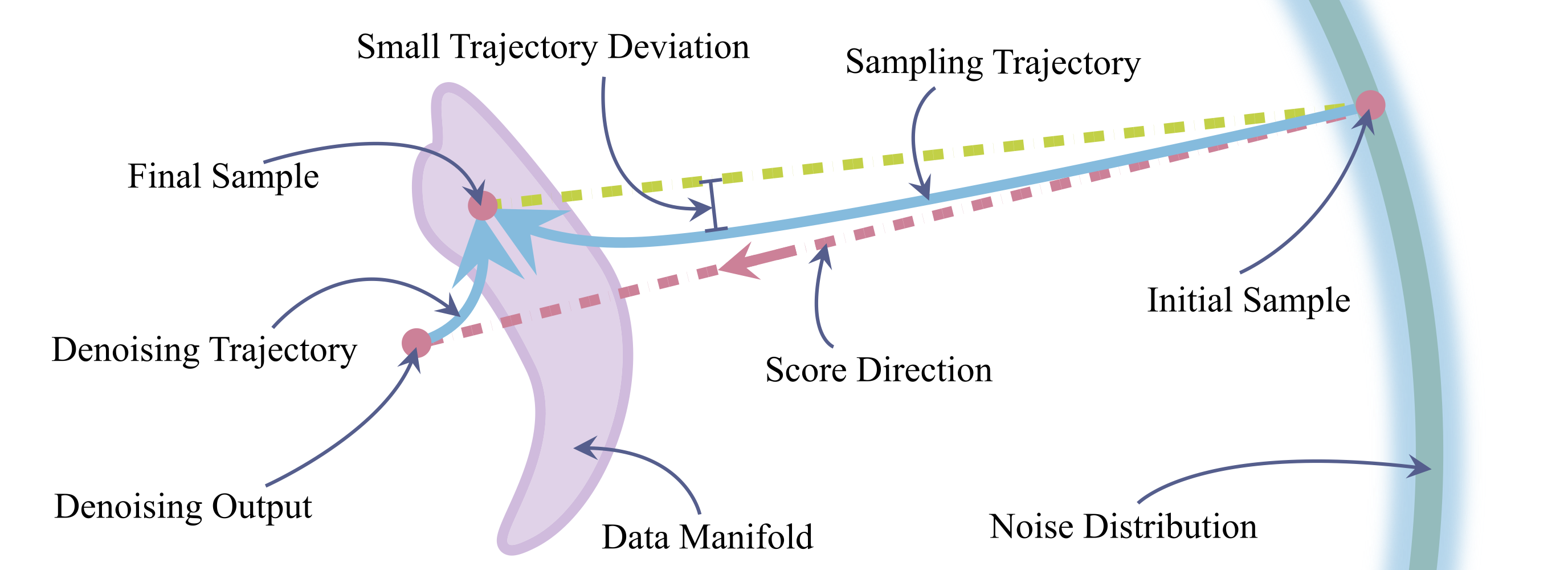
This paper presents a geometric framework for understanding ODE-based sampling in diffusion models, revealing that the denoising trajectory—driven by the model's score function—forms a faster-converging, implicit path to high-quality samples. It establishes a theoretical link between optimal ODE sampling and mean-shift algorithms, showing that each Euler step approximates a convex combination of mean-shift and current position, and demonstrates that the denoising trajectory consistently outperforms the sampling trajectory in visual quality and FID, enabling faster inference via ODE-Jump sampling.
Recent years have witnessed significant progress in developing effective training and fast sampling techniques for diffusion models. A remarkable advancement is the use of stochastic differential equations (SDEs) and their marginal-preserving ordinary differential equations (ODEs) to describe data perturbation and generative modeling in a unified framework. In this paper, we carefully inspect the ODE-based sampling of a popular variance-exploding SDE and reveal several intriguing structures of its sampling dynamics. We discover that the data distribution and the noise distribution are smoothly connected with a quasi-linear sampling trajectory and another implicit denoising trajectory that even converges faster. Meanwhile, the denoising trajectory governs the curvature of the corresponding sampling trajectory and its finite differences yield various second-order samplers used in practice. Furthermore, we establish a theoretical relationship between the optimal ODE-based sampling and the classic mean-shift (mode-seeking) algorithm, with which we can characterize the asymptotic behavior of diffusion models and identify the empirical score deviation. Code is available at \url{https://github.com/zju-pi/diff-sampler}.
Motivation & Objective
- To provide a geometric understanding of ODE-based sampling dynamics in diffusion models, particularly for variance-exploding SDEs.
- To reveal the existence of a faster-converging, implicit denoising trajectory distinct from the explicit sampling trajectory.
- To establish a theoretical connection between ODE-based sampling and the mean-shift (mode-seeking) algorithm.
- To explain why the denoising trajectory consistently produces higher visual quality than the sampling trajectory.
- To develop and validate ODE-Jump sampling, a method that leverages the denoising trajectory for faster, high-quality generation.
Proposed method
- The authors analyze the ODE-based sampling process of a variance-exploding SDE, identifying two key trajectories: the explicit sampling trajectory and the implicit denoising trajectory.
- They derive that the derivative of the denoising trajectory aligns with the negative second-order derivative of the sampling trajectory, linking it to second-order numerical solvers.
- The paper establishes a theoretical equivalence between the optimal ODE sampling and the annealed mean-shift algorithm, showing each Euler step moves the sample toward a convex combination of the current position and the mean-shift target.
- The ODE-Jump sampling method is proposed, which uses the denoising trajectory to jump ahead in the sampling process, reducing the number of score function evaluations (NFEs) while maintaining high quality.
- The method is validated across multiple datasets (CIFAR-10, ImageNet, FFHQ, Stable Diffusion) using FID and visual quality comparisons against standard samplers like DPM-Solver and EDM.
- Theoretical analysis shows that under mild conditions, the likelihood of samples along the denoising trajectory exceeds that along the sampling trajectory, explaining its superior performance.
Experimental results
Research questions
- RQ1What geometric structures underlie the sampling dynamics of ODE-based diffusion models?
- RQ2How does the denoising trajectory differ from the explicit sampling trajectory, and why does it converge faster in visual quality?
- RQ3What is the theoretical relationship between ODE-based sampling and the mean-shift algorithm?
- RQ4Why does the denoising trajectory consistently produce higher-quality samples than the sampling trajectory?
- RQ5Can the denoising trajectory be leveraged to design faster, more efficient sampling methods?
Key findings
- The denoising trajectory converges significantly faster than the sampling trajectory in terms of Fréchet Inception Distance (FID), achieving better FID with fewer score function evaluations (NFEs).
- On CIFAR-10 and ImageNet-64, ODE-Jump sampling with DPM-Solver-3 and NFE=48 achieves faster FID convergence than standard EDM samplers.
- The denoising trajectory consistently surpasses the sampling trajectory in likelihood and visual quality, with FID improvements of up to 30% in early sampling steps.
- Theoretical analysis confirms that each Euler step in ODE sampling approximates a convex combination of the current sample and the mean-shift target, linking ODE sampling to mode-seeking behavior.
- The denoising trajectory's derivative corresponds to the negative second-order derivative of the sampling trajectory, explaining the origin of second-order samplers in terms of finite differences.
- A slight empirical score deviation from the optimal score is shown to preserve generative capability while reducing mode collapse, due to the inherent robustness of the mean-shift-like dynamics.
Read this paper
Open the full text in the Nubint reader and ask about any passage as you read.
Read this paper on NubintThis review was generated by AI from the original paper. Please check the paper before citing it.