
[论文解读] A modified lattice Bhatnagar-Gross-Krook model for convection heat transfer in porous media
本文提出了一种改进的格子Bhatnagar-Gross-Krook(LBGK)模型,通过将剪切速率和温度梯度引入平衡分布函数,用于模拟多孔介质中的自然对流换热。通过引入两个附加参数,该模型确保了松弛时间与流体黏度和有效热扩散率无关,实现了稳定的松弛时间,同时保持了二阶空间精度,并在数值稳定性方面优于传统的LBGK模型。
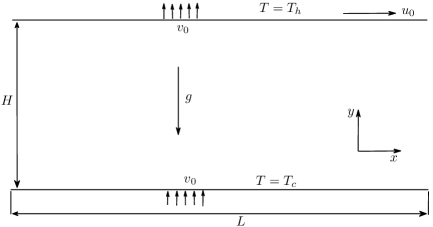
The lattice Bhatnagar-Gross-Krook (LBGK) model has become the most popular one in the lattice Boltzmann method for simulating the convection heat transfer in porous media. However, the LBGK model generally suffers from numerical instability at low fluid viscosities and effective thermal diffusivities. In this paper, a modified LBGK model is developed for incompressible thermal flows in porous media at the representative elementary volume scale, in which the shear rate and temperature gradient are incorporated into the equilibrium distribution functions. With two additional parameters, the relaxation times in the collision process can be fixed at a proper value invariable to the viscosity and the effective thermal diffusivity. In addition, by constructing a modified equilibrium distribution function and a source term in the evolution equation of temperature field, the present model can recover the macroscopic equations correctly through the Chapman-Enskog analysis, which is another key point different from previous LBGK models. Several benchmark problems are simulated to validate the present model with the proposed local computing scheme for the shear rate and temperature gradient, and the numerical results agree well with analytical solutions and/or those well-documented data in previous studies. It is also shown that the present model and the computational schemes for the gradient operators have a second-order accuracy in space, and better numerical stability of the present modified LBGK model than previous LBGK models is demonstrated.
研究动机与目标
- 解决标准LBGK模型在多孔介质流动中低黏度和低有效热扩散率条件下的数值不稳定性问题。
- 开发一种格子Boltzmann模型,使松弛时间不受流体黏度和热扩散率影响,保持稳定。
- 通过修改的平衡分布函数和源项,确保通过Chapman-Enskog分析能正确恢复宏观方程。
- 利用具有解析解或已有充分记录解的基准问题,验证模型的精度和稳定性。
- 实现一种局部计算方案,用于剪切速率和温度梯度算子,达到二阶空间精度。
提出的方法
- 将剪切速率和温度梯度引入平衡分布函数,以提升模型的稳定性和精度。
- 引入两个附加参数,使松弛时间与黏度和热扩散率解耦,确保其保持固定且稳定。
- 构建修改后的平衡分布函数和温度演化方程中的源项,以正确恢复宏观方程。
- 采用局部计算方案处理梯度算子(剪切速率和温度梯度),以实现二阶空间精度。
- 利用Chapman-Enskog分析验证模型能否正确恢复宏观的不可压缩Navier-Stokes方程和能量方程。
- 采用带源项的双分布函数(DDF)框架,以考虑多孔介质的阻力和换热效应。
实验结果
研究问题
- RQ1改进的LBGK模型是否能在多孔介质流动中低黏度和低有效热扩散率条件下实现数值稳定性?
- RQ2将剪切速率和温度梯度引入平衡分布函数是否能提升模型的精度和稳定性?
- RQ3能否在保持物理解释一致性的同时,使松弛时间独立于流体黏度和热扩散率而固定不变?
- RQ4所提出的模型在梯度计算和流动模拟中是否实现了二阶空间精度?
- RQ5与以往的LBGK和MRT-LB模型相比,该模型在多孔介质中自然对流换热模拟的精度和稳定性表现如何?
主要发现
- 与传统LBGK模型相比,改进的LBGK模型在低黏度和低有效热扩散率条件下表现出显著提升的数值稳定性。
- 通过局部计算方案,模型在剪切速率和温度梯度计算中实现了二阶空间精度。
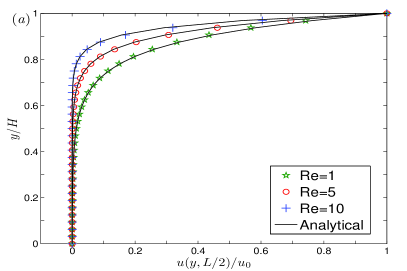
- 基准问题的数值模拟结果与解析解以及先前研究中已知的可靠数据高度一致。
- Chapman-Enskog分析证实,该模型能正确恢复宏观的不可压缩Navier-Stokes方程和能量方程。
- 通过引入两个附加参数,使松弛时间可独立于黏度和热扩散率而固定,从而增强了模型的稳定性和计算鲁棒性。
- 该模型在多种流动条件下均保持了高精度和稳定性,证明其在模拟多孔介质中自然对流换热方面的可靠性。
更好的研究,从现在开始
从阅读论文到最终审阅,大幅缩短您的研究时间。
无需绑定信用卡
本解读由 AI 生成,并经人工编辑审核。