
[Paper Review] A Multi-level Supervised Contrastive Learning Framework for Low-Resource Natural Language Inference
This paper proposes MultiSCL, a multi-level supervised contrastive learning framework for low-resource natural language inference that jointly optimizes sentence-level and pair-level contrastive objectives to improve discriminative representation learning. By leveraging data augmentation and a cross-attention module for joint representation learning, MultiSCL achieves a 3.1% average accuracy gain over prior methods on low-resource NLI benchmarks and outperforms state-of-the-art models by 8.5% on average in cross-domain adaptation tasks.
Natural Language Inference (NLI) is a growingly essential task in natural language understanding, which requires inferring the relationship between the sentence pairs (premise and hypothesis). Recently, low-resource natural language inference has gained increasing attention, due to significant savings in manual annotation costs and a better fit with real-world scenarios. Existing works fail to characterize discriminative representations between different classes with limited training data, which may cause faults in label prediction. Here we propose a multi-level supervised contrastive learning framework named MultiSCL for low-resource natural language inference. MultiSCL leverages a sentence-level and pair-level contrastive learning objective to discriminate between different classes of sentence pairs by bringing those in one class together and pushing away those in different classes. MultiSCL adopts a data augmentation module that generates different views for input samples to better learn the latent representation. The pair-level representation is obtained from a cross attention module. We conduct extensive experiments on two public NLI datasets in low-resource settings, and the accuracy of MultiSCL exceeds other models by 3.1% on average. Moreover, our method outperforms the previous state-of-the-art method on cross-domain tasks of text classification.
Motivation & Objective
- To address the challenge of limited labeled data in natural language inference by improving discriminative representation learning in low-resource settings.
- To overcome the failure of existing models in distinguishing between different NLI classes due to insufficient contrastive signal in small-data regimes.
- To enhance semantic representation learning by integrating both sentence-level and pair-level contrastive learning objectives.
- To improve zero-shot domain generalization through more robust, invariant representations using multi-level contrastive signals.
- To evaluate the effectiveness of data augmentation and component ablation in low-resource NLI scenarios.
Proposed method
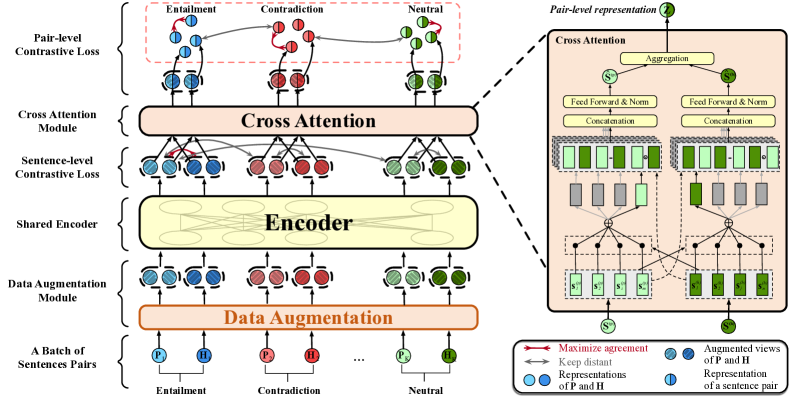
- MultiSCL employs a data augmentation module to generate multiple views of input sentences, enhancing robustness in low-resource settings.
- It applies sentence-level contrastive learning by treating entailment and contradiction hypotheses as positive and negative sets relative to a premise.
- A cross-attention mechanism is used to learn joint representations of sentence pairs, capturing inter-sentence relationships.
- Pair-level contrastive learning pulls together embeddings of sentence pairs in the same NLI class (entailment, contradiction, neutral) and pushes apart those from different classes.
- The framework jointly optimizes both sentence-level and pair-level contrastive objectives to improve representation discriminability.
- The model is fine-tuned using a supervised contrastive loss that encourages intra-class compactness and inter-class separation in the embedding space.
Experimental results
Research questions
- RQ1Can multi-level contrastive learning improve representation learning in low-resource natural language inference?
- RQ2How does joint sentence-level and pair-level contrastive learning enhance model generalization in low-data regimes?
- RQ3To what extent does data augmentation improve robustness and performance in low-resource NLI?
- RQ4How effective is MultiSCL in zero-shot domain adaptation across diverse NLI datasets?
- RQ5What is the contribution of each component (sentence-level, pair-level, data augmentation) to the overall performance gain?
Key findings
- MultiSCL achieves a 3.1% average accuracy improvement over previous state-of-the-art models on low-resource NLI benchmarks across two public datasets.
- On cross-domain text classification tasks, MultiSCL outperforms existing models by 8.5% on average across six domain adaptation settings.
- In domain adaptation from SciTail to SNLI and MNLI, MultiSCL achieves 49.2% and 51.4% accuracy, surpassing the previous SOTA by 10.1% and 10.4%, respectively.
- The model demonstrates strong zero-shot transfer performance, particularly benefiting from the joint optimization of sentence-level and pair-level contrastive signals.
- Ablation studies confirm that both sentence-level and pair-level contrastive learning contribute significantly to performance gains, with data augmentation further improving robustness.
- The framework shows superior performance on dissimilar domains like SciTail, indicating strong domain-invariant representation learning.
Read this paper
Open the full text in the Nubint reader and ask about any passage as you read.
Read this paper on NubintThis review was generated by AI from the original paper. Please check the paper before citing it.