
[Paper Review] A reading survey on adversarial machine learning: Adversarial attacks and their understanding
This survey provides a comprehensive classification of adversarial attacks in deep learning across multiple perspectives, analyzing their mechanisms, vulnerabilities, and limitations. It reviews existing defenses, identifies key challenges such as lack of robustness and theoretical understanding, and outlines future research directions including adaptive attacks, black-box analysis, and proactive defense frameworks.
Deep Learning has empowered us to train neural networks for complex data with high performance. However, with the growing research, several vulnerabilities in neural networks have been exposed. A particular branch of research, Adversarial Machine Learning, exploits and understands some of the vulnerabilities that cause the neural networks to misclassify for near original input. A class of algorithms called adversarial attacks is proposed to make the neural networks misclassify for various tasks in different domains. With the extensive and growing research in adversarial attacks, it is crucial to understand the classification of adversarial attacks. This will help us understand the vulnerabilities in a systematic order and help us to mitigate the effects of adversarial attacks. This article provides a survey of existing adversarial attacks and their understanding based on different perspectives. We also provide a brief overview of existing adversarial defences and their limitations in mitigating the effect of adversarial attacks. Further, we conclude with a discussion on the future research directions in the field of adversarial machine learning.
Motivation & Objective
- To systematically classify adversarial attacks based on different perspectives such as attack type, threat model, and optimization method.
- To analyze the limitations of current adversarial defenses, particularly their lack of consistency and generalization across attack types.
- To identify key challenges in adversarial machine learning, including the brittleness of learned features and theoretical intractability of optimization problems.
- To propose future research directions such as adaptive attacks, black-box evaluation, and proactive defense mechanisms.
- To provide researchers with a structured understanding of adversarial vulnerabilities and their implications for real-world AI safety and security.
Proposed method
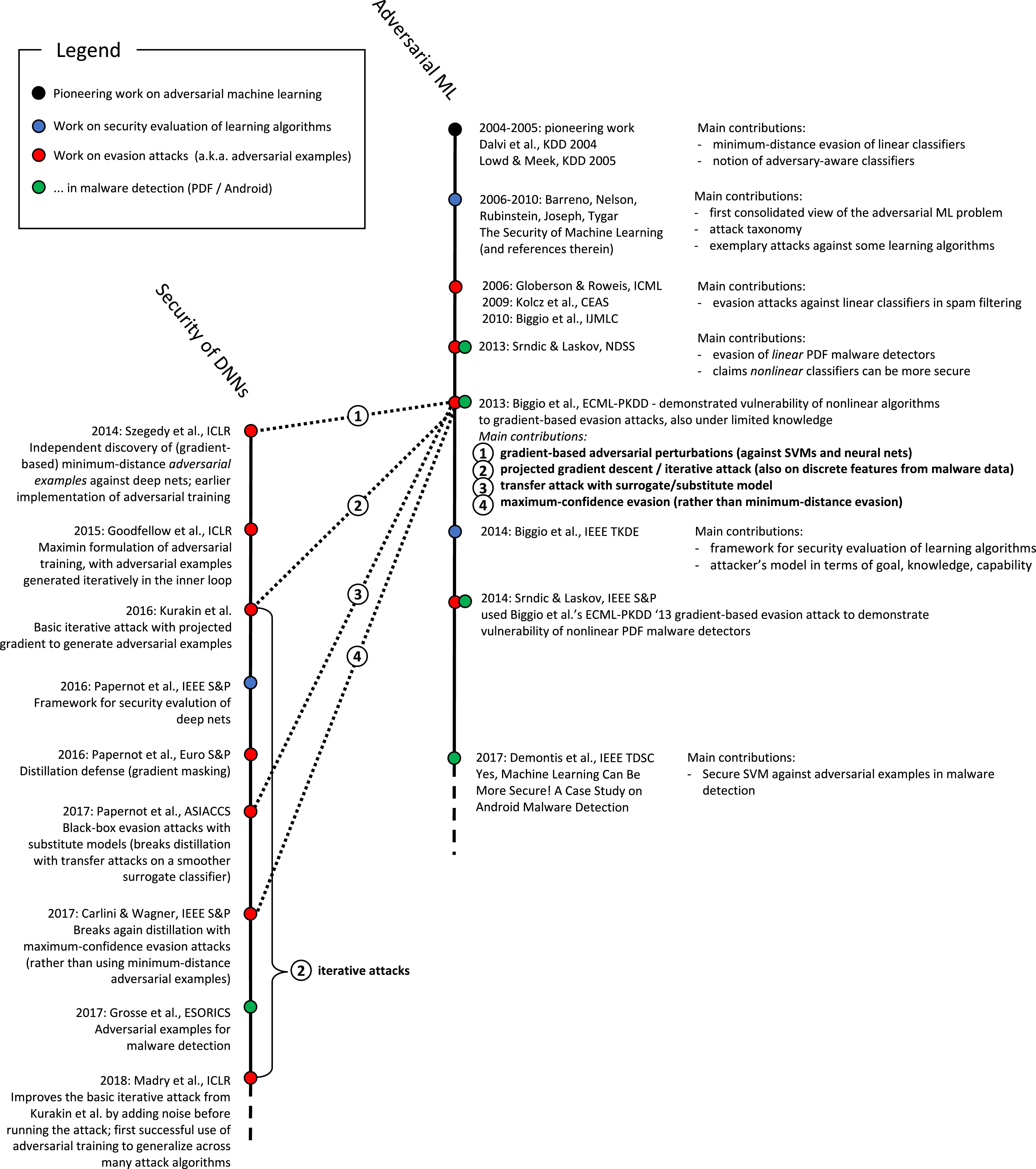
- Conducts a systematic literature review of adversarial attacks and defenses published between 2013 and 2020.
- Classifies adversarial attacks along dimensions such as evasion vs. poisoning, white-box vs. black-box, and targeted vs. untargeted.
- Analyzes optimization techniques used in crafting adversarial examples, including gradient-based methods like FGSM and PGD.
- Reviews existing defense mechanisms, including adversarial training, input transformation, and gradient masking, and evaluates their limitations.
- Uses empirical evidence from prior work to highlight the fragility of current models and the lack of generalizable robustness.
- Synthesizes insights into future research directions based on theoretical, empirical, and architectural shortcomings in the field.
Experimental results
Research questions
- RQ1How can adversarial attacks be systematically classified across different threat models and attack objectives?
- RQ2Why do current adversarial defenses fail to generalize across diverse attack types and model architectures?
- RQ3What are the core reasons behind the brittleness of deep neural networks in the presence of small input perturbations?
- RQ4How do adversarial examples reveal limitations in the feature learning and reasoning processes of neural networks?
- RQ5What are the key open challenges in developing robust, adaptive, and theoretically grounded defenses against adversarial attacks?
Key findings
- Adversarial attacks exploit the non-robustness of deep neural networks, often causing misclassification with imperceptible perturbations.
- Current defenses are largely reactive and fail under stronger, adaptive attacks, with many relying on gradient masking rather than true robustness.
- Theoretical analysis reveals that adversarial examples are solutions to non-convex, non-linear optimization problems, making them difficult to analyze and defend against.
- Adversarial examples often cause models to attend to spurious, non-semantic features, indicating a misalignment between human and model reasoning.
- Black-box attacks are increasingly effective, and existing models often lack auditability, limiting trust and security in real-world deployments.
- There is a critical need for proactive defense frameworks and learning techniques that build resilient, less brittle features to improve model robustness.
Read this paper
Open the full text in the Nubint reader and ask about any passage as you read.
Read this paper on NubintThis review was generated by AI from the original paper. Please check the paper before citing it.