
[Paper Review] A Survey of Generative AI for de novo Drug Design: New Frontiers in Molecule and Protein Generation
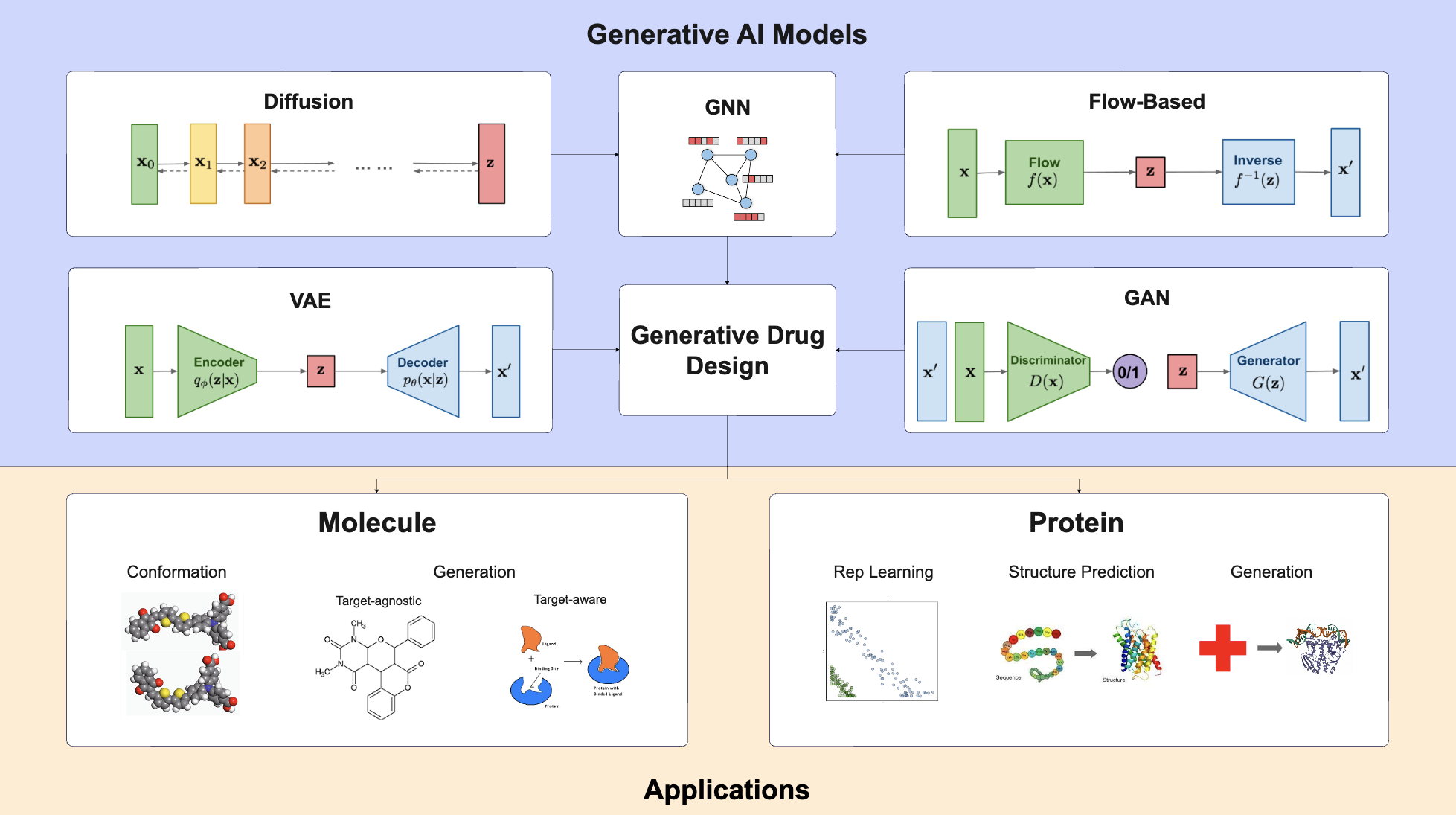
This survey provides a comprehensive overview of generative AI in de novo drug design, focusing on small molecule and protein generation. It evaluates model architectures, benchmarks, datasets, and performance across tasks, highlighting diffusion models and graph neural networks as leading approaches, with RFDiffusion and GeoLDM achieving state-of-the-art results in protein and molecule generation, respectively.
Artificial intelligence (AI)-driven methods can vastly improve the historically costly drug design process, with various generative models already in widespread use. Generative models for de novo drug design, in particular, focus on the creation of novel biological compounds entirely from scratch, representing a promising future direction. Rapid development in the field, combined with the inherent complexity of the drug design process, creates a difficult landscape for new researchers to enter. In this survey, we organize de novo drug design into two overarching themes: small molecule and protein generation. Within each theme, we identify a variety of subtasks and applications, highlighting important datasets, benchmarks, and model architectures and comparing the performance of top models. We take a broad approach to AI-driven drug design, allowing for both micro-level comparisons of various methods within each subtask and macro-level observations across different fields. We discuss parallel challenges and approaches between the two applications and highlight future directions for AI-driven de novo drug design as a whole. An organized repository of all covered sources is available at https://github.com/gersteinlab/GenAI4Drug.
Motivation & Objective
- To organize and systematize the rapidly evolving field of generative AI for de novo drug design into two core domains: small molecule and protein generation.
- To identify key subtasks, datasets, benchmarking protocols, and model architectures across both domains.
- To compare the performance of leading models, including diffusion, GNN-based, and flow-based architectures, across target-agnostic and target-aware generation tasks.
- To highlight shared challenges such as explainability, benchmarking standardization, and alignment with real-world biological constraints.
- To outline future research directions, including improved task formulation, better evaluation metrics, and integration with predictive models for binding affinity and drug-likeness.
Proposed method
- The survey conducts a systematic review of generative AI models in de novo drug design, categorizing methods by input modality (1D sequence vs. 2D/3D structure) and task type (target-agnostic vs. target-aware generation).
- It evaluates model architectures including variational autoencoders (VAEs), generative adversarial networks (GANs), normalizing flows, and diffusion models, with a focus on graph neural networks (GNNs) and E(3)-equivariant architectures.
- The paper analyzes performance across standardized benchmarks such as QM9, GEOM-Drugs, and protein-specific datasets like those used in antibody CDR-H3 generation and fold classification.
- It compares models using metrics like validity, stability, novelty, and property optimization (e.g., binding affinity, drug-likeness), with emphasis on target-aware generation tasks.
- The survey integrates insights from predictive models such as affinity classifiers used in conditional generation, emphasizing their role in guiding generation toward biologically relevant outcomes.
- It compiles a comprehensive, curated repository of sources and models at https://github.com/gersteinlab/GenAI4Drug for reproducibility and future reference.
Experimental results
Research questions
- RQ1What are the dominant model architectures and their performance across small molecule and protein generation tasks in de novo drug design?
- RQ2How do structure-based and sequence-based approaches compare in generating novel, stable, and drug-like molecules and proteins?
- RQ3What are the key challenges in explainability, benchmarking, and real-world applicability that hinder the adoption of generative AI in drug discovery?
- RQ4How do diffusion models, particularly those with E(3) equivariance, outperform other architectures in molecular and protein generation?
- RQ5What future research directions are most critical for advancing generative AI toward clinically viable de novo drug candidates?
Key findings
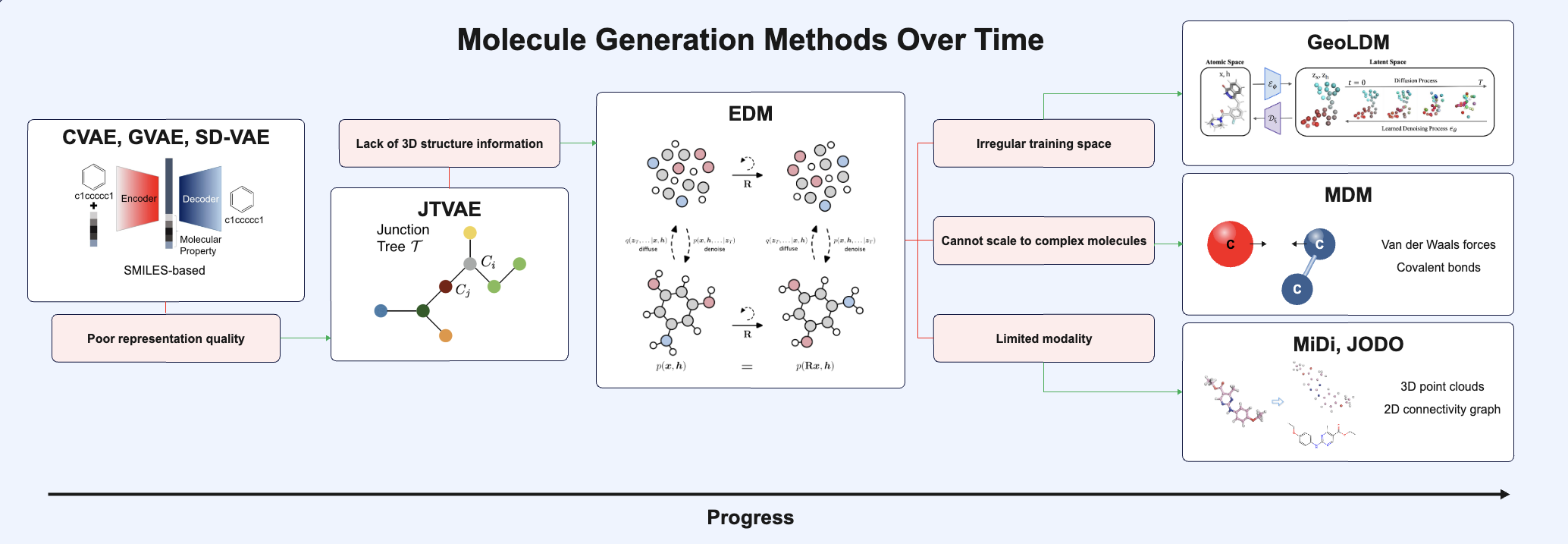
- Graph-based diffusion models such as GeoLDM and MiDi achieve state-of-the-art performance in target-agnostic small molecule generation, particularly in generating valid and stable molecules.
- In target-aware molecule generation, models like TargetDiff, Pocket2Mol, and DiffSBDD outperform sequence-based baselines by leveraging 3D structural information and protein-ligand interaction data.
- Torsional Diffusion achieves the highest performance in molecular conformation generation, enabling accurate 3D structure prediction from 2D SMILES inputs.
- For protein generation, RFDiffusion emerges as the top-performing model in scaffolding tasks, significantly outperforming prior methods in generating novel, stable protein folds.
- Structure-based models like GearNET, which integrate ESM-1B and UniRep representations with 3D geometry, demonstrate superior performance over purely sequence-based methods in protein design.
- Despite progress, current models still struggle with explainability, benchmarking standardization, and generating high-affinity binders, indicating critical gaps in real-world applicability.
Read this paper
Open the full text in the Nubint reader and ask about any passage as you read.
Read this paper on NubintThis review was generated by AI from the original paper. Please check the paper before citing it.