
[论文解读] A Survey on Deep Learning based Time Series Analysis with Frequency Transformation
本文综述了频率变换如何提升深度学习模型在时间序列分析中的应用,提出一个分类体系并概述优点、局限性与未来方向。
Recently, frequency transformation (FT) has been increasingly incorporated into deep learning models to significantly enhance state-of-the-art accuracy and efficiency in time series analysis. The advantages of FT, such as high efficiency and a global view, have been rapidly explored and exploited in various time series tasks and applications, demonstrating the promising potential of FT as a new deep learning paradigm for time series analysis. Despite the growing attention and the proliferation of research in this emerging field, there is currently a lack of a systematic review and in-depth analysis of deep learning-based time series models with FT. It is also unclear why FT can enhance time series analysis and what its limitations are in the field. To address these gaps, we present a comprehensive review that systematically investigates and summarizes the recent research advancements in deep learning-based time series analysis with FT. Specifically, we explore the primary approaches used in current models that incorporate FT, the types of neural networks that leverage FT, and the representative FT-equipped models in deep time series analysis. We propose a novel taxonomy to categorize the existing methods in this field, providing a structured overview of the diverse approaches employed in incorporating FT into deep learning models for time series analysis. Finally, we highlight the advantages and limitations of FT for time series modeling and identify potential future research directions that can further contribute to the community of time series analysis.
研究动机与目标
- Explain how frequency transformation (DFT, DCT, DWT) aids time series analysis.
- Classify neural models that integrate frequency information for forecasting, anomaly detection, and classification.
- Summarize advantages and limitations of FT in time series modeling.
- Propose a taxonomy and identify promising future research directions.
提出的方法
- Review existing FT-equipped neural models and categorize by incorporation approach and value type.
- Discuss neural network types that operate on complex vs. real frequency outputs.
- Summarize representative FT-based models across forecasting, anomaly detection, and classification.
- Analyze why FT enhances time series modeling and outline its limitations.
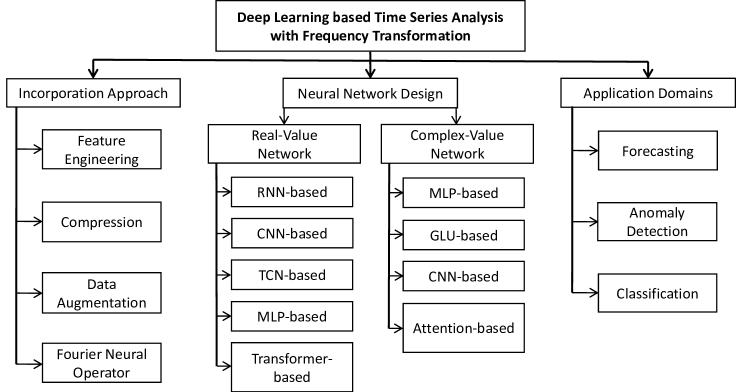
- Propose a taxonomy (Fig. 2) and synthesize practical implications.

实验结果
研究问题
- RQ1What strategies do neural time series models use to incorporate frequency transformation?
- RQ2What neural network types leverage FT in time series analysis?
- RQ3What are representative FT-equipped models for forecasting, anomaly detection, and classification?
- RQ4Why does frequency transformation improve performance, and what are its limitations?
- RQ5What future directions can further advance FT-based time series analysis?
主要发现
- FT provides a global view and decomposes signals into frequency components to capture periodic patterns and multi-scale representations.
- DWT-based approaches enable multi-resolution time-frequency analysis and can enhance pattern discovery.
- FT enables efficient computation via the convolution theorem and supports sparse representations for compression.
- A variety of FT-based models improve forecasting efficiency and accuracy, and augment data through frequency-domain representations.
- Limitations include potential loss of temporal information and dependence on parameter choices such as windowing and frequency bands.
更好的研究,从现在开始
从论文设计到论文写作,大幅缩短您的研究时间。
无需绑定信用卡
本解读由 AI 生成,并经人工编辑审核。