
[论文解读] A Survey on Explainability of Graph Neural Networks
本综述提供了针对图神经网络(GNNs)的可解释性方法的全面分类体系,涵盖事实性和对比事实性方法,并讨论评估指标和数据集。
Graph neural networks (GNNs) are powerful graph-based deep-learning models that have gained significant attention and demonstrated remarkable performance in various domains, including natural language processing, drug discovery, and recommendation systems. However, combining feature information and combinatorial graph structures has led to complex non-linear GNN models. Consequently, this has increased the challenges of understanding the workings of GNNs and the underlying reasons behind their predictions. To address this, numerous explainability methods have been proposed to shed light on the inner mechanism of the GNNs. Explainable GNNs improve their security and enhance trust in their recommendations. This survey aims to provide a comprehensive overview of the existing explainability techniques for GNNs. We create a novel taxonomy and hierarchy to categorize these methods based on their objective and methodology. We also discuss the strengths, limitations, and application scenarios of each category. Furthermore, we highlight the key evaluation metrics and datasets commonly used to assess the explainability of GNNs. This survey aims to assist researchers and practitioners in understanding the existing landscape of explainability methods, identifying gaps, and fostering further advancements in interpretable graph-based machine learning.
研究动机与目标
- 由于GNNs的复杂非线性结构,激发可解释性的需求。
- 给出一个以目标和方法学为分类维度的新颖分类体系。
- 总结每个类别的优势、局限性及应用场景。
- 突出用于评估GNN可解释性的评估指标及常用数据集。
- 弥补以往研究仅聚焦于事实性或对比事实性方法所留下的空白。
提出的方法
- 提出一个将GNN可解释性分为事实性方法和对照事实性方法的新颖分类体系。
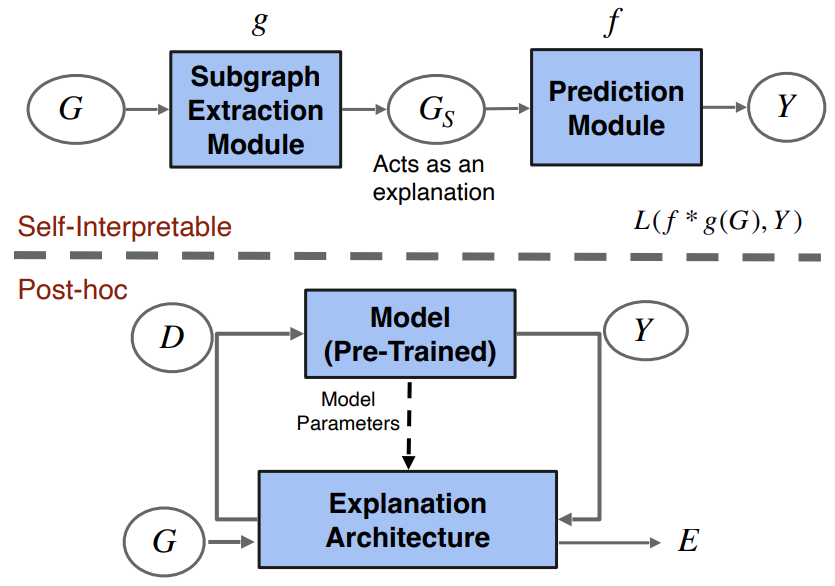
- 将事实性方法分为自解释和事后解释,进一步将事后解释分为分解、基于梯度、代理、扰动和生成等类别。
- 基于信息或结构约束回顾自解释方法,并以预测Y为目标解释子图提取。
- 讨论用于评估GNN可解释性的评估策略和数据集。
- 讨论图解释特有的挑战,例如组合子结构搜索,以及需要同时考虑节点特征和图结构的问题。
![Figure 1 : Overview of the Schema. (1) Factual. Information constraints: GIB [ 118 ] , VGIB [ 116 ] , GSAT [ 69 ] , LRI [ 70 ] ; Structural Constraints: DIR [ 107 ] , ProtGNN [ 125 ] , SEGNN [ 12 ] , KER-GNN [ 21 ] ; Decomposition: CAM [ 77 ] , Excitation-BP [ 77 ] , DEGREE [ 22 ] , GNN-LRP [ 84 ] ;](https://ar5iv.labs.arxiv.org/html/2306.01958/assets/Schema_V12.png)
实验结果
研究问题
- RQ1现有的GNN可解释性方法有哪些,以及如何对它们进行系统分类?
- RQ2GNN可解释性各类别的优势、局限性及适用应用场景是什么?
- RQ3常用来评估GNN可解释性的数据集和评估指标有哪些?
- RQ4在GNN解释的情境中,事实性与对照事实性方法有何比较?
主要发现
- 提出一个全面的分类体系,将可解释性方法划分为事实性和对照事实性,并有详细的子类别。
- 指出事后方法可以是白盒或黑盒,自解释方法将解释融入到模型架构中。
- 总结了基于分解、基于梯度、代理、基于扰动和基于生成的事后方法,以及它们的典型输入、输出和约束。
- 强调自解释方法可能因集成约束而以可解释性换取预测精度。
- 强调在解释GNN预测时需要同时考虑节点属性和图结构。
- 回顾GNN可解释性常用的数据集和评估指标(论文的第7和第8节)。
更好的研究,从现在开始
从论文设计到论文写作,大幅缩短您的研究时间。
无需绑定信用卡
本解读由 AI 生成,并经人工编辑审核。