
[Paper Review] AI capabilities can be significantly improved without expensive retraining
This paper introduces the compute-equivalent gain (CEG) metric to quantify the performance improvement of post-training AI enhancements—such as tool use, prompting, and scaffolding—relative to the compute needed to achieve the same gain through retraining. It finds that many enhancements deliver gains equivalent to 5x–20x more pre-training compute, at a fraction of the cost, suggesting they are highly efficient drivers of AI capability growth.
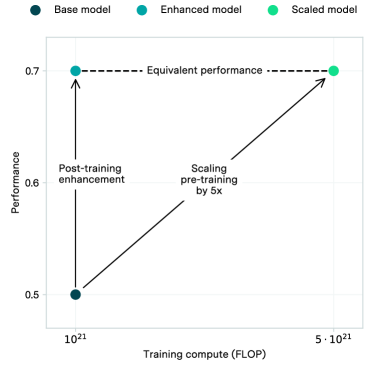
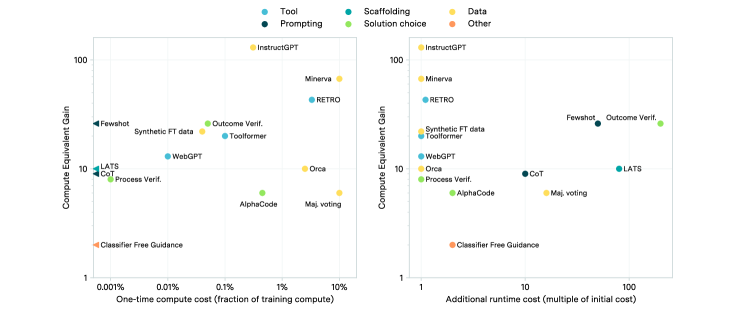
State-of-the-art AI systems can be significantly improved without expensive retraining via "post-training enhancements"-techniques applied after initial training like fine-tuning the system to use a web browser. We review recent post-training enhancements, categorizing them into five types: tool-use, prompting methods, scaffolding, solution selection, and data generation. Different enhancements improve performance on different tasks, making it hard to compare their significance. So we translate improvements from different enhancements into a common currency, the compute-equivalent gain: how much additional training compute would be needed to improve performance by the same amount as the enhancement. Our non-experimental work shows that post-training enhancements have significant benefits: most surveyed enhancements improve benchmark performance by more than a 5x increase in training compute, some by more than 20x. Post-training enhancements are relatively cheap to develop: fine-tuning costs are typically <1% of the original training cost. Governing the development of capable post-training enhancements may be challenging because frontier models could be enhanced by a wide range of actors.
Motivation & Objective
- To quantify the impact of post-training enhancements on AI capabilities using a common metric, overcoming the challenge of comparing performance gains across diverse techniques.
- To assess whether post-training enhancements offer substantial performance improvements relative to the cost of additional pre-training compute.
- To evaluate the economic and strategic implications of post-training enhancements for AI development and governance.
- To explore how these enhancements might reshape the trajectory of AI progress and influence future safety and policy decisions.
Proposed method
- Introduces the compute-equivalent gain (CEG) metric: the amount of additional pre-training compute required to achieve the same performance gain as a given post-training enhancement.
- Categorizes post-training enhancements into five types: tool-use, prompting, scaffolding, solution selection, and data generation.
- Estimates CEG values by comparing model performance on benchmarks before and after enhancement, assuming gains from increased compute on the same pre-training distribution.
- Evaluates cost efficiency by comparing the one-time and runtime costs of enhancements to the original pre-training cost.
- Uses benchmark data from existing studies (e.g., MATH, HumanEval, GSM8K) to estimate CEGs across diverse tasks and enhancement types.
- Applies the CEG framework to assess the cumulative and diminishing returns of multiple enhancements, and explores their skill profiles and temporal improvement rates.
Experimental results
Research questions
- RQ1How much performance gain do post-training enhancements deliver relative to the compute needed to achieve the same gain through retraining?
- RQ2What are the relative costs of developing and deploying post-training enhancements compared to pre-training compute increases?
- RQ3To what extent do post-training enhancements provide generalizable capability improvements, or are they task-specific?
- RQ4How do multiple enhancements interact, and is there diminishing return or a ceiling on total improvement from post-training techniques?
- RQ5What are the implications of widespread, low-cost capability gains via post-training for AI governance and safety policy?
Key findings
- Most surveyed post-training enhancements deliver performance gains equivalent to more than 5x additional pre-training compute, with some achieving gains equivalent to over 20x more compute.
- The cost of fine-tuning for most enhancements is less than 1% of the original pre-training cost, making them highly cost-effective compared to retraining.
- Post-training enhancements are often domain-specific, unlike pre-training scaling, which improves performance across a broad range of tasks.
- The compute-equivalent gain (CEG) provides a useful, standardized metric for comparing the impact of diverse post-training techniques across different benchmarks and domains.
- There is significant potential for continued progress through post-training enhancements, though the existence of diminishing returns or a performance ceiling remains an open question.
- The wide accessibility of post-training enhancements—potentially improvable by a broad range of actors—poses a unique challenge for AI governance and safety regulation.
Read this paper
Open the full text in the Nubint reader and ask about any passage as you read.
Read this paper on NubintThis review was generated by AI from the original paper. Please check the paper before citing it.