
[Paper Review] AISHELL-4: An Open Source Dataset for Speech Enhancement, Separation, Recognition and Speaker Diarization in Conference Scenario
AISHELL-4 is a 120-hour, real-recorded Mandarin multi-speaker meeting dataset collected with an 8-channel microphone array in conference scenarios, featuring natural speech characteristics like overlap, pauses, and noise. The paper proposes a PyTorch-based baseline system integrating speech enhancement, separation, recognition, and diarization, achieving 30.49% and 39.86% character error rates (CER) on speaker-independent and speaker-dependent ASR tasks after front-end processing, significantly improving over raw input.
In this paper, we present AISHELL-4, a sizable real-recorded Mandarin speech dataset collected by 8-channel circular microphone array for speech processing in conference scenario. The dataset consists of 211 recorded meeting sessions, each containing 4 to 8 speakers, with a total length of 120 hours. This dataset aims to bridge the advanced research on multi-speaker processing and the practical application scenario in three aspects. With real recorded meetings, AISHELL-4 provides realistic acoustics and rich natural speech characteristics in conversation such as short pause, speech overlap, quick speaker turn, noise, etc. Meanwhile, accurate transcription and speaker voice activity are provided for each meeting in AISHELL-4. This allows the researchers to explore different aspects in meeting processing, ranging from individual tasks such as speech front-end processing, speech recognition and speaker diarization, to multi-modality modeling and joint optimization of relevant tasks. Given most open source dataset for multi-speaker tasks are in English, AISHELL-4 is the only Mandarin dataset for conversation speech, providing additional value for data diversity in speech community. We also release a PyTorch-based training and evaluation framework as baseline system to promote reproducible research in this field.
Motivation & Objective
- To address the lack of large-scale, real-world Mandarin meeting datasets for multi-speaker speech processing.
- To bridge the gap between advanced research and real-world application in complex acoustic environments such as conference rooms.
- To support joint optimization of speech enhancement, separation, recognition, and diarization through a unified, realistic dataset.
- To promote reproducible research by releasing a PyTorch-based training and evaluation framework alongside the dataset.
Proposed method
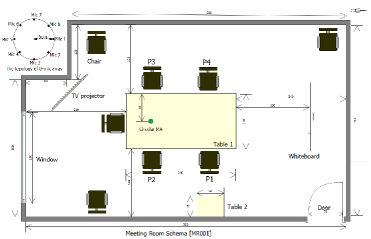
- The dataset was collected using an 8-channel circular microphone array in real conference venues, capturing 211 sessions with 4–8 speakers each.
- High-precision annotations include word-level transcriptions, speaker turn boundaries, and voice activity detection (VAD) for each meeting.
- A multi-stage baseline system was developed using a complex spectrogram-based beamforming method for speech enhancement and separation, defined by the weight vector $ \mathbf{w}_f^k = \frac{\mathbf{R}_f^{-1}\mathbf{u}_r}{\mathbf{u}_r^H\mathbf{R}_f^{-1}\mathbf{u}_r} $.
- Speech recognition employs a 2-layer 2D CNN followed by 8-layer transformer encoder and 6-layer decoder, trained with joint CTC and cross-entropy loss.
- Data augmentation via SpecAugment and mixed training on simulated and real-recorded data (768h train, 97h dev) improves robustness.
- Evaluation uses speaker-independent and speaker-dependent CER metrics, with ground-truth segmentation used in the former and full pipeline in the latter.
Experimental results
Research questions
- RQ1How does real-world acoustic degradation in conference scenarios affect automatic speech recognition performance?
- RQ2To what extent can front-end processing (enhancement, separation, SAD, diarization) improve ASR accuracy in overlapping, multi-speaker meetings?
- RQ3Can a unified, end-to-end pipeline combining enhancement, separation, recognition, and diarization achieve better performance than isolated modules?
- RQ4How does the performance of ASR models trained on synthetic data compare to those fine-tuned on real recordings from the same domain?
Key findings
- The baseline system achieved 32.56% CER on the speaker-independent ASR task using raw, unprocessed input, demonstrating the significant impact of real-world acoustics.
- After applying front-end processing (enhancement, separation, SAD, and diarization), CER dropped to 30.49% on the speaker-independent task, showing measurable improvement.
- On the speaker-dependent task, CER decreased from 41.55% to 39.86% after front-end processing, indicating consistent gains across full pipeline evaluation.
- The inclusion of real-recorded data (63 hours) in training significantly improved model generalization compared to synthetic-only data.
- The proposed PyTorch-based framework enables reproducible research and facilitates joint optimization across speech processing tasks.
- AISHELL-4 is the first large-scale, real-recorded Mandarin meeting dataset, offering unique value for non-English speech processing research.
Read this paper
Open the full text in the Nubint reader and ask about any passage as you read.
Read this paper on NubintThis review was generated by AI from the original paper. Please check the paper before citing it.