
[Paper Review] An Evaluation of ChatGPT-4's Qualitative Spatial Reasoning Capabilities in RCC-8
This paper evaluates ChatGPT-4's ability to perform qualitative spatial reasoning using the RCC-8 calculus, a standard framework for representing spatial relations like 'disconnected', 'touching', and 'part-of'. Despite access to extensive QSR literature in its training data, ChatGPT-4 shows inconsistent performance, frequently failing at composition tasks and making elementary errors, particularly with inverse relations, indicating limited reliability for formal spatial reasoning tasks.
Qualitative Spatial Reasoning (QSR) is well explored area of Commonsense Reasoning and has multiple applications ranging from Geographical Information Systems to Robotics and Computer Vision. Recently many claims have been made for the capabilities of Large Language Models (LLMs). In this paper we investigate the extent to which one particular LLM can perform classical qualitative spatial reasoning tasks on the mereotopological calculus, RCC-8.
Motivation & Objective
- To assess the extent to which ChatGPT-4 can perform qualitative spatial reasoning using the RCC-8 calculus.
- To evaluate its ability to compute compositional relations between spatial entities, a core task in qualitative spatial reasoning.
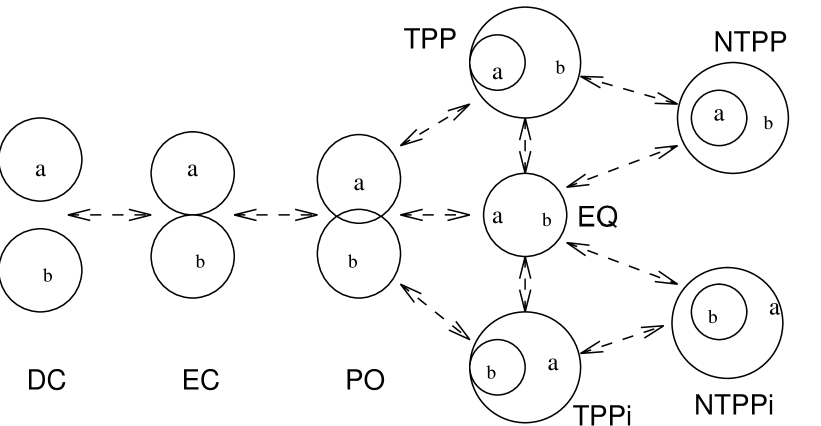
- To investigate whether the model can correctly reason about the conceptual neighborhood diagram of RCC-8 relations.
- To identify systematic weaknesses in its reasoning, especially regarding inverse relations and logical consistency.
- To determine whether the model's performance stems from knowledge of QSR literature or from stochastic generation without logical grounding.
Proposed method
- The study uses a series of controlled, single-turn conversations with ChatGPT-4 (version May 24, 2023) to test reasoning on RCC-8 relations.
- Each experiment presents a prompt defining the eight RCC-8 relations (e.g., DC, EC, PO, TPP, NTPP, EQ) with formal definitions.
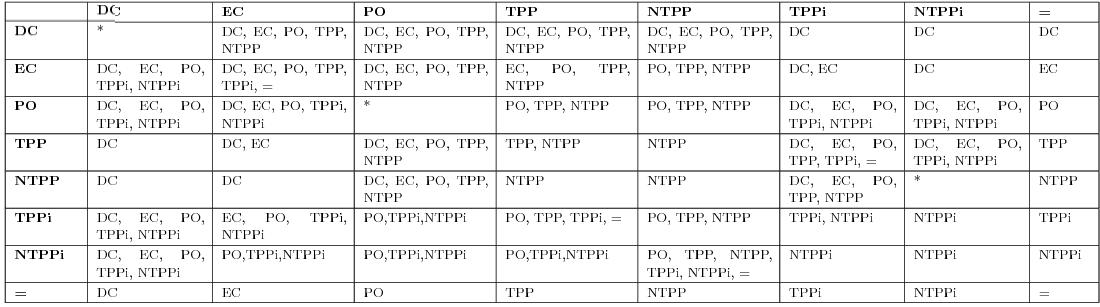
- The model is asked to compute possible relations between entities based on two given relations (e.g., DC(x,y) and DC(y,z)), simulating composition in the RCC-8 calculus.
- Responses are evaluated for correctness, completeness, and consistency, particularly regarding inverse relations (e.g., TPP vs. TPPi).
- The evaluation includes both composition tasks and checks on conceptual neighborhood consistency, using known composition tables as ground truth.
- All conversations are archived and publicly available at https://tinyurl.com/qr23sup for reproducibility.
Experimental results
Research questions
- RQ1To what extent can ChatGPT-4 correctly compute the composition of two RCC-8 relations?
- RQ2Does ChatGPT-4 consistently apply the inverse of a relation when required, such as distinguishing TPP(x,y) from TPPi(x,y)?
- RQ3How often does the model produce incorrect or incomplete answers in composition tasks, even when the correct answer is known?
- RQ4Can the model correctly identify all possible relations in a composition table cell, or does it frequently miss valid options?
- RQ5Does the model’s performance improve with more complex or context-rich prompts, or does it remain fundamentally inconsistent?
Key findings
- ChatGPT-4 frequently fails to correctly compute compositions in the RCC-8 calculus, even for basic relation pairs.
- The model often produces incorrect or incomplete sets of possible relations, such as omitting valid options from the composition table.
- It shows inconsistent reasoning, correctly handling a relation but failing when its inverse is presented.
- The model sometimes confuses a relation with its inverse, indicating a lack of robust understanding of relational symmetry.
- Despite exposure to QSR literature during training, the model does not reliably perform logical spatial reasoning, suggesting limitations in knowledge grounding.
- Performance remains suboptimal even with standard prompting, and improvements via chain-of-thought or fine-tuning are unlikely to fully compensate for fundamental reasoning flaws.
Read this paper
Open the full text in the Nubint reader and ask about any passage as you read.
Read this paper on NubintThis review was generated by AI from the original paper. Please check the paper before citing it.